
Corporate Shuttle Service Toronto – Daily Staff & Workforce Transportation
Fixed-route employee shuttle programs delivering operational efficiency through workforce mobility solutions. Recurring service contracts supporting corporate HQ connectivity, warehouse shuttle routes, industrial zone transportation, and transit hub integration across Greater Toronto Area employment centers.
Workforce Shuttle Fleet Configuration Options
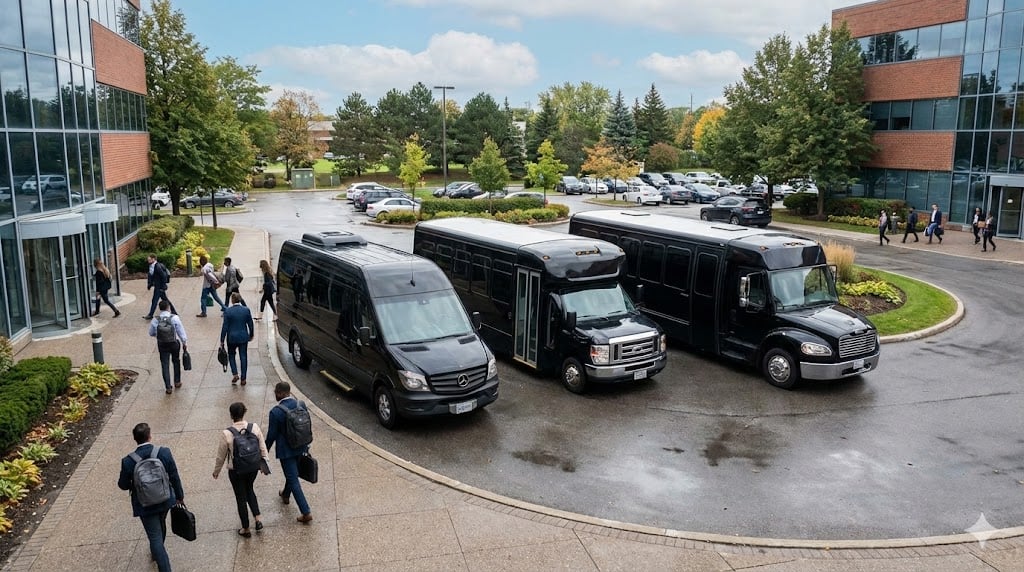
Multi-Vehicle Employee Shuttle Programs
Sprinter vans, shuttle buses, and mini-coaches deployed for high-volume workforce transportation programs. Scalable capacity supporting 14-35 passenger requirements across distributed employment locations.
Capacity: 14-35 passengers per vehicle | Rate: $150-200/hr (5hr minimum) | Fleet rate structure
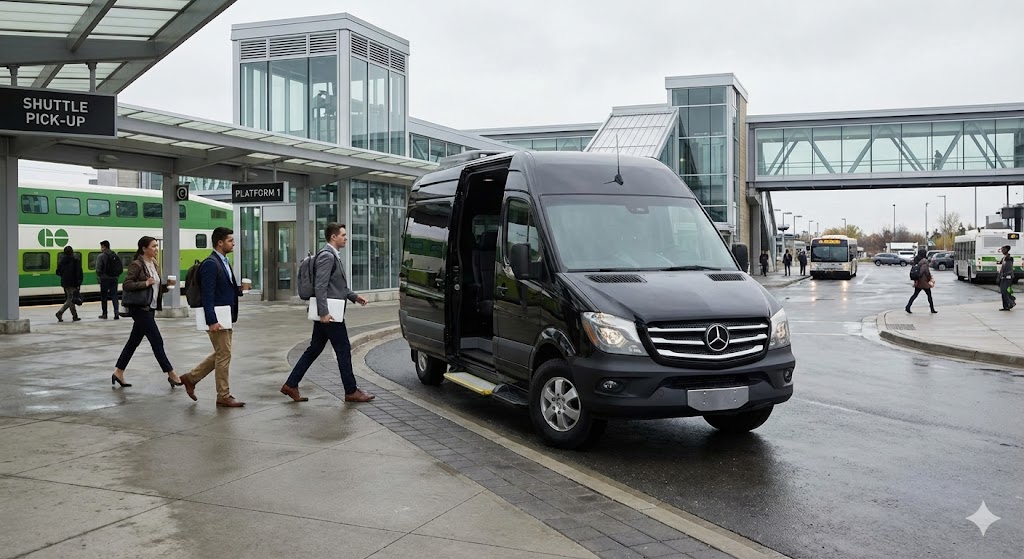
Transit Hub Integration
GO Station coordination for commuter connectivity.
Service: Fixed-route schedules | Get Quote →
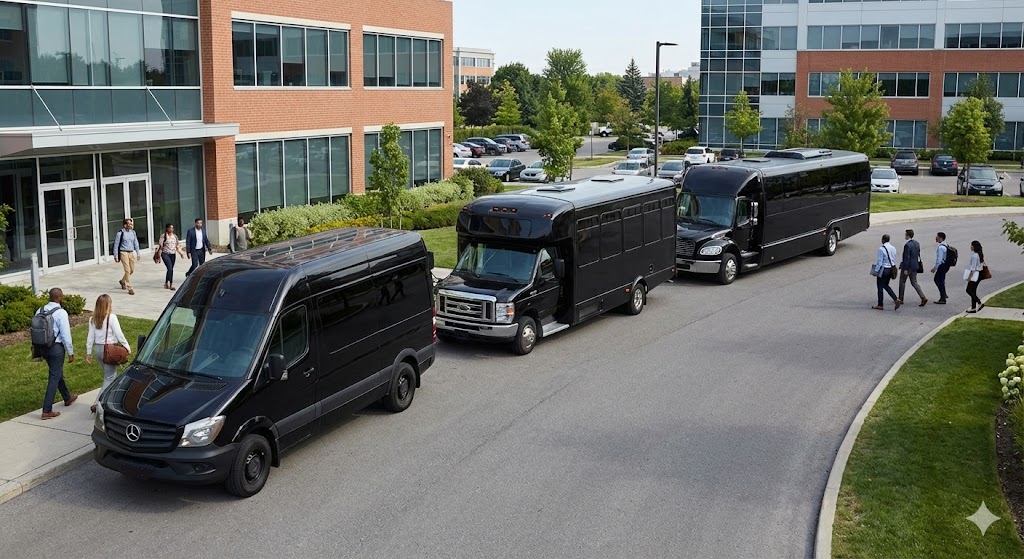
Office Park Shuttle Routes
Campus connectivity for corporate facilities.
Rate: $175/hr | Get Quote →
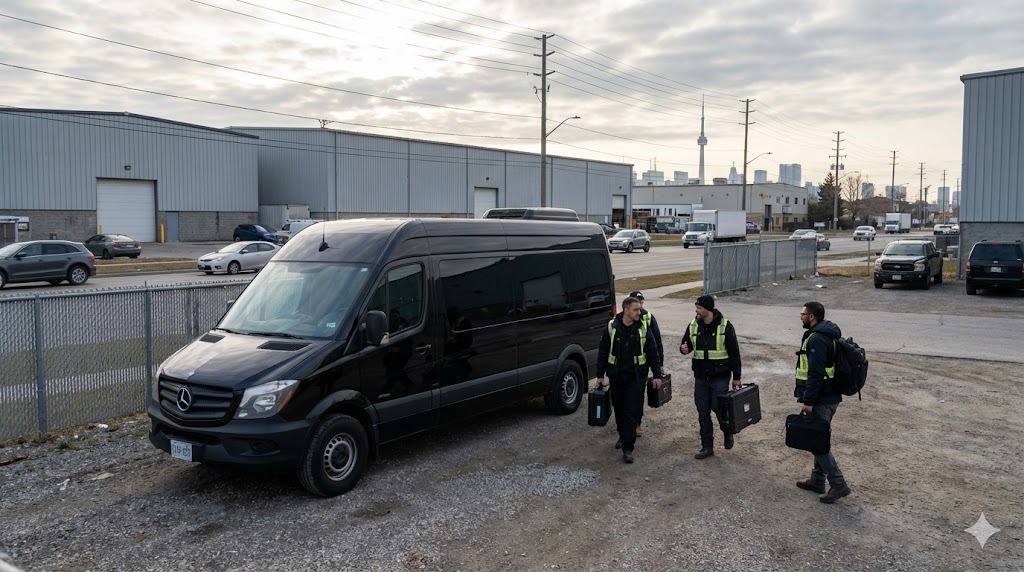
Industrial Zone Operations
Warehouse crew shuttles, shift coverage.
Hours: Early AM/late PM shifts | Get Quote →
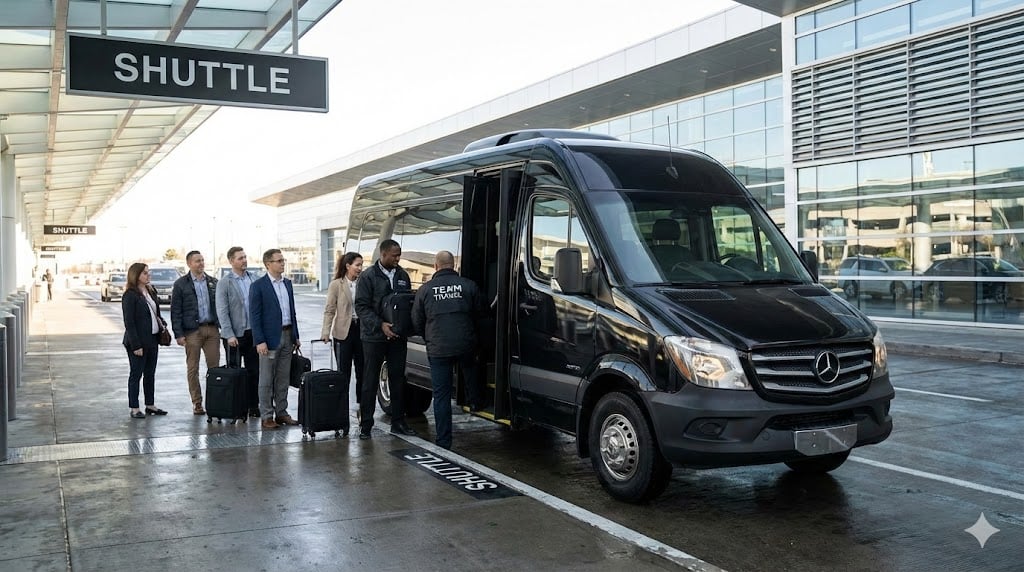
Airport Employee Shuttles
Pearson workforce coordination.
Service: Multi-shift coverage | Get Quote →

Construction Crew Transport
Job site crew coordination.
Capacity: 14 passengers + equipment | Get Quote →
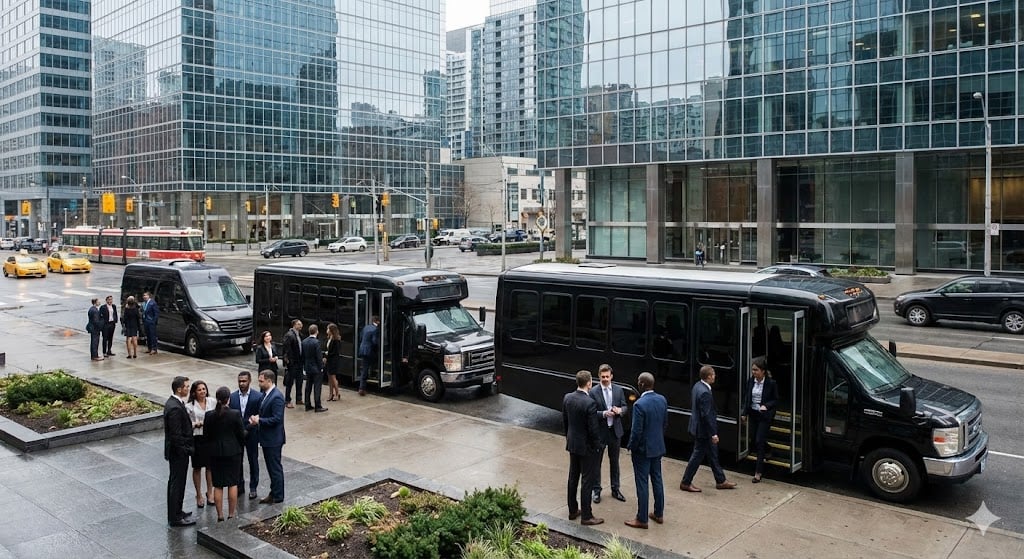
Scalable Fleet Deployment
Service: Custom enterprise programs | Get Quote →
Enterprise Workforce Mobility Infrastructure: Strategic Operational Framework
Corporate shuttle service programs deliver measurable operational efficiency through workforce mobility optimization, addressing critical HR procurement requirements including recruitment differentiation, employee retention enhancement, parking infrastructure cost mitigation, and sustainability initiative alignment. Organizations implementing recurring daily shuttle contracts achieve predictable cost structures while eliminating fragmented employee transportation reimbursement programs, rideshare expense volatility, and parking facility capacity constraints limiting employment growth potential.
Fixed-route employee shuttle operations connect distributed employment centers with residential concentrations, transit hub nodes, and satellite facility locations across Greater Toronto Area industrial corridors, office parks, warehouse districts, and corporate campus environments. Service architecture supports diverse operational requirements including corporate headquarters connectivity, manufacturing facility shift coverage, distribution center workforce deployment, technology campus transportation, and airport employment zone coordination serving terminal operators, airline personnel, and aviation services workforce populations.
Procurement framework: Organizations establish service-level agreements defining route parameters, schedule frequency, vehicle capacity allocation, service reliability metrics, and performance reporting requirements. Monthly contracted pricing structures provide budget predictability versus variable per-employee reimbursement models. Fleet configuration spans 14-passenger Sprinter vans serving intimate route densities through 35-passenger mini-coaches supporting high-volume employment corridors. Request enterprise shuttle proposal: 905-633-5804.
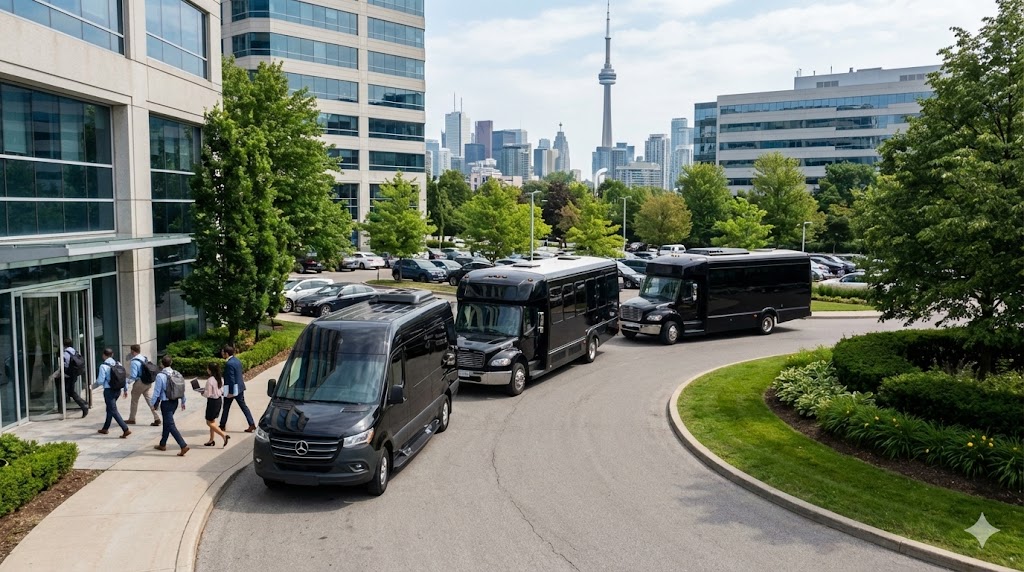
High-Volume Corporate Campus Shuttle Deployment
Multi-vehicle coordination supporting large-scale employment center operations, delivering synchronized arrival/departure sequencing across distributed corporate facilities and office park infrastructure.
Strategic Rationale for Outsourced Workforce Transportation Programs
Parking infrastructure cost mitigation. Organizations facing parking capacity constraints realize immediate capital expenditure avoidance through employee shuttle implementation versus parking facility expansion. Urban employment centers experience parking costs of $25,000-$40,000 per constructed space (land acquisition, structure development, ongoing maintenance). Shuttle programs eliminating 50-100 parking requirements generate $1.25M-$4.0M capital avoidance while converting fixed infrastructure investment into flexible operational expense enabling workforce scaling without facility constraint. Annual parking operation costs ($3,000-$5,000 per space including snow removal, lighting, security, maintenance) represent ongoing expenditure eliminated through transit-oriented shuttle deployment.
Recruitment and retention competitive advantage. Talent acquisition teams leverage corporate shuttle programs as recruitment differentiation addressing candidate transportation concerns limiting employment offer acceptance rates. Organizations operating facilities in suburban office parks, industrial zones, or airport employment areas face candidate accessibility challenges where public transit infrastructure remains underdeveloped. Shuttle service provision expands candidate pools beyond vehicle-owning demographics, supports international workforce onboarding (pre-driver license acquisition), enables multi-generational employment accessibility, and demonstrates employer commitment to employee quality-of-life enhancement. HR departments quantify retention impact through reduced turnover costs ($30,000-$50,000 per professional replacement) attributable to commute stress elimination and work-life balance improvement facilitated through reliable daily transportation.
Operational efficiency and productivity optimization. Employee commute time conversion into productive work hours generates measurable ROI through shuttle program implementation. Knowledge workers utilizing WiFi-enabled shuttle vehicles recover 8-12 hours weekly for email processing, document review, video conference participation, and collaborative planning activities previously lost to driving tasks. Organizations calculate productivity value at employee hourly rates ($35-$75 blended compensation) generating monthly ROI of $1,120-$3,600 per participating employee. Shift-based operations realize punctuality improvements through elimination of traffic-related tardiness, vehicle breakdown delays, and weather-impact commute disruptions. Manufacturing facilities quantify production impact where 5-minute individual delays across 100-employee shift generate 8.3 hours lost productivity daily ($250-$600 value depending on production metrics).
Sustainability initiative compliance and ESG alignment. Corporate sustainability teams utilize workforce shuttle programs achieving measurable carbon footprint reduction supporting Environmental, Social, Governance (ESG) reporting requirements and corporate responsibility commitments. Single 14-passenger shuttle vehicle replacing 14 individual commuter vehicles eliminates 180-250 metric tons CO2 annually (based on 25km average commute, 240 working days). Organizations pursuing LEED certification, carbon neutrality commitments, or institutional investor ESG compliance leverage transportation programs as quantifiable sustainability metrics. Employee shuttle implementation addresses Scope 3 emissions categories (employee commuting) representing 15-30% organizational carbon footprint across service-sector enterprises.
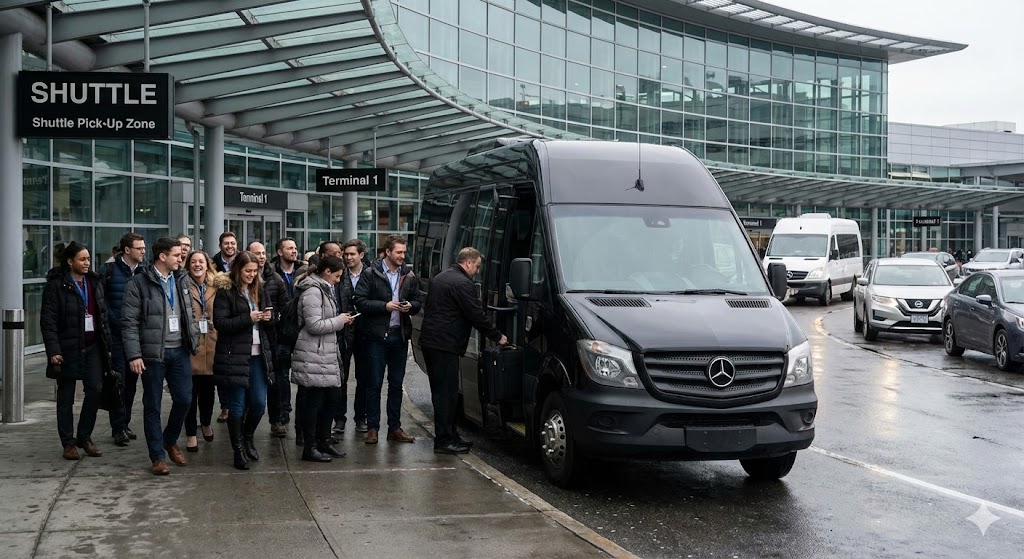
Airport Workforce Transportation Coordination
Dedicated Pearson employment zone shuttles serving airline personnel, terminal operations staff, and aviation services workforce populations requiring multi-shift coverage across 24/7 operational schedules.
Daily Shuttle Route Configuration Models
Corporate headquarters and office park connectivity. Fixed-route services connecting downtown Toronto employment centers with suburban transit hubs (GO Train stations, TTC subway terminals, regional bus facilities) enabling commuter workforce access to central business district offices, technology campuses, and corporate headquarters facilities. Route design incorporates morning inbound service (6:30 AM-9:30 AM arrival windows), midday shuttle coverage supporting flexible work schedules, evening outbound deployment (4:00 PM-7:00 PM departure sequences). Organizations operating distributed office park environments implement campus shuttle loops connecting parking facilities, building entrances, cafeteria amenities, and fitness centers supporting employee mobility across multi-building corporate campuses. Fleet deployment: 14-passenger Sprinter vans ($150/hour, 5-hour minimum daily) serving 50-75 employee routes, mini-coaches ($180/hour) supporting 100-150 employee volumes.
Warehouse and distribution center shift coverage. Industrial zone transportation supporting manufacturing facilities, distribution centers, e-commerce fulfillment operations, and logistics hubs requiring shift-based workforce deployment across early morning, day, evening, and overnight operational periods. Service parameters accommodate staggered shift timing (6 AM, 2 PM, 10 PM, 2 AM start times), high-volume employee boarding requirements (50-100 workers per shift change), equipment/personal effects storage capability (lunch containers, safety gear, work boots), and weather-protected waiting areas at pickup locations. Route architecture connects residential concentrations in Brampton, Mississauga, Vaughan with Highway 427/401 industrial corridor employment zones. Organizations utilize shuttle programs addressing recruitment challenges where industrial facility locations lack public transit accessibility limiting workforce pools to vehicle-owning candidates.
Airport employment zone and aviation workforce services. Specialized transportation serving Toronto Pearson International Airport employment populations including airline crew personnel, terminal operations staff, ground handling services, cargo facility workers, and airport authority employees. Service delivery addresses unique operational requirements including 24/7 shift coverage, security clearance coordination, restricted area access protocols, airline uniform/equipment accommodation, and flight schedule synchronization for crew positioning. Route configurations connect employee parking facilities with terminal buildings, cargo zones, maintenance hangars, and airline operation centers. Organizations including airlines, ground handling contractors, catering services, and airport retail operators implement consolidated shuttle programs reducing individual parking demand while ensuring workforce punctuality critical to aviation operational reliability.
Technology campus and multi-site facility coordination. Complex routing supporting organizations operating distributed facility networks including corporate headquarters, research centers, manufacturing plants, data centers, and sales offices requiring inter-site employee mobility. Service architecture enables workforce deployment across facility locations supporting cross-functional collaboration, equipment sharing, consolidated amenity access (cafeterias, fitness centers, training facilities), and flexible workspace utilization. Technology sector employers utilize campus shuttle systems connecting building clusters across extensive corporate campuses (Google Kitchener-Waterloo, Amazon fulfillment network, automotive sector manufacturing complexes). Fleet deployment incorporates frequent service intervals (10-15 minute headways) supporting spontaneous inter-building mobility versus fixed scheduled departures. Monthly service costs: $18,000-$32,000 supporting 200-400 employee daily ridership across 2-3 vehicle continuous operation (10-hour daily service, 22 working days monthly).
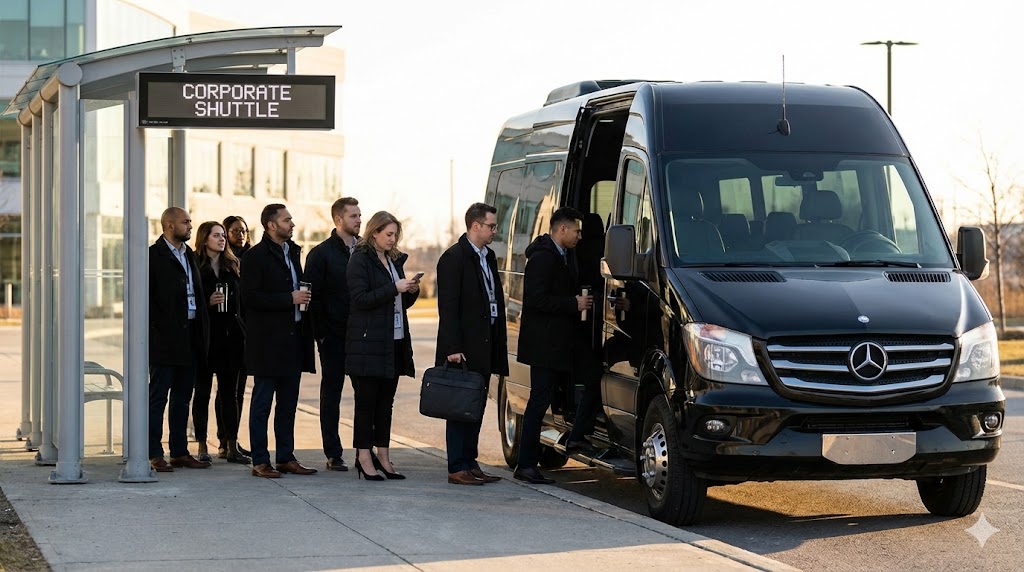
Office Building Employee Pickup Coordination
Multi-vehicle deployment supporting corporate office shuttle programs, coordinating Sprinter vans and executive vehicles for tiered workforce transportation services.
Service Reliability Framework and Schedule Management Infrastructure
On-time performance guarantees and SLA compliance. Enterprise shuttle contracts establish service-level agreements defining reliability metrics including on-time departure performance (95% within 2-minute scheduled window), vehicle availability guarantees (99.5% service delivery excluding force majeure events), driver punctuality standards, and contingency response protocols. Real-time GPS tracking infrastructure provides operations teams with fleet positioning visibility enabling proactive schedule adherence management, traffic pattern anticipation, and dynamic routing adjustments addressing unexpected road conditions. Monthly performance reporting delivers transparency through documented metrics supporting vendor management oversight and continuous improvement initiatives. Organizations requiring mission-critical workforce deployment (manufacturing shift changes, airline crew positioning, hospital staff coverage) access enhanced SLA tiers incorporating dedicated backup vehicle allocation and priority dispatch support.
Schedule optimization and demand pattern analysis. Service design incorporates ridership data analytics identifying demand patterns enabling route optimization, capacity allocation refinement, and schedule timing adjustments maximizing operational efficiency. Initial deployment phases utilize conservative capacity allocation (vehicle quantity, service frequency) with subsequent optimization driven by actual utilization metrics. Organizations experience typical 6-8 week adoption curves as employee populations transition from personal vehicle commuting to shuttle utilization, requiring schedule flexibility accommodating ridership growth. Technology integration through mobile applications enables ridership forecasting where employees indicate intended shuttle usage supporting dynamic capacity deployment versus fixed scheduled service. Peak demand periods (Monday mornings, Friday afternoons, post-holiday returns) require surge capacity management through temporary vehicle augmentation preventing service degradation during high-utilization windows.
Weather contingency protocols and operational continuity. Shuttle service operations incorporate comprehensive winter weather preparedness addressing Ontario climate conditions including snow events, ice storms, extreme cold periods, and visibility limitations. Fleet deployment utilizes winter-equipped vehicles (all-weather tires, block heaters, auxiliary heating systems) ensuring reliable operation during adverse conditions when workforce transportation becomes most critical. Contingency planning includes alternative routing protocols avoiding weather-impacted roadways, extended service windows accommodating slower travel speeds, and communication systems providing employees with real-time service status updates. Organizations maintaining essential service operations (healthcare, manufacturing, 24/7 facilities) depend on shuttle reliability ensuring workforce deployment regardless of weather conditions when individual employee commuting becomes hazardous or impossible.
Driver training and customer service standards. Professional driver personnel undergo comprehensive training programs including defensive driving certification, customer service protocols, emergency response procedures, and route familiarization ensuring consistent service delivery quality. Background verification, commercial licensing compliance, and ongoing performance monitoring maintain safety standards and operational excellence. Driver teams develop route expertise recognizing regular passengers, understanding facility access protocols, coordinating with employer security procedures, and maintaining discrete professionalism supporting positive employee experience. Organizations value consistent driver assignment building employee familiarity versus rotating personnel creating service inconsistency. Request comprehensive service proposal including reliability frameworks: 905-633-5804.

Employee Pickup Coordination and Real-Time Communication
Mobile technology integration enabling workforce shuttle tracking, real-time arrival notifications, and dispatch communication supporting seamless employee pickup operations.
Recurring Contract Structures and Enterprise Pricing Models
Monthly contracted service agreements. Organizations establish recurring shuttle service contracts delivering cost predictability through fixed monthly pricing versus variable per-trip charges or employee reimbursement programs. Contract terms typically span 12-36 months enabling amortization of implementation costs (route planning, technology integration, driver training) while providing service stability supporting long-term workforce planning. Monthly billing consolidation simplifies accounting processes versus fragmented individual expense tracking, enables departmental cost allocation supporting budget management, and facilitates financial forecasting through predictable transportation expense structures. Example pricing: Single 14-passenger Sprinter route operating 10 hours daily (morning/evening peaks), 22 working days monthly = 220 service hours × $150/hour = $33,000 monthly contract value. Multi-route programs achieve volume pricing efficiencies through consolidated service deployment.
Per-employee cost analysis and budget modeling. Financial planning teams calculate shuttle program costs using per-participating-employee metrics enabling ROI comparison against alternative solutions. Example scenario: Corporate shuttle program serving 100 employees, 2 routes, 10-hour daily service, $150/hour Sprinter deployment. Monthly cost: 2 vehicles × 220 hours × $150 = $66,000. Per-employee monthly allocation: $660. Comparative analysis: Individual employee parking ($200-$400 monthly downtown Toronto), mileage reimbursement ($0.68/km × 50km daily × 22 days = $748 monthly), rideshare subsidy ($15-25 daily × 22 days = $330-$550 monthly). Shuttle programs deliver cost competitiveness while providing operational control, service reliability, and recruitment/retention benefits exceeding pure transportation cost considerations.
Scalability provisions and workforce growth accommodation. Service agreements incorporate flexibility mechanisms enabling capacity adjustments responding to organizational workforce changes including seasonal demand fluctuations, facility expansion projects, merger/acquisition integration, and employment growth trajectories. Contract structures permit route additions, service hour extensions, vehicle upgrades (14-passenger to 25-passenger capacity), and temporary surge support without renegotiation penalties. Organizations experiencing rapid growth leverage shuttle infrastructure scalability avoiding parking facility constraints that otherwise limit hiring velocity. Technology sector employers, e-commerce operations, and manufacturing facilities utilize transportation flexibility supporting employment scaling aligned with business expansion without capital infrastructure dependencies. Request customized pricing proposal incorporating workforce projections and scalability requirements.

Executive and FBO Ground Crew Transportation Coordination
Specialized private aviation ground services supporting FBO operations personnel, executive flight crews, and corporate aviation departments requiring Toronto Pearson coordination.
HR Procurement Requirements and Operations Pain Point Resolution
Recruitment accessibility and talent pool expansion. HR departments facing candidate pipeline constraints utilize shuttle programs eliminating transportation barriers limiting employment offer acceptance rates. Suburban office park facilities, industrial zone operations, and airport employment centers experience accessibility challenges where public transit infrastructure remains underdeveloped or non-existent. Corporate shuttle implementation expands candidate pools beyond vehicle-owning demographics (estimated 15-20% GTA households lack personal vehicle access), supports newcomer workforce integration pre-driver license acquisition, enables student employment programs, and demonstrates employer commitment to workforce accessibility. Organizations quantify recruitment impact through increased application volumes, improved offer acceptance rates, and reduced time-to-fill metrics for hard-to-staff positions.
Retention enhancement and turnover cost mitigation. Employee retention teams address commute-related attrition through transportation program deployment eliminating primary resignation driver (excessive commute burden, transportation cost stress, work-life balance deterioration). Manufacturing operations, distribution centers, and customer service facilities experience elevated turnover rates where workforce populations face challenging commute patterns including multiple transit transfers, extended travel durations (90+ minutes each direction), or unreliable service outside peak hours. Organizations calculate turnover cost impact at $30,000-$50,000 per professional replacement (recruiting, onboarding, productivity ramp, institutional knowledge loss) and $8,000-$15,000 per hourly workforce replacement. Shuttle programs reducing annual turnover 3-5 percentage points generate measurable ROI through retention improvement alone before considering recruitment, parking, or productivity benefits.
Operational continuity and absenteeism reduction. Operations management teams leverage workforce shuttle reliability addressing attendance challenges where employee transportation barriers create chronic lateness or weather-related absenteeism. Manufacturing shift operations, healthcare facilities, and customer service centers requiring minimum staffing levels experience productivity disruption when individual employees face vehicle breakdowns, weather commute challenges, or family transportation conflicts. Centralized shuttle deployment eliminates individual transportation dependencies, provides weather-resistant service continuity (professional drivers, equipped vehicles, alternative routing), and creates attendance accountability through scheduled pickup times versus individual commute variability. Organizations quantify absenteeism cost impact through lost production, overtime coverage requirements, customer service degradation, and quality control challenges attributable to understaffing situations. Enterprise shuttle consultation: 905-633-5804.
Greater Toronto Area Workforce Transportation Coverage
Enterprise procurement: 905-633-5804 | Schedule consultation
Corporate Workforce Shuttle Solutions
Serving corporate employers across Greater Toronto Area, Mississauga, Brampton, and Vaughan with recurring workforce mobility solutions.