

Airport group van service, run like a standing account.
Recurring Pearson pickups for delegations, executive travellers, and relocating staff, on Sprinter and mini coach vans with a dedicated coordinator, NET 30 invoicing, and a contract rate tailored to your run schedule.
A single flight lands 4 executives one week and 14 conference delegates the next, and a corporate account turns both into the same phone call: send the manifest, the van is at the kerb. This page covers the airport-specific version of the standing group van program, built for companies that move people through Pearson often enough to want one invoice, one coordinator, and one rate structure instead of booking each transfer from scratch.
Contract Airport Van Service vs One-Off Booking
Two different products live under “airport van service”: a one-off hourly booking for a single trip, and a standing corporate account for companies that run Pearson pickups every week.
The one-off booking is straightforward: a Sprinter at $175 an hour with a 5-hour minimum, or an Executive Sprinter at $195 an hour, quoted per trip through our general Pearson group Sprinter page. The contract account is a different shape entirely: instead of a published tier table, we build a per-day rate around your actual run count, vehicle size, and contract length, anchored around $500 to $800 a day for a 14-passenger Sprinter, with longer commitments earning the lower end. Neither number is a teaser; both are the number invoiced.
Companies that book 3 or more airport runs a month are usually better served by the account structure: one coordinator, one monthly invoice, and priority scheduling during flight-delay chaos instead of competing for same-day availability. Companies booking a single trip should just call it in hourly. Our Sprinter contract and corporate account page covers the non-airport version of the same program; this page is the Pearson-specific build.
The math behind that 3-trips-a-month line is simple: at $175 an hour and a 5-hour practical minimum, a single Sprinter round trip runs close to $875 before HST and gratuity, so 3 or more of those a month already approaches what a light contract account costs across the same period, before counting the coordination time saved. Below that volume, hourly booking is genuinely simpler and nobody should be talked into a contract they do not need. Above it, the account almost always wins on both cost and admin load.

Fleet for Airport Group and Corporate Account Work
Three vehicle sizes cover the range: a Cadillac Escalade for 1 to 6 executive travellers, a 14-passenger Sprinter for the standard delegation, and a 27-seat mini coach when the flight brings a real crowd.
The Escalade tier handles the single executive or small leadership group who wants an SUV rather than a van, at $175 an hour. The Regular Sprinter at $175 an hour and the Executive Sprinter at $195 an hour, with WiFi and a fold-out worktable, cover the 10 to 14 passenger range that most corporate arrivals actually need. When a conference lands 20-plus delegates on one flight wave, the 27-seat mini coach steps in at $250 an hour rather than running 2 Sprinters back to back.
Every vehicle in the account is black, current-model-year, and unbranded, so a delegation stepping off a flight is not hunting for a logo in a sea of rideshare cars. Plus HST 13% and gratuity of 15 to 20 percent on every rate, straight from our rate card.

Airport Van Rates: One-Off and Contract
One-off airport runs quote hourly with the vehicle minimum; standing accounts quote as a tailored daily rate: $175 to $195 an hour for a Sprinter, $250 an hour for the 27-seat mini coach, or $500 to $800 a day under a contract, plus HST 13% and gratuity of 15 to 20 percent.
| Vehicle | Capacity | One-off hourly | Contract account |
|---|---|---|---|
| Cadillac Escalade ESV | 1-6 | $175 / hr | Tailored quote |
| Regular Sprinter | 1-14 | $175 / hr | from $500 / day |
| Executive Sprinter | 1-14 | $195 / hr | from $650 / day |
| 27-Seat Mini Coach | up to 27 | $250 / hr | Tailored quote |
The contract column is a range, not a menu, because the real number depends on runs per week, contract length, and whether the vehicle sits idle between pickups or runs a second job. A 6-month commitment with 4 runs a week lands near the low end; a short-term 2-week engagement lands higher. Every proposal itemizes HST and gratuity separately so procurement sees the real total before signing.

How the Corporate Account Works
A corporate account replaces per-trip booking with a standing arrangement: 1 coordinator, 1 monthly invoice, and a run schedule built around your actual flight patterns.
Setup starts with a short call: how many airport runs a month, typical passenger counts, preferred vehicle tier, and whether pickups cluster around specific flight windows (Monday morning arrivals, Friday evening departures) or spread evenly. From that we build a proposed schedule and a per-day rate, and the account goes live once approved. NET 30 invoicing is standard, with a single itemized statement covering every run in the billing period instead of a folder of individual receipts.
Flight tracking is built into every pickup, contract or one-off: the driver checks the actual landing time, not the scheduled one, and adjusts the staging window so a delayed flight does not mean a driver circling the terminal for an hour. Corporate accounts get priority scheduling during weather and holiday disruption, when demand for airport transport spikes fastest.
Onboarding a new account usually takes less than a week from first call to first run: the coordinator confirms typical flight patterns, proposes a vehicle tier and rate, and the account goes live once approved, often in time for the next travel week rather than the next quarter. Existing accounts revisit the rate only at renewal, not mid-contract, so a busier-than-expected month does not trigger a surprise adjustment. Cancellations and reschedules inside the account follow the same flexible rule as one-off bookings: a change in flight number is a text message, not a new quote.
Most accounts name a primary and a backup driver where the run volume supports it, so a regular delegation sees a familiar face and does not have to re-explain preferred routes, building access codes, or a habitual coffee order every single week. That continuity is a small thing on paper and a noticeable one in practice once an account has been running for a few months.


How Pickup Works at Pearson
Arriving passengers check in at the Pre-Arranged Limousine Desk inside the terminal, and the vehicle stages at the assigned pickup post rather than idling at the curb the whole time.
The driver tracks the flight, confirms the gate and baggage claim, and has the vehicle at the post by the time the passenger reaches the desk, so there is no standing around waiting for a car to appear. Departures work the other direction: pickup at the office, home, or hotel, timed to the security-line reality of the specific terminal, not a generic 2-hour rule. Both directions run on the same account rate, so a round-trip delegation does not require 2 separate bookings.

Conference Delegations and Employee Relocation Arrivals
Two recurring patterns drive most contract airport work: conference delegations landing on a cluster of flights, and new-hire or relocating staff arriving over the first month of an assignment.
Delegation waves get a published pickup schedule matched to actual flight arrivals rather than one fixed time, so the group is not standing around for stragglers or leaving early flyers waiting an hour. A 27-seat mini coach or a pair of Sprinters covers most single-day waves; multi-day conferences run the same schedule outbound at the close. Relocation and onboarding arrivals are quieter but just as standing: a new hire’s first Toronto touchdown, spouse and kids on a second flight, moving crates on a third, all covered under one account instead of three separate quotes.
HR and mobility teams tend to run the relocation pattern for 30 to 90 days per new hire: the initial arrival, a return trip if the offer includes a home visit, and the occasional airport run for household goods or a spouse’s delayed flight. Folding those into the same account as the executive and delegation runs keeps a single monthly statement covering every airport touchpoint the company generates, rather than expensing individual rides across a dozen different corporate cards.

When the Account Grows Beyond the Airport
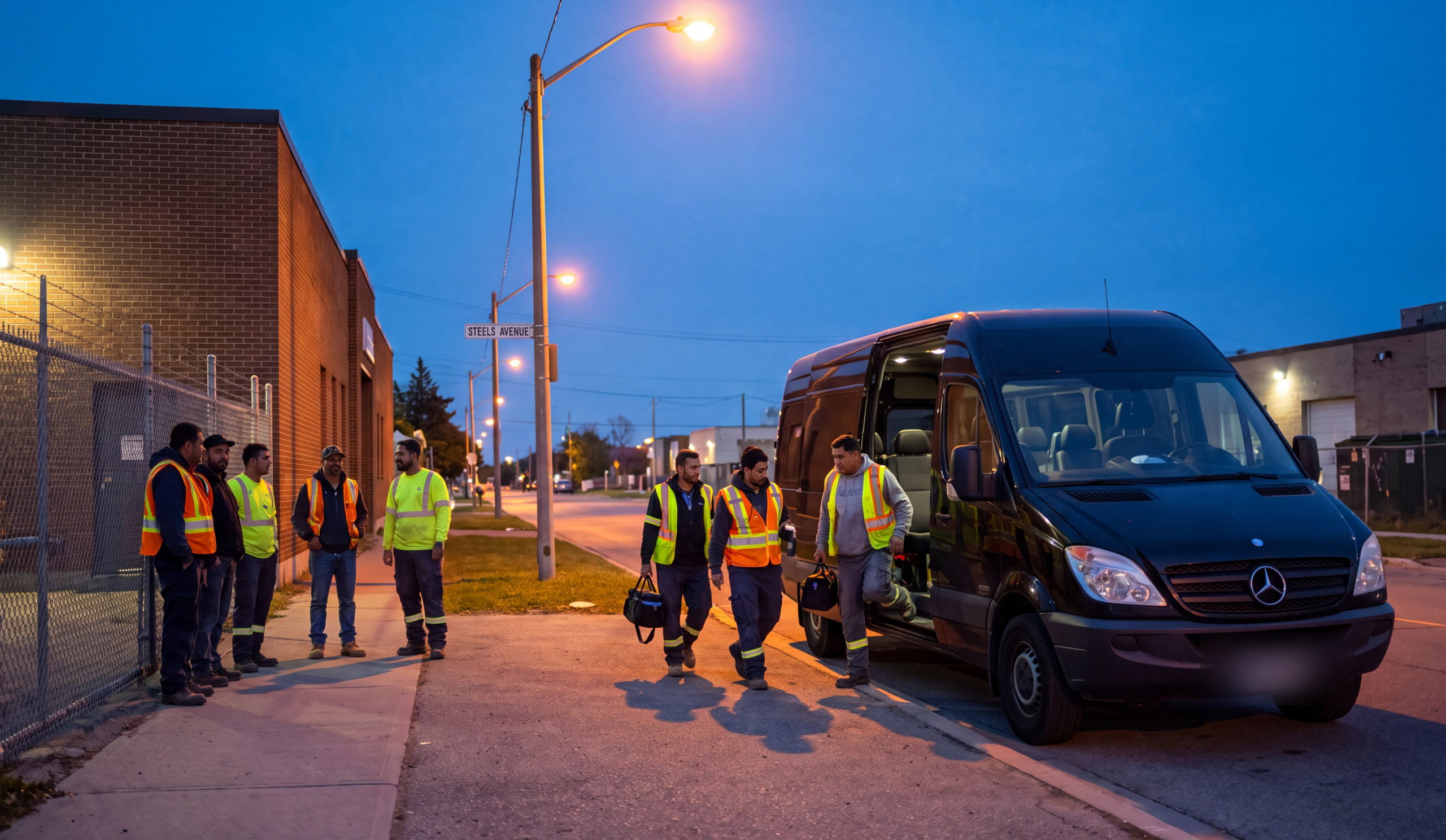
Most accounts start as pure airport pickup and grow into something broader: hotel-to-office transfers, GO station connections for staff who commute in from outside the city, and shift-change runs for teams that work outside standard hours.
The same account rate structure extends to those legs without a separate contract; it is simply more runs on the same monthly invoice. Our corporate offsite and retreat program page covers the version of this built around multi-day events rather than daily transport. For teams shuttling in from GO stations or running predawn shift changes, the vehicle and driver are the same fleet, just a different pickup point on the manifest.

Setting Up an Airport Corporate Account
Send 3 things to start: typical monthly run count, usual passenger size, and whether pickups cluster around specific days or spread evenly. A tailored account proposal comes back within the hour, itemized with HST and gratuity.
One-off trips need less: date, flight number, and headcount, quoted the same hour. Accounts can start small (a single weekly executive pickup) and expand as flight volume grows; the rate adjusts at renewal, not mid-contract. Every account gets 1 named coordinator who knows the schedule, so nobody explains the account from scratch on every call.
“I would like to appreciate David and his team of professionals for giving such an amazing service of picking up my family from their home in Mississauga and dropping them off at Pearson Airport, Toronto. Back and forth communication through email with David made my life easy as he thoroughly explained all the related expenses and detail of vehicles readily available to choose from. Their executive sprinter van was so big and comfortable which adjusted as many as 13 big bags and 5 travelling passengers. The passengers had a very good experience to the airport. I highly appreciate their professional team in terms of arriving on time, vehicle professionally driven. Keep up with the good work. Looking forward using this service very soon. Thanks”
“We received transportation to and from the airport (party of 6). Punctual, professional, polite, respectful, efficient and friendly staff. Reasonable price for service provided. Great communication from staff. Clean, comfortable, high end vehicles. Water provided to customers. Safe drivers. Drivers assisted with customers getting in/out of vehicles as required and managed the loading/unloading of bags/suitcases. Highly recommended. Will call upon them for transportation in the future.”
“This service was wonderful.. kind..and very prompt… highly recommend!!!”
Airport Corporate Account FAQ
The billing, scheduling, and process questions Toronto companies ask before setting up a standing Pearson pickup account.
How much does an airport corporate account cost per day?
$500 to $800 a day covers a 14-passenger Sprinter under a standing contract, with longer commitments and higher run counts earning the lower end, plus HST 13% and gratuity of 15 to 20 percent. The exact number depends on runs per week and contract length, quoted as a tailored proposal rather than a fixed table. One-off trips outside the contract quote hourly instead.
What is the difference between a contract account and booking each trip separately?
1 monthly invoice versus a receipt per trip: a contract account bundles every airport run into one NET 30 statement with a dedicated coordinator, while one-off booking quotes and bills each transfer individually at $175 to $195 an hour. Companies running 3 or more airport trips a month typically save time and money on the account structure. Single trips just book hourly, no account needed.
How much does a one-off Sprinter airport transfer cost?
$175 per hour books the Regular Sprinter with a 5-hour practical minimum, and $195 per hour books the Executive Sprinter with WiFi and a fold-out worktable, both including the driver, plus HST 13% and gratuity of 15 to 20 percent. Point-to-point single transfers can also quote as a fixed trip rate rather than hourly. The quote is confirmed before pickup either way.
How does pickup work at Pearson for a pre-arranged corporate ride?
1 stop: the passenger checks in at the Pre-Arranged Limousine Desk inside the terminal, and the vehicle stages at the assigned pickup post once the driver confirms the flight has landed and bags are moving. There is no standing at the curb waiting for a car to circle back. Departures run the same way in reverse, timed to the terminal’s actual security-line pace.
What vehicle handles a 20-person conference delegation landing on one flight?
The 27-seat mini coach at $250 per hour covers a single flight wave of 20-plus delegates in one vehicle instead of running 2 Sprinters back to back. Smaller waves of 10 to 14 fit the standard Sprinter tier. The right size depends on the confirmed headcount, not the hopeful one.
Is NET 30 invoicing available for airport corporate accounts?
Yes, NET 30 terms are standard on every corporate account, with 1 itemized monthly statement covering every run in the billing period instead of a receipt per trip. HST is shown separately on the invoice. Procurement deals with a single vendor line instead of a folder of one-off charges.
How many airport runs a month justify switching to a contract account?
3 or more runs a month is the usual break-even: at that volume the flat account rate beats stacking individual $175-to-$195-an-hour hourly bookings, and the scheduling and single-invoice benefits start to matter. Below that, one-off booking per trip is simpler. We will quote both shapes and let the math decide.
Can the account cover both arrivals and departures?
Yes, round-trip coverage runs on the same account rate: an arrival pickup at the Pre-Arranged Desk and a departure pickup at the office or hotel both bill under 1 contract instead of 2 separate bookings. Timing for each leg is set independently to match the actual flight, not a shared window. Most standing accounts run both directions from day one.
Do you track flight delays for corporate pickups?
Yes, 100 percent of pickups, contract or one-off, track the actual landing time rather than the scheduled one, and the driver’s staging window adjusts automatically. A 45-minute delay does not mean a driver circling the terminal or a passenger waiting curbside. Corporate accounts get priority rescheduling during wider weather or holiday disruption.
What is the vehicle for a single executive traveller?
The Cadillac Escalade ESV at $175 per hour covers 1 to 6 executive travellers who want an SUV rather than a van, with the same driver-included, HST-plus-gratuity pricing as the rest of the fleet. It is the standard choice for a single VIP arrival or a small leadership group. Larger groups step up to the Sprinter tier.
How do you handle employee relocation arrivals from the airport?
Relocation arrivals run as scheduled pickups under the same account: a new hire’s first landing, a spouse or family on a following flight, and moving items on a separate run, all billed under 1 monthly statement instead of 3 separate quotes. HR teams send the arrival dates once and the schedule tracks flights automatically. It folds into an existing account or starts as its own.
Can we start with a small account and add more runs later?
Yes, accounts commonly start with 1 weekly executive pickup and grow as airport volume increases; the rate is revisited at renewal rather than mid-contract. There is no minimum run count to open an account. Growth in either direction, more or fewer runs, gets a straightforward proposal update.
Do you provide a Sprinter with WiFi and a worktable for airport pickups?
Yes, the Executive Sprinter at $195 per hour includes WiFi and a fold-out worktable, letting a delegation start a call or review notes on the ride in from Pearson instead of losing that time. The Regular Sprinter at $175 per hour covers the same capacity without those extras. Both seat up to 14.
How far in advance should we book an airport corporate run?
24 hours covers most single trips comfortably, and standing accounts run on a published schedule so day-of booking is not usually needed at all. Peak travel weeks (holiday season, major conferences) benefit from earlier flight numbers so staging windows can be planned. The quote holds once confirmed, so early booking costs nothing extra.
What happens if a flight is cancelled or rebooked?
0 penalty: the pickup simply moves to the new flight number, and sending the updated details lets the driver retarget the staging window automatically. Contract accounts do not lose the scheduled run: it shifts rather than disappears. One-off bookings get the same flexibility up to the day of travel.
Do you serve both Pearson Terminal 1 and Terminal 3?
Yes, both: pickups and drop-offs cover Terminal 1 and Terminal 3 at Pearson, with the driver confirming the correct terminal against the flight number before staging. International and domestic arrivals both route through the Pre-Arranged Limousine Desk process. The terminal is confirmed on the booking, not guessed on the day.
Can a corporate account include non-airport trips too?
Yes, 3 common additions: hotel-to-office transfers, GO station connections, and shift-change runs, all riding on the same monthly invoice once the airport pattern is established. It is the same fleet and driver pool, just additional pickup points on the manifest. The rate structure carries over without a separate contract.
Is gratuity included in the quoted rate?
No, HST 13% and gratuity of 15 to 20 percent are itemized separately on every quote and invoice, contract or one-off. The number a coordinator approves for the account is the number that appears on the monthly statement, with tax and gratuity broken out clearly. Nothing new appears after the fact.
What is the minimum group size for the mini coach tier?
There is no strict minimum, but the 27-seat mini coach at $250 per hour makes the most sense above 15 to 18 passengers; smaller delegations are usually better served by 1 or 2 Sprinters. We will quote both shapes for a borderline headcount so the account picks the cheaper real option. The confirmed list, not the invite list, decides.
How do you handle a large multi-flight conference wave?
1 published pickup schedule tracks each flight in the wave, staging vehicles in sequence rather than holding one vehicle for the whole cluster. Overlapping arrivals split across the Sprinter and mini coach tiers as needed. The schedule is built with the event planner before the first flight lands, not improvised on the day.
Can the account cover weekend and holiday pickups?
Yes, 365 days a year including weekends and holidays, with priority scheduling for account holders during the highest-demand travel windows. Holiday-season staffing is planned ahead of the surge, not scrambled the week of. The rate does not change for weekend or holiday runs under a standing contract.
Who is the point of contact once the account is set up?
1 named coordinator manages the account, holds the run schedule, and takes changes by phone or email without the account being re-explained on every call. That person also owns the monthly invoice and any schedule adjustments. It is the same person across the life of the account, not a rotating desk.
How long does it take to set up a new corporate account?
Under 1 week from first call to first run: the coordinator confirms typical flight patterns and passenger counts, proposes a vehicle tier and rate, and the account goes live once approved. Rush setups for an immediate travel week are usually possible with a same-day call. Existing accounts add new travellers or runs without a fresh setup process.
Does the rate change if we book more or fewer runs than usual in a given month?
No, 0 mid-contract changes: the agreed per-day or per-run rate holds for the length of the contract and is revisited only at renewal, not adjusted mid-month for a busier or quieter travel period. That predictability is one of the reasons companies move from hourly booking to an account in the first place. Significant, sustained volume changes can prompt a renegotiated proposal at the next renewal point.
One manifest. One invoice.
Send your typical monthly run count and passenger size. A tailored corporate account proposal comes back within the hour.