

2026 Price Guide
How Much Does a Party Bus Cost in Toronto?
A clear 2026 breakdown of party bus rental prices in Toronto: hourly rates, the 4-hour minimum, per-person math, and what moves the final number. Before trusting any number, read the hidden fees that inflate limo quotes.
A party bus in Toronto costs $200 to $300 per hour, and every booking carries a 4-hour minimum. That sets the floor at $800 for the 17-passenger regular van and $1,000 for the 35-passenger VIP bus. Driver, fuel, and commercial insurance are already inside that rate. The only line items added afterward are Ontario HST at 13% and a gratuity for your chauffeur.
Most people who type this question want a single number. There isn’t one, because the total moves with the vehicle you pick and how long you keep it. So here is the whole picture: the hourly rates for all three party vehicles, the math behind the 4-hour minimum, what counts as included versus extra, how the per-person cost collapses once you fill the seats, the five things that push the price around, and how the bus stacks up against a pile of rideshares or a row of limos.
On this page
Hourly rates for every party vehicle
The 4-hour minimum and the math
What is included and what costs extra
Cost per hour versus cost per day
Five things that change your final price
Party bus cost per person
Party bus versus Ubers and limos
Seasonal and peak-date pricing
Deposit and cancellation costs
A full sample quote, line by line
Frequently asked questions
Hourly rates for every party vehicle
Chauffeuropolis runs three party vehicles across the Toronto GTA. They run $200 to $300 per hour, with the 35-passenger VIP bus at $250. Each rate already covers the driver, the fuel, and the commercial insurance, so the number you see is the number the vehicle costs before tax and tip.
The 35-passenger VIP party bus is $250 per hour. The 16-passenger party LUX van is $300 per hour. The 17-passenger party regular van is the budget pick at $200 per hour. All three carry the same 4-hour GTA minimum, so the shortest booking you can make is four hours on any of them.
| Vehicle | Per hour | 4 hours (min) | 5 hours | 6 hours | 8 hours |
|---|---|---|---|---|---|
| 35-passenger VIP party bus | $250 | $1,000 | $1,250 | $1,500 | $2,000 |
| 16-passenger party LUX van | $300 | $1,200 | $1,500 | $1,800 | $2,400 |
| 17-passenger party regular van | $200 | $800 | $1,000 | $1,200 | $1,600 |
Base rates only. Add Ontario HST 13% and a customary gratuity for the all-in total. GTA hourly bookings. Out-of-town routes and peak dates are quoted by itinerary.
Rates are a guide and may change without notice.
Read the table left to right and the pattern is plain. The hourly rate never changes the longer you ride. A fifth hour on the 35-passenger bus is another $250, a sixth is another $250, and an eight-hour day lands at $2,000 before tax. The 17-passenger regular van follows the same logic at $200 a step, which is why a long day on the budget van still tops out well under what the VIP bus costs for half the time.
Pick the vehicle by the group, not by the badge. Sixteen people who want the full LED-and-sound build take the LUX van at $300 or the VIP bus at $250. A crew of twelve heading to dinner and a couple of bars, who care more about the bill than the light show, take the 17-passenger regular van at $200 and pocket the difference. The seats decide the floor; the hours decide the rest.
The 4-hour minimum and the math
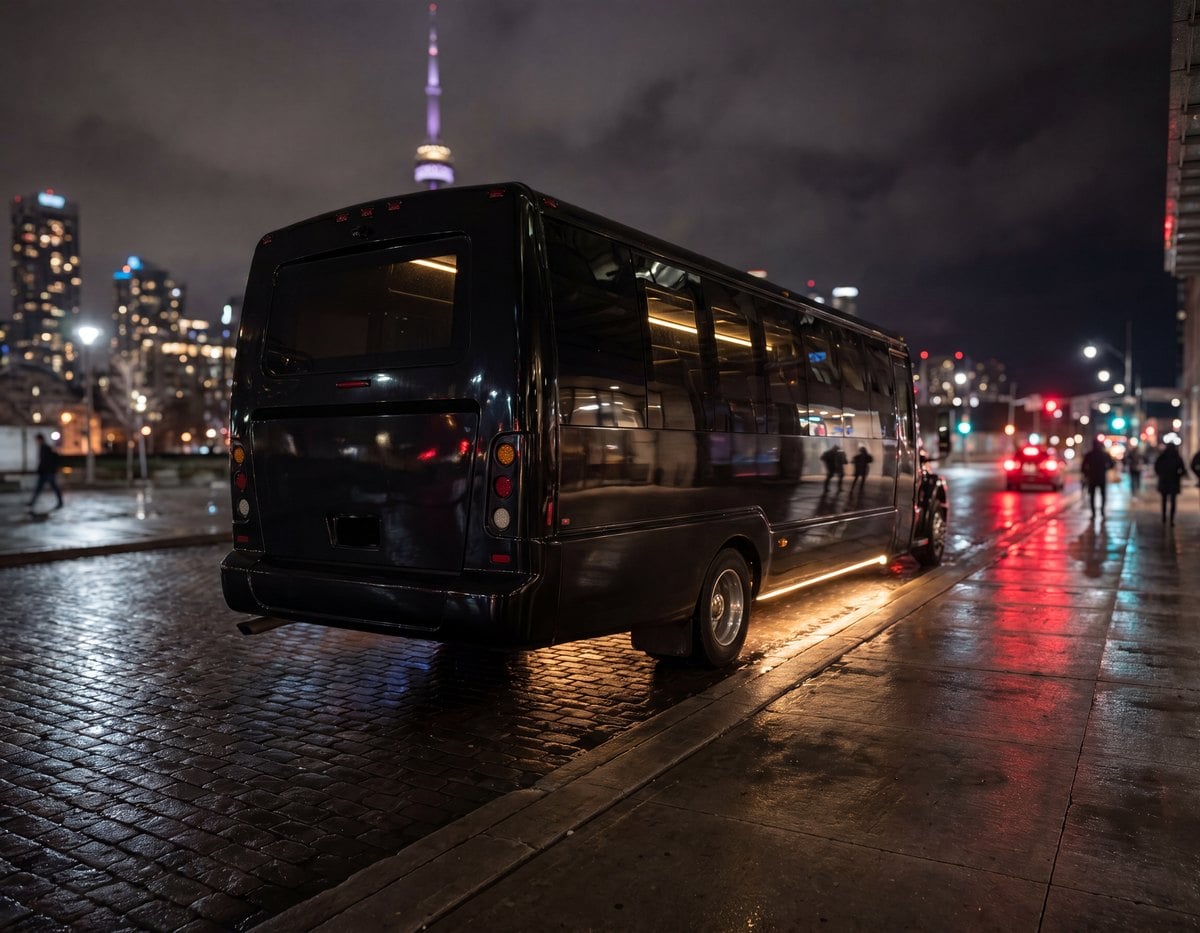
Every GTA party booking starts at four hours. The formula is one line. You multiply the hourly rate by the hours you book, and four is the smallest number that fits in the hours slot.
On the 35-passenger bus that is $250 times 4, or $1,000 before tax. On the 16-passenger LUX van it is $1,200. On the 17-passenger regular van it is $200 times 4, or $800. Want a fifth hour? Add one more hour at the identical rate. There is no escalating “after midnight” multiplier and no weekend rate baked into the hourly number itself. Four hours is the entry point, and the meter simply keeps the same pace past it.
Why a minimum exists at all comes down to fixed cost. A chauffeur, a fueled bus, and a full commercial insurance policy cost the operator nearly the same whether you book three hours or four. The minimum keeps the hourly rate clean instead of loading short trips with setup fees and surcharges. The practical takeaway is to plan the night and round up. Groups almost always wish they had booked the extra hour, not the other way around, because the party ends when the clock does and nobody wants to cut the last bar short.
One more piece of math worth knowing before you book: the clock usually starts at pickup and ends at the final drop, not when the first person climbs aboard at the bar. If your pickup is in Mississauga and your night ends back in Mississauga, the hours in between are the hours you pay for. Tight, well-planned routes keep that window short. A scattered pickup across five suburbs eats into the same four hours you were counting on for the actual party.
What is included and what costs extra
Three things are always included in the hourly rate: the professional chauffeur, the fuel, and the commercial insurance. There are no fuel surcharges, no separate vehicle-access fees, and no per-mile add-on inside the GTA. The LED lighting, the sound system, and the lounge seating are part of the vehicle, not paid extras.
Two things sit on top of every quote, every time. Ontario HST is 13%. On a $1,200 booking that is $156. A driver gratuity is customary, usually 15% to 18% of the base fare, so figure $180 to $216 on that same $1,200 bus. The gratuity is at your discretion, but it is expected for good service, and a sharp, on-time night tends to earn the higher end.
A short list of extras applies only if your trip calls for them. Highway tolls on the 407 are passed through when your route uses that road. A child seat can be arranged on request if your group includes little ones. Out-of-town runs to spots like Niagara Falls and peak calendar dates such as New Year’s Eve are quoted by itinerary rather than the flat hourly rate, because distance and demand both move the number. If a vehicle allows smoking and your group uses it, a cleanup fee can apply. BYOB is permitted under Ontario liquor law for guests 19 and over, and what you spend at the bar is entirely your own line, never ours.
The fast way to read your quote
Take the base fare, add 13%, then add roughly 15% to 18% on the base for the tip. That is your all-in. A $1,200 four-hour booking on the VIP bus becomes about $1,536 to $1,572 once HST and a standard gratuity are in. Tolls or a child seat, if you need them, sit on top of that. Nothing hides in the fine print, and a written quote spells out each line before you commit.
Cost per hour versus cost per day
There is no separate, cheaper “day rate” that quietly beats the hourly math for a normal night out. The hourly rate is the rate. A 4-hour booking on the 35-passenger bus is $1,000, a 6-hour booking is $1,500, and an 8-hour day is $2,000, each before HST and gratuity. You are not penalized for going long, and you are not rewarded with a secret discount for it either.
Where the hourly model wins is control. You pay for the window you actually use. A bachelorette crew doing dinner, two bars, and a drop-home rarely needs a full twelve-hour day. They need five or six hours, and the hourly rate prices exactly that, no more. The flip side is that very long, multi-stop days and out-of-town routes are better handled as a fixed itinerary quote. Send the plan, get one number for the whole run, and you remove any guesswork about where the clock stops. The complete rate card lives on the rates page if you want every vehicle and tier in one place.
A simple rule of thumb: if your event fits inside a single evening, think in hours. If it sprawls across a full day, crosses city lines, or stacks several pickups and drop-offs, ask for an itinerary quote so the price reflects the real route instead of a stack of clock hours.
Five things that change your final price
The hourly rate is fixed per vehicle. Five variables decide where your total actually lands.
1. Hours booked
This is the biggest lever by far. Four hours on the 35-passenger bus is $1,000. Each added hour is another $250. A six-hour night is $1,500 and an eight-hour day is $2,000, all before tax. Every other factor is small next to the number of hours on the clock, so this is the first dial to set when you build a budget.
2. Vehicle choice
The 17-passenger regular van at $200 per hour undercuts both the $250 bus and the $300 van. If your group fits and you do not need the full VIP build, that single decision saves $400 over a 4-hour booking and $800 over an eight-hour day. The LUX van runs $300 per hour and the 35-passenger VIP bus runs $250 per hour, so between those two the choice comes down to capacity, feel, and how many hours you need.
3. Date and season
Prom season in May and June, New Year’s Eve, Halloween weekend, and the December holiday stretch book out first and may carry a non-refundable deposit. A Saturday in peak season sits in far higher demand than a Tuesday in February. The hourly rate is the anchor, but the calendar decides availability and how firm the deposit terms are.
4. Route
GTA trips run on the hourly rate. A run to Niagara Falls, Blue Mountain, or another out-of-town stop is quoted by itinerary so the price reflects distance and wait time, not just clock hours. For larger groups headed well out of town, a charter bus rental is often the better-value fit than stretching a party bus across a long highway haul.
5. Gratuity
Not in the base rate, but expected. Most groups tip 15% to 18% of the base fare, which is $180 to $216 on a $1,200 booking. It is the one variable you fully control on the night, and it is the difference between a quote and a true all-in figure, so build it into the budget from the start rather than treating it as a surprise at the end.
Party bus cost per person

A party bus costs about $29 per person for a 4-hour booking when you fill the 35-passenger VIP bus. The arithmetic is the part most people skip. You rent the vehicle, not the seats, so the price is identical whether 10 people board or 35. The more heads you put on the bus, the lower the cost each.
Work the example. The 35-passenger bus is $1,000 for four hours before tax. Split across 35 guests, that is roughly $29 each. Add 13% HST and a 15% gratuity and the all-in lands near $37 per person. Now drop the count. Put 20 people on the same bus and the base is $50 each. Put 15 on it and the base climbs to about $67 each, because the same $1,000 now covers fewer heads. The conclusion is blunt: fill the bus and the per-head cost falls off a cliff; run it half-empty and you are paying for empty seats.
The 17-passenger regular van tells the same story at a lower entry point. At $800 for four hours, a full van of 17 is about $47 each before tax, while a smaller group of 10 is $80 each. The per-person sweet spot is always a full or near-full vehicle, which is why matching the vehicle size to the actual headcount matters more for the per-person number than picking the cheapest hourly rate.
| Vehicle & booking | Base fare | 10 riders | Full vehicle |
|---|---|---|---|
| 35-pax VIP bus, 4 hours | $1,000 | $100/person | ~$29/person (35 riders) |
| 16-pax LUX van, 4 hours | $1,200 | $120/person | $75/person (16 riders) |
| 17-pax regular van, 4 hours | $800 | $80/person | ~$47/person (17 riders) |
Per-person figures are base fare divided by riders, before HST and gratuity. Add roughly 28% for the all-in per-head number.
For a deeper look at pricing built around specific occasions and exact group sizes, see how much a party bus is in Toronto by occasion and group size.
Party bus versus Ubers and limos
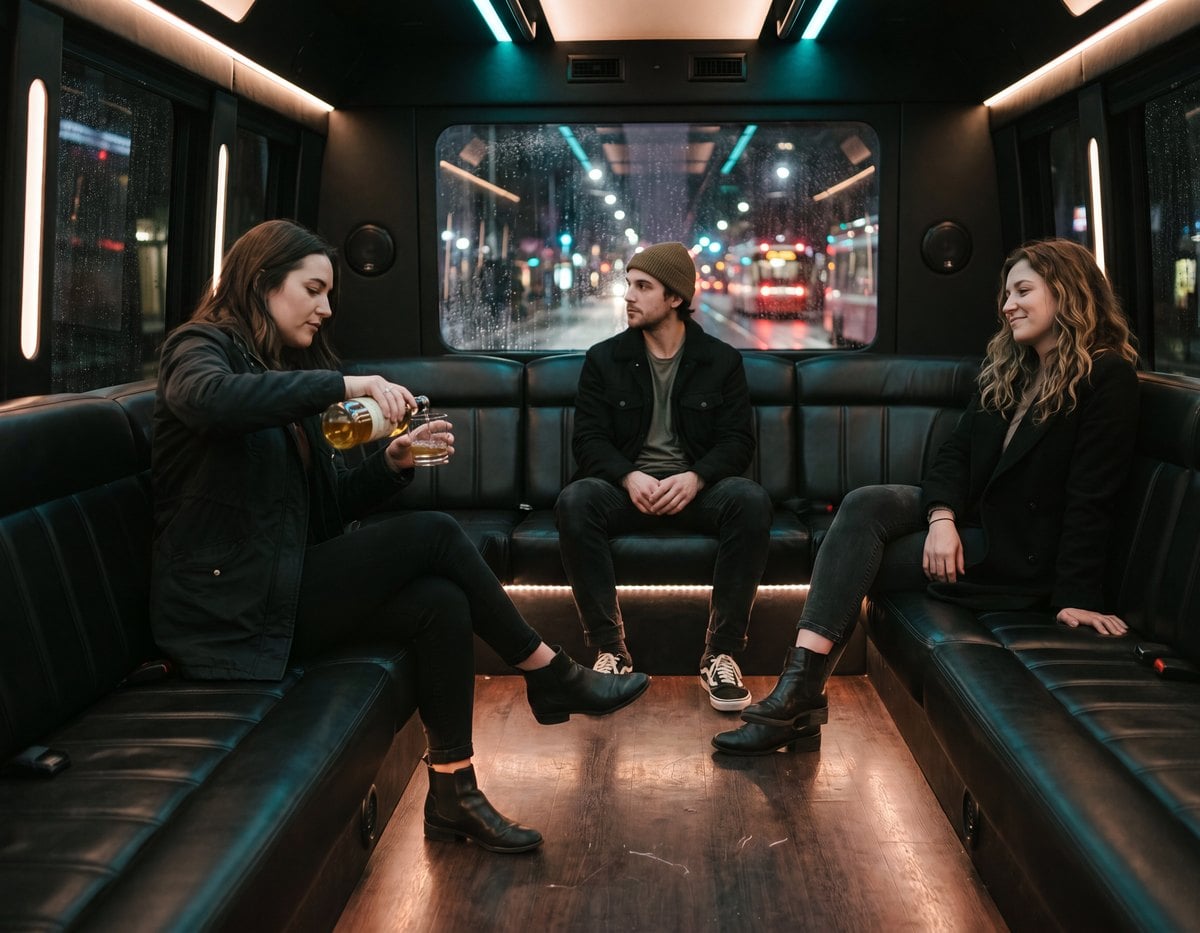
For a group of 25 on a Friday night out, a party bus at $1,000 for four hours often costs less than the rideshare and parking it replaces, and it keeps everyone together. Rideshare looks cheap right up until you count both directions, surge pricing, and the number of cars 25 people actually need.
Twenty-five people will not fit in two cars. You are looking at four to six UberXL trips each way, and Friday-night surge in downtown Toronto can double the meter after 11 PM. Stack the return trips at 2 AM, when surge is at its worst, and the rideshare total climbs past $900 fast while the group scatters across six vehicles and three different arrival times. Three stretch limos for the same crowd run $1,800 or more for the evening and still split everyone into separate cars.
| Option for 25 people, 4 hours | Rough cost | Group stays together |
|---|---|---|
| 35-passenger VIP party bus | $1,000 base | Yes, all 25 on one vehicle |
| 4 to 6 UberXL each way, with surge | $700 to $1,000+ | No, split across 6 cars |
| 3 stretch limos for the night | $1,800+ | No, split across 3 cars |
Rideshare and limo figures are typical GTA ranges for a peak Friday night, not Chauffeuropolis rates. Surge and availability vary.
The party bus holds the group in one place for the whole night, with no surge, no parking hunt, and no designated driver sitting the party out. On a per-person basis it lands around $44 all-in, and nobody is refreshing an app at last call. Ready to lock it in? Here is how to rent a party bus in Toronto step by step, or go straight to the party bus rental in Toronto page to check your date.
Seasonal and peak-date pricing
The hourly rate stays $200 to $300 year round, but availability and deposit terms tighten on the busy dates. Peak periods do not rewrite the per-hour number on the rate card; what they change is how early you need to book and how firm the deposit is once you do.
The dates that move first are prom season across May and June, New Year’s Eve, Halloween weekend, Canada Day weekend, and the December holiday run. On those nights the fleet fills weeks ahead, so the real cost of waiting is not a surcharge, it is missing out on the vehicle you wanted and settling for whatever is left. Far-out and peak bookings also carry a non-refundable deposit to hold the date, which is the trade for locking a high-demand slot months in advance.
Off-peak is the value window. A weeknight in February or a Sunday outside the holiday season is the easiest time to get the vehicle you want at the standard hourly rate with the most flexible terms. If your date is movable and the budget matters more than the calendar, steering toward a weeknight or an off-season weekend is the single cleanest way to keep the booking simple and the deposit terms friendly.
One planning note that saves money: the GTA party calendar runs on the same peaks as weddings and proms, so the vehicle you eye for a June Saturday is the same one a dozen wedding parties want that weekend. If your booking is a wedding party bus, that overlap is worth planning around. Book early for peak dates and book whenever you like for off-peak ones.
Deposit and cancellation costs
A deposit is required to lock in your date, and on standard GTA bookings the rest is due close to the trip. The deposit is the mechanism that holds your vehicle off the calendar so it is not sold to another group, which is why peak and out-of-town dates ask for a non-refundable deposit while ordinary dates are more flexible.
The cancellation terms decide whether a change of plans costs you anything. Cancel 14 or more days out, or within 48 hours of booking, and you get a full refund or a free reschedule. Cancel 7 to 14 days out and an administrative fee applies. Cancel inside 7 days and the booking moves to a reschedule rather than a refund. Far-out and peak-date bookings, such as New Year’s Eve or a prom weekend, sit on a non-refundable deposit from the start because the date is held exclusively for you.
The cost lesson here is simple. Book the date you are confident about, and if there is any real chance of a change, give yourself the 14-day window so a cancellation costs nothing. The further ahead and the higher the demand, the more the deposit is treated as committed money, so a peak Saturday is not the booking to make on a maybe. The full terms live on the cancellation policy page.
A full sample quote, line by line
Numbers in a table are one thing; a real quote is another. Here is what a typical Saturday-night booking looks like once every line is on the page, so there are no surprises when the total appears.
Say a group of 28 books the 35-passenger VIP party bus for a five-hour night out: dinner downtown, two bars, and a drop-home across the GTA. The base fare is $250 times 5, or $1,250. Ontario HST at 13% adds $162.50. A 15% gratuity on the base is $187.50. No 407 toll on this route and no child seat. The all-in lands at $1,600, which works out to about $57 per person across 28 riders.
| Line item | Amount |
|---|---|
| 35-pax VIP bus, 5 hours at $250 | $1,250 |
| Ontario HST, 13% | $162.50 |
| Gratuity, 15% of base | $187.50 |
| Tolls and child seat | $0 |
| All-in total | $1,600 |
| Per person, 28 riders | ~$57 |
Swap the vehicle for the 17-passenger regular van and the same five hours start at $200 times 5, or $1,000 base. HST is $130, a 15% gratuity is $150, and the all-in is $1,280, or about $75 each across 17 riders. The bigger bus costs more in total but less per head once it is full, which is the per-person math from earlier playing out in a real quote. To get your own version of this with your exact date, vehicle, and route, request a fixed quote and you get every line spelled out within the hour.
Frequently asked questions
Every cost question, answered with the real number first.
How much does a party bus cost in Toronto?
A party bus costs $200 to $300 per hour in Toronto, with a 4-hour minimum on every booking. That works out to a floor of $800 for the 17-passenger regular van and $1,000 for the 35-passenger VIP bus, before 13% HST and gratuity. Driver, fuel, and insurance are included in the rate.
How much does a party bus cost per hour?
A party bus costs $200 to $300 per hour. The 17-passenger regular van is $200 per hour. The 16-passenger LUX van is $300 per hour and the 35-passenger VIP bus is $250 per hour. Every rate covers the chauffeur, fuel, and insurance, with a 4-hour GTA minimum.
How much does a party bus cost for 6 hours?
Six hours costs $1,500 on the 35-passenger VIP bus at $250 per hour, $1,800 on the 16-passenger LUX van at $300 per hour, and $1,200 on the 17-passenger regular van at $200 per hour. Add 13% HST and a 15% to 18% gratuity for the all-in total.
How much is a party bus for a full 8-hour day?
Eight hours costs $2,000 on the 35-passenger VIP bus at $250 per hour, $2,400 on the 16-passenger LUX van at $300 per hour, and $1,600 on the 17-passenger regular van at $200 per hour, all before HST and gratuity. The hourly rate does not drop on longer bookings; you simply pay the same rate for each hour.
Is the driver included in the party bus cost?
Yes, the driver is always included. The professional chauffeur, the fuel, and the commercial insurance are all part of the hourly rate. The only additions are 13% HST and a gratuity, which is customary at 15% to 18% of the base fare.
Are HST and gratuity extra on a party bus?
Yes, HST and gratuity are both added on top of the base rate. Ontario HST is 13%, so $156 on a $1,200 booking. Gratuity is customary at 15% to 18% of the base fare, roughly $180 to $216 on that same booking, and it is at your discretion.
What is the 4-hour minimum on a party bus?
The 4-hour minimum means every GTA booking is priced for at least 4 hours. On the 35-passenger bus that is $1,000, and on the 17-passenger regular van it is $800, both before tax. You can book more hours at the same hourly rate, never fewer.
How much is a party bus per person?
A party bus costs about $29 per person before tax when you fill the 35-passenger VIP bus on a 4-hour booking. The $1,000 base splits across 35 guests at roughly $29 each, or near $37 all-in with HST and gratuity. Fewer riders means a higher per-head cost, because you rent the whole vehicle, not the seats.
Is a party bus cheaper than multiple Ubers?
For a group of 25 on a peak Friday night, a party bus at $1,000 for 4 hours often beats four to six UberXL trips each way once surge pricing hits. Rideshare also splits the group across many cars, while the bus keeps all 25 together for the full window.
Do you need a deposit for a party bus?
A deposit is required to lock in your date, and it is non-refundable on far-out or peak bookings such as New Year’s Eve or prom weekends. Standard GTA dates follow the cancellation policy, where 14 or more days notice means a full refund or reschedule.
What is the overage rate on a party bus?
The overage rate matches the hourly rate, so $250 per hour on the 35-passenger bus and $200 per hour on the 17-passenger regular van. If your night runs long, extra time is billed at the same per-hour rate as the rest of the booking, plus HST.
Does a party bus cost more on weekends or peak dates?
The hourly rate stays $200 to $300 year round, including weekends. What changes on peak dates like prom season, New Year’s Eve, and holiday weekends is availability and the deposit, which becomes non-refundable to hold a high-demand slot. Off-peak weeknights are the easiest dates to book at standard terms.
What is the cancellation cost on a party bus?
Cancelling 14 or more days out, or within 48 hours of booking, costs nothing and gets a full refund or reschedule. Cancelling 7 to 14 days out carries an administrative fee, and inside 7 days the booking moves to a reschedule rather than a refund. Peak and far-out dates sit on a non-refundable deposit.
Fixed quote within the hour. Driver, fuel, and insurance on every rate. Or call (905) 633-5804 for 24/7 dispatch.