

Employee shuttles in Scarborough: the shift starts on time.
Contract and scheduled staff shuttle service across Scarborough: Golden Mile and Tapscott-Steeles industrial shifts, Scarborough Town Centre office campuses, and GO-station last-mile runs, with one coordinator and one invoice.
Scarborough runs on shift work spread across Golden Mile, the Tapscott-Steeles industrial belt, Milliken, and the Scarborough Town Centre office cluster, and most of it sits well past a comfortable walk from the RT or a GO platform. This page is the daily and contract staff shuttle program: scheduled routes, named riders, one invoice. For a single event bus or a one-off charter, the sibling page for that is linked below; this page is for the commute that repeats every working day.
How an Employee Shuttle Service Works in Scarborough
A staff shuttle is a scheduled vehicle on a fixed route with a named rider list: the same pickup points, the same times, every working day. The company sponsors it, employees ride free, and the no-show problem stops being HR’s problem. No parking hunt. No missed shift.
Building one starts with a single planning call: where the workforce lives, where the RT and bus network stop reaching, and what the shift board looks like at the plant or office. From there, a route with 2 to 5 pickup points and a door-to-door time riders can set a watch by. This is a distinct program from a one-off charter bus rental for a single event; this page is the daily commute, not the weekend trip.
The route survey does the unglamorous work: a postal-code map of the real workforce laid over the transit grid and the shift board. It usually finds 2 or 3 pickup clusters nobody had mapped, and it kills at least one assumed stop that would have run empty. An hour of survey saves a year of half-full runs.
Most facilities underestimate how far their workforce actually travels until the postal codes are mapped. A Golden Mile distribution centre commonly draws staff from as far as Pickering and Ajax on one shift and from walking distance on another, and a single flat pickup point serves neither well. The survey is what turns “our workers commute from all over” into 3 or 4 concrete stops with real headcounts attached, which is the only version of that sentence a route can actually be built from.
Golden Mile and Tapscott-Steeles Shift Shuttles
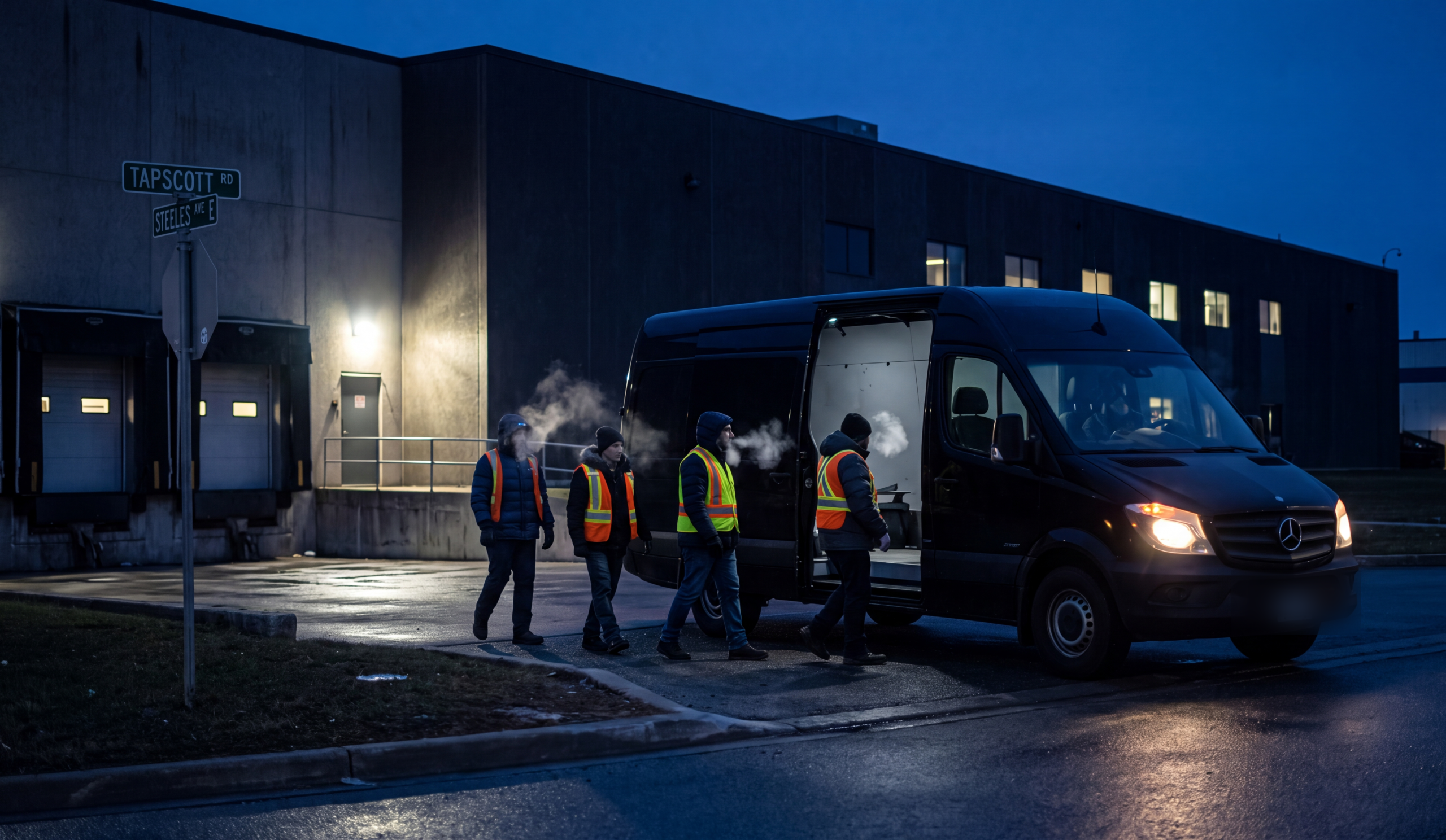
The hardest commute in Scarborough is the 5:45 a.m. wave along Golden Mile and the Tapscott-Steeles industrial belt, where the workforce is large, transit is thin before sunrise, and a missed connection means a missed shift.
Shift shuttles run to the clock the plant actually keeps: pre-dawn inbound waves, mid-day crossovers, and late-out returns, with the vehicle waiting at shift change instead of the workforce waiting on it. Operations managers run it as a retention line, because the plants that solve the commute keep the workers the plant across the street keeps losing to a shorter drive.
The math is blunt: replacing one warehouse worker costs weeks of recruiting, onboarding, and lost throughput, and the commute nobody solved is consistently the top reason cited for leaving shift work. A shuttle that saves 4 or 5 of those departures a year pays for itself before anyone counts the recruiting ads it made unnecessary or the overtime paid to cover the empty line on the floor.

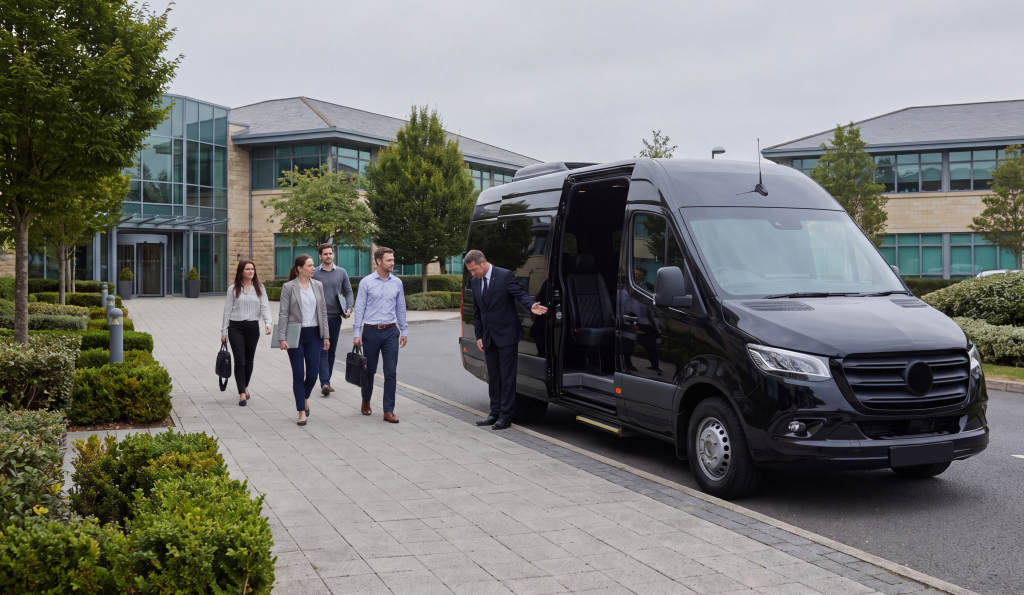
Office and Campus Shuttles: Scarborough Town Centre and UofT Scarborough
Office-side, the problem inverts: the talent lives near the subway and the office campus does not, so Scarborough Town Centre employers and UofT Scarborough departments run shuttles as a recruiting feature, not a cost.
The standard shapes: a GO-station connector timed to the trains, a lunchtime loop into the Town Centre, and an event shuttle for the days a whole department moves. Vehicles scale with the program, from the 14-passenger Sprinter to the mini coach tier, sized to the actual wave, and the same account covers ad-hoc executive and offsite runs alongside the daily staff program.
Recruiters feel the difference first: an office 4 kilometres from the nearest RT stop either pays downtown wages to candidates who drive, or it runs a connector and interviews the whole east-end corridor. Facilities teams feel it second, when the overflow parking problem stops growing.
Scarborough Town Centre sits at the meeting point of the RT extension, the Scarborough GO line, and 3 major bus terminals, which sounds like abundant transit until the shift board is checked against it: RT and GO service both taper hard after 7 p.m. and on weekends, exactly when retail, hospitality, and after-hours office shifts change over. A connector timed to the actual schedule, not the transit map, is what closes that gap for departments running evenings or Saturdays.


Last-Mile Shuttles from Agincourt and Milliken GO
Most Scarborough commutes fail in the final stretch: the GO train gets an employee within a few kilometres of the plant or office, and then nothing does.
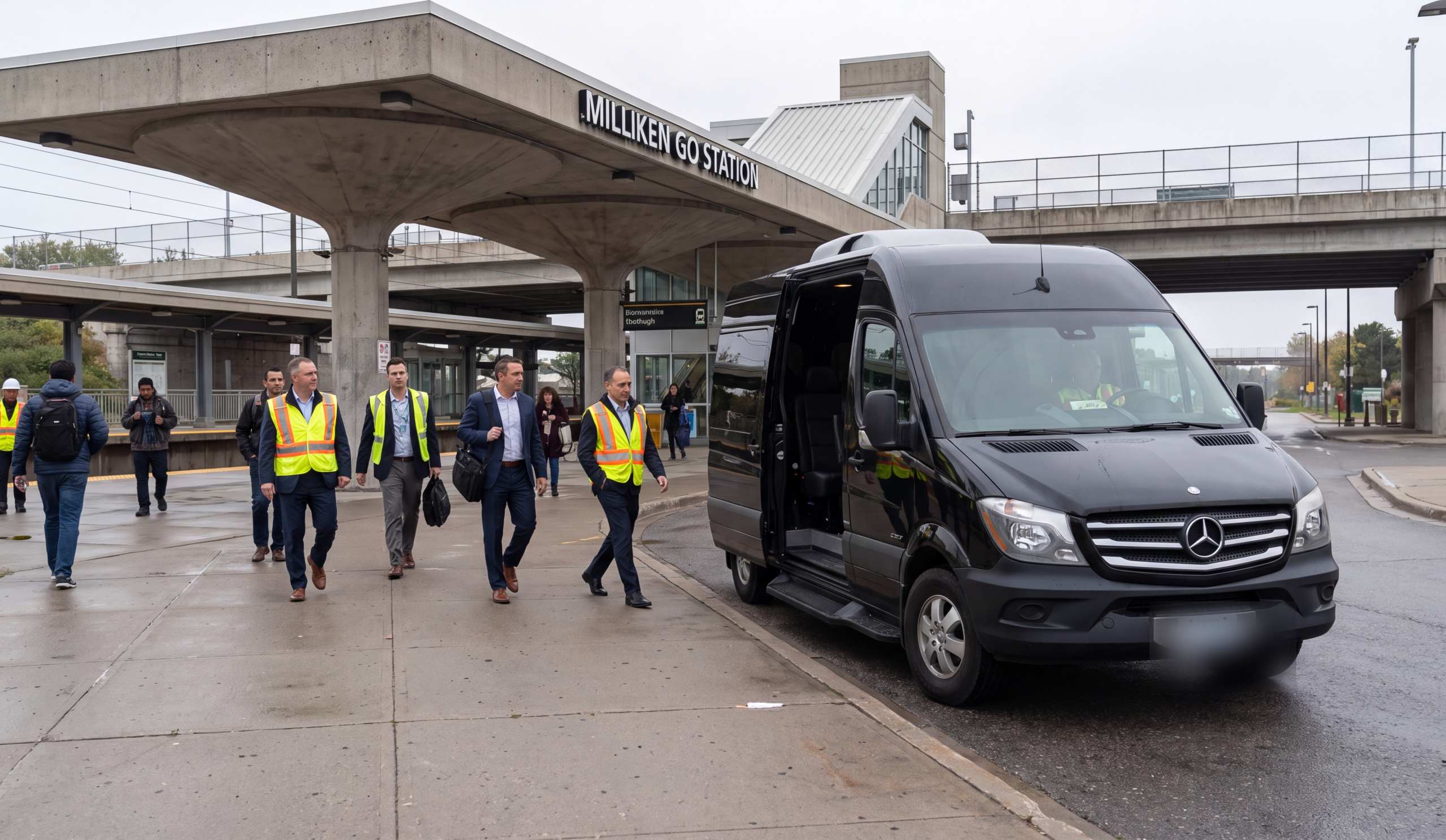
A last-mile shuttle meets the trains at Agincourt or Milliken GO on a published cadence and closes the final leg in minutes. It is the cheapest program shape because the route is short and the schedule piggybacks on transit times, and it plugs directly into the GO-station-to-work-site model already running for other employers. For a workforce recruited across the GTA, it is often the difference between accepting the role and declining the commute.
The mechanics are simple because GO publishes its side: the connector meets the 7:20 and 7:50 arrivals at the station lay-by, waits a buffered 6 minutes for late trains, and runs the final leg in under 12. Riders learn the pattern within a week and stop thinking about it, which is the entire measure of success.
Milliken and Agincourt sit on the Stouffville line, which runs a lean off-peak schedule compared to the Lakeshore corridors, so a plant relying on midday or evening GO arrivals cannot assume a train every 15 minutes the way a downtown commuter might. The connector schedule is built against the real Stouffville timetable, not a generic GO cadence, which is the detail that keeps a last-mile program from stranding a night-shift worker on an empty platform.
Where Scarborough Employee Shuttles Run
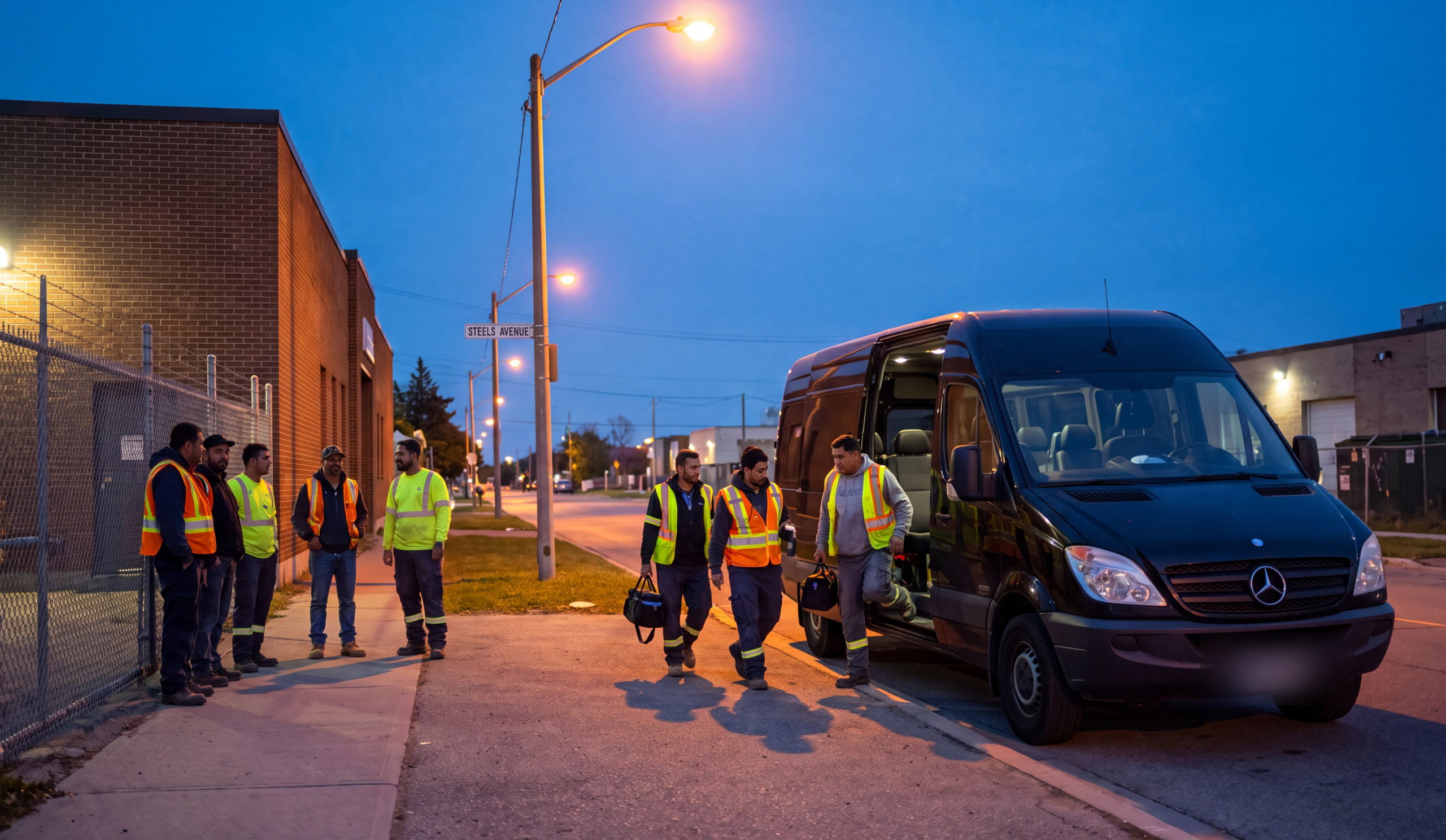
Coverage follows the work: Golden Mile, Milliken, the Tapscott-Steeles industrial belt, Agincourt, Scarborough Town Centre, and the UofT Scarborough campus corridor, with rider pickups reaching across Scarborough and into neighbouring cities.
Cross-border routes are normal: Markham and Pickering riders working Scarborough plants, and the reverse, with a sibling program already running under Employee Shuttle Service Toronto and in Mississauga. One program can hold routes across two cities; the invoice does not care about municipal lines. A Golden Mile plant pulling shift workers from Ajax and a Milliken office pulling admin staff from Richmond Hill can both run under the same Scarborough-anchored account without either route knowing the other exists operationally.
Each zone has its own personality: Golden Mile is manufacturing and distribution with staggered starts, Tapscott-Steeles is classic three-shift industrial, Agincourt and Milliken are GO-timed commuter zones, and the Town Centre corridor is office campuses with train-shaped mornings. The route that works in one zone embarrasses itself in another, which is exactly why programs are built zone-first.
A program is never locked to one zone at signing. A facility that opens a second line in Milliken six months into a Golden Mile contract adds a route, not a new vendor relationship, and the invoice absorbs it as one more line rather than a second procurement cycle. That flexibility is the actual argument for a contract program over ad-hoc booking: the commute problem rarely stays the shape it was on day one.

Contract Shuttle Programs and What They Cost in Scarborough
There is no flat price list for contract shuttles, and that is deliberate: every program is tailored on a planning call, because vehicle size, runs per day, and contract length change the number completely.
As a working anchor, a 14-passenger Sprinter program typically lands between $500 and $800 per day, with longer contracts earning the lower end, plus HST 13% and gratuity of 15 to 20 percent. One facility needs 2 runs a day, another needs 4, a third needs 5 across two buildings, and a month-to-month arrangement carries a different number than a year. A table cannot price that honestly, so we do not publish one.
What is fixed: the tailored quote comes back within 2 business days of the planning call, a pilot month is available so the route proves itself before anyone signs a year, and the program runs on one monthly invoice, NET 30, with one coordinator handling every change. The rate card covers one-off hourly runs; contracts get the conversation instead of a menu.
The 2-run-a-day facility and the 5-run-a-day facility are not priced on the same curve, and neither is the single-building program versus the 2-building program sharing a route. Longer commitments earn the lower end of the $500 to $800 range because the vehicle and driver amortize across more shifts per contract month; a 3-month pilot commitment prices differently than a 12-month renewal, and that difference is disclosed on the quote, not buried in it.
How to Start a Scarborough Employee Shuttle
Send 4 things: the facility address, the shift times, roughly where the workforce lives, and the headcount per shift. A route proposal and fixed monthly quote come back within 2 business days, usually with 2 route options at different vehicle sizes to compare side by side.
Pilots run a month on the proposed route with ridership counted at every boarding, and the route adjusts before the contract locks. Ad-hoc needs (a plant shutdown day, a training-centre week, an offsite) book as one-off runs at the hourly tiers within the same account, or through charter bus rental Scarborough for a single event.
Facilities coming from a third-party-managed shuttle or a patchwork of rideshare stipends usually send one extra thing: last quarter’s ridership or reimbursement data. It is not required, but it shortens the survey, because the pickup clusters a facility has been informally solving for years are often the same 3 or 4 the route ends up formalizing.
What the first month usually teaches: one stop is in the wrong plaza, the 6 a.m. wave needs 10 more minutes of buffer, and ridership on the late wave is double the estimate because word spread. All three fixes cost an email. The program that survives its pilot intact was surveyed well; the program that adjusted was managed well.
“Friendly, excellent service, thank you”
“We received transportation to and from the airport (party of 6). Punctual, professional, polite, respectful, efficient and friendly staff. Reasonable price for service provided. Great communication from staff. Clean, comfortable, high end vehicles. Water provided to customers. Safe drivers. Drivers assisted with customers getting in/out of vehicles as required and managed the loading/unloading of bags/suitcases. Highly recommended. Will call upon them for transportation in the future.”
“We booked a car service for a special evening out, and were not disappointed. The driver was professional and punctual. The car was comfortable. A great enhancement to our evening!”
Scarborough Employee Shuttle FAQ
The questions operations and HR managers actually ask before starting a staff shuttle in Scarborough, answered with published tiers.
How much does an employee shuttle service cost in Scarborough?
There is no one-size price, on purpose: every program is tailored, and a 14-passenger Sprinter program typically lands between $500 and $800 per day depending on runs per day and contract length, plus HST 13% and gratuity of 15 to 20 percent. Longer commitments earn the lower end of that range. The tailored quote comes back within 2 business days of the planning call.
What is a staff shuttle?
A scheduled vehicle on a fixed route with a named rider list: 2 to 5 pickup points, the same times every working day, sponsored by the employer and free for the employees who ride it. It exists to close the gap between where a Scarborough workforce lives and where the RT or GO line stops reaching. Boarding runs on a name check, and the coordinator sees a live manifest.
How is this different from a charter bus rental?
A charter is 1 booking for 1 event: a company picnic, a conference day, a single group trip, booked through our charter bus rental Scarborough page. An employee shuttle is the opposite: the same route, the same riders, every working day, on a monthly contract. Both run from the same fleet and account if a facility needs both.
Can a shuttle cover a 5:45 a.m. warehouse shift?
Yes, pre-dawn waves are the core of the Golden Mile and Tapscott-Steeles workload: 5:30 to 6:30 a.m. inbound runs, exactly when transit coverage is thinnest. The vehicle stages ahead of the wave, not behind it. Late-out and overnight-shift returns run the same discipline in reverse.
How many employees fit per shuttle?
14 in the Sprinter, 27 in the mini coach, 35 in the limousine bus, and 56 in the full coach, and programs mix sizes across waves so a facility never pays for empty seats. The route survey sizes the vehicle to real ridership. Growing headcounts step up a tier without rebuilding the program.
Do you run last-mile shuttles from Agincourt or Milliken GO?
Yes, and it is the cheapest program shape, often 2 short runs an hour: GO-timed connectors meet the trains at Agincourt or Milliken and close the final kilometres to the plant or office in minutes. The schedule piggybacks on the train times, the same model running under our GO-station-to-work-site program.
What areas of Scarborough do you cover?
All of them, with the work concentrated in 5 zones: Golden Mile, Milliken, the Tapscott-Steeles industrial belt, Agincourt, and the Scarborough Town Centre and UofT Scarborough corridor. Rider pickups reach across Scarborough and into Markham and Pickering. Cross-city routes run under one program and one invoice.
Can one program serve two facilities or cities?
Yes, 1 account can hold multiple routes: a Golden Mile plant and a Markham distribution centre, or a campus plus its overflow office. Sibling programs already run under Employee Shuttle Service Toronto and in Mississauga, and routes chain across borders where the workforce does. The invoice consolidates it all monthly.
Is there a minimum contract length?
No long lock-in to start: a 1-month pilot runs the proposed route with ridership counted at every boarding, and the contract only locks after the route proves itself. Ongoing programs run month to month or annually, priced the same. Ad-hoc single runs book at the hourly tiers anytime.
How fast can a shuttle program launch in Scarborough?
2 business days to a route proposal and quote after the planning call, and most pilots launch within 2 weeks of approval. Urgent gaps, a transit change, a plant move, a sudden hiring wave, can start with an interim hourly-tier run while the program spins up.
Who manages rider lists and changes?
1 coordinator on our side holds the manifest: adds, drops, shift swaps, and route tweaks all flow through them by email or text. HR sends changes; the manifest updates before the next run. Monthly reporting shows ridership per stop so the route earns its keep visibly.
Can employees track the shuttle?
Yes, riders get the published schedule plus 1 live driver contact through the coordinator, and pickup points are fixed enough that tracking is rarely needed: the vehicle is where it always is, when it always is. Weather delays push a group text.
What happens when a shift schedule changes?
The route follows: 1 notice from operations reshapes pickup times for the next working day, and seasonal shift patterns are built into the program from the survey. The vehicle serves the shift board, not the other way around, all year round. No change fees inside normal program flexing.
Do you provide shuttles for temporary needs like shutdowns or training weeks?
Yes, one-off and short-term runs use the published rate card: $175 per hour for the Sprinter, $250 to $325 for the coaches, plus HST and gratuity, unlike contracts, which are tailored. Plant shutdown days, training cohorts at a different site, and audit weeks are the usual shapes.
Is an employee shuttle worth it compared to parking or transit subsidies?
For facilities off the RT and GO grid it usually wins on 3 lines at once: recruiting reach, retention, and land, since a shuttle replaces rows of parking. The pilot month exists to prove the math with real ridership numbers. Bring the shift board and run the comparison.
Do you cover airport-corridor and flight-timed shifts near Scarborough?
Yes, employers near the eastern industrial corridors run flight-timed waves and airport-linked shifts through the same account as our Pearson group work, from $450 per leg for Sprinter airport runs or on program pricing for daily routes.
Can the shuttle carry tools or work gear?
Yes, the Sprinter’s rear bay and the coach underbody take 14 passengers’ worth of lunch coolers, tool bags, and PPE without crowding seats. Trades cohorts heading to a Golden Mile site ride with the gear below.
Are the vehicles insured and the drivers licensed?
Yes, 100 percent: every vehicle carries full commercial insurance and every driver holds the appropriate commercial licence, with the paperwork available to procurement on request. This is the boring part, and it is entirely handled.
How do invoicing and reporting work?
1 consolidated invoice per month on NET 30, HST itemized, with per-route ridership reporting alongside it. Procurement sees one vendor line; operations sees which stops earn their place. Ad-hoc runs on the account fold into the same invoice.
Can office and warehouse programs share vehicles?
Yes, and the good programs do: the 27-seat mini coach that runs the 5:45 a.m. plant wave can run the 8:40 campus connector after it, which is exactly how the per-month number stays lean. The route survey finds these pairings.
What is the smallest program you will run?
1 route, 1 wave, 14 seats: a single Sprinter meeting one shift or one train is a real program and prices accordingly. Plenty of contracts started as one stubborn commute problem.
How long is a typical shuttle route in Scarborough?
20 to 40 minutes end to end with 2 to 5 stops is the sweet spot: long enough to cover the catchment where the workforce lives, short enough that the first pickup does not resent the last. The route survey optimizes stop order against real addresses.
Do shuttles run weekends and holiday shifts?
Yes, the schedule follows the facility, not the calendar: 7-day operations, statutory-holiday skeleton crews, and seasonal weekend surges all run at the same program rates. If the plant runs Boxing Day, the shuttle runs Boxing Day.
What happens if a driver is sick or a vehicle breaks down?
Backup coverage is built into the program from day 1: a replacement driver or vehicle dispatches against the same route sheet, and the coordinator notifies riders by group text before most would notice. 1 missed shift wave defeats the entire point of a shuttle.
Can we brand or wrap the shuttle with our company logo?
No, 0 wraps or logos ever: the fleet runs unbranded gloss black, which keeps the service discreet at client-facing campuses and means your program never advertises staffing patterns to competitors on Kennedy Road. The professionalism is the branding.
Is gratuity included in the quote?
No, HST 13% and gratuity of 15 to 20 percent are added and itemized on every quote and invoice before approval. Program quotes state the full monthly number up front.
How is the monthly program price actually calculated?
3 inputs decide it: vehicle size, runs per day, and contract length, folded into one fixed monthly number with HST itemized; a single-Sprinter program anchors around $500 to $800 per day inside that math. No per-rider pricing, so ridership growth costs nothing until the vehicle size steps up.
The shift board is set. Now the commute is too.
Send the facility address, shift times, and headcount. A route proposal and fixed quote come back within 2 business days.