

CHAUFFEUROPOLIS / ONTARIO JOURNAL
Wild Kabin from Toronto: choose the cabin, then the ride
Toronto and Pearson departures to Wild Kabin, with the return planned around your stay.
What to budget for the transfer
Start with these approximate one-way budgets, then book online using your pickup, travel date and passenger details. If the vehicle or itinerary is not offered online, contact us for that arrangement.
| Vehicle | Passenger capacity | From YYZ, one way | From downtown Toronto, one way |
|---|---|---|---|
| Sedan | 2 to 3 passengers | Approx. $325 to $475 | Approx. $300 to $425 |
| SUV | Up to 6 passengers | Approx. $475 to $675 | Approx. $450 to $625 |
| Cadillac Escalade | Up to 6 passengers | Approx. $725 to $1,000 | Approx. $675 to $925 |
| Sprinter | Up to 14 passengers | Approx. $1,000 to $1,375 | Approx. $925 to $1,275 |
All amounts are CAD, plus 13% HST and 15% to 20% gratuity. Luggage, stops, waiting, tolls and vehicle selection can affect the total. Passenger capacity does not override property occupancy or access limits.
The YYZ ranges are planning estimates based on our published Muskoka rates and the approximate road-distance difference. Downtown Toronto ranges are estimates using Union Station as the reference pickup, not published flat fares. Allowance ranges are not a guarantee of the final price. See our current rates.
Google Maps puts the driving distance at approximately 210 km from YYZ and 190 km from Union Station to Minden as a reference for the cabin collection; other Wild Kabin properties have different routes. These are locality reference routes, not measurements to a private cottage entrance. Distances depend on the route selected; some routes use toll roads. Enter the exact address for your booking.
The table covers one outward journey. Add the return when booking if you need both directions; these amounts do not include a driver staying with you or local trips during your visit.
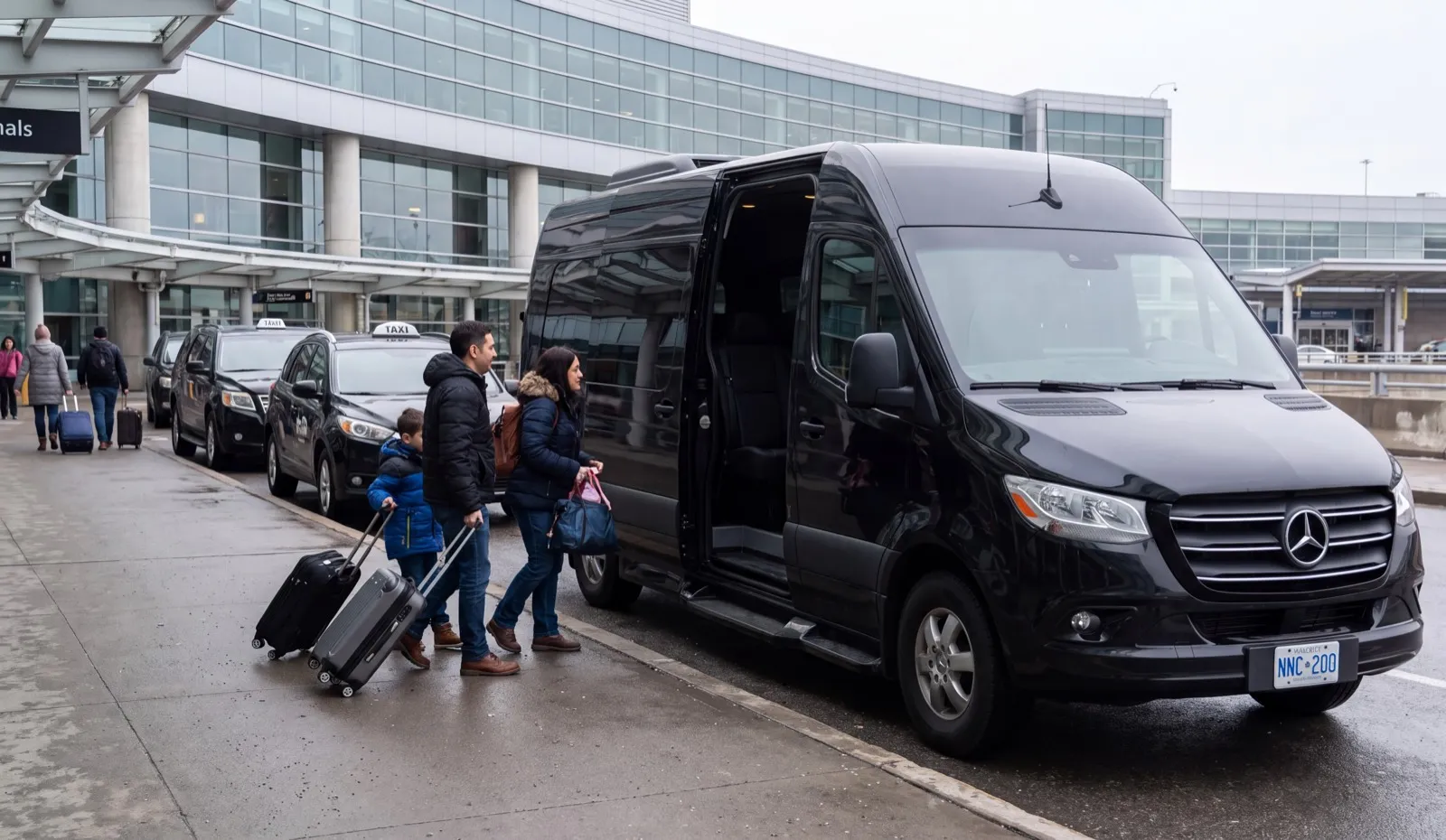
A Toronto or Toronto Pearson transfer to Wild Kabin starts with the name of the cottage you have booked. Wild Kabin Co. lists separate properties, not one resort entrance. Arrange the outward journey and the return around that property’s access instructions, confirmed guest list and luggage. Request an out-of-town, distance-based quotation for the actual itinerary. A vehicle recommendation cannot be settled from the brand name alone.
This matters particularly in winter. Kabin Tapoke and Skelwood Kabin publish specific four-wheel-drive and winter-tire requirements; Kabin Anora describes a different approach road and an inclined driveway. A vehicle with enough seats may still be unsuitable for the final approach. Resolve that question before guests commit to a shared departure.
The following is about Toronto-based intercity travel to a booked cottage and back, including YYZ arrivals and departures. It is not a local sightseeing shuttle programme. Cottage reservations and Chauffeuropolis transportation are separate bookings, with no property affiliation implied.
On this page
- Four properties, four different arrival conversations
- Choose a journey arrangement, not just a seat count
- Set a Toronto departure around the actual check-in
- Build a separate plan for guests arriving at Pearson
- Pack for a self-catered stay without overloading the vehicle
- Agree on the final approach before travel day
- Make checkout and the return pickup fit together
- If friends book more than one Wild Kabin property
- What a useful quotation request contains
- Questions about Toronto to Wild Kabin transfers
- Put the confirmed cottage on the transport request
Four properties, four different arrival conversations
The Wild Kabin website introduces Kabin Tapoke, Skelwood Kabin, Kabin Bjorn and Kabin Anora. Each has its own listing. Use that listing and the host’s booking confirmation together: the public description explains the stay, while the confirmation should settle the address, access instructions and arrangements for your dates. Do not give the driver a generic map result for “Wild Kabin.”
Kabin Tapoke: Moore Lake and a demanding winter approach
Kabin Tapoke’s official listing describes a four-bedroom, two-bathroom cottage in Minden Hills overlooking Moore Lake. It states accommodation for up to eight adults. The listing also asks guests to keep noise down, especially in the evening, because sound travels across the lake. This is a cottage stay to plan around the booked party, not an invitation to add a vehicle full of visitors.
The approach deserves attention before the luggage does. Tapoke describes an unassumed road with steep hills, says it is plowed in colder months and requires a 4×4 with winter tires for winter access. Plowing does not remove that requirement. Send the access wording to the transport provider and ask for a response about the actual proposed vehicle, not a general assurance that it travels to cottage country.
Tapoke also describes approximately 120 steps on the path to the waterfront. Those steps concern access within the property, not a published transfer drop-off point. For a guest with mobility needs, separate the questions: where can the vehicle unload, how is the cottage entered, and can the guest use the waterfront? An answer about one does not settle the others.
Skelwood Kabin: a strict guest count and a narrow private road
Skelwood’s listing describes a four-bedroom log cottage in Haliburton, with two full bathrooms and a half bathroom. More importantly for the organiser, it states a maximum of eight people including children and infants. A child is not an extra person to add after the accommodation count has been agreed. Keep the full guest list consistent across the cottage reservation and the transport request.
For winter, Skelwood requires a 4×4 with good winter tires and describes the private road as narrow and hilly. A larger passenger vehicle should not be chosen first with the road question left for the day of travel. Ask the provider to review the host’s directions, turning space and unloading arrangements before confirming the journey. A smaller suitable vehicle arrangement may be the only proposal worth pursuing.
The property asks guests to respect a quiet lakeside setting. That affects how the group arrives as well as how it spends the evening. Have bags labelled and the entry instructions ready so unloading does not become an extended gathering outside. The transport booking does not override the cottage’s occupancy or noise rules.
Kabin Bjorn: a river stay with a communications warning
Kabin Bjorn’s official page describes a log cabin on the Irondale River, with three bedrooms, two bathrooms and a maximum of six guests. It lists a kitchen, hot tub and sauna. Those are Bjorn facts, not a reason to assume the same layout or capacity at another Wild Kabin property.
The practical detail for a return transfer is the listing’s warning about cellular reception. It reports no Bell or Telus service and reports service for Rogers and Fido. It also describes Wi-Fi. These are the host’s published observations, not a guarantee that a particular phone will connect when the driver arrives. Save the confirmed pickup instructions before leaving Toronto and arrange a contact method that does not depend on a last-minute cellular call.
Bjorn’s river setting also changes what guests may pack. The listing describes kayaks and other equipment, but availability and personal suitability should be checked with the host. Do not load bulky recreational gear merely because the group assumes nothing is supplied. Equally, do not assume a supplied life jacket will fit every guest. Keep equipment questions with the accommodation booking and transport-space questions with the vehicle booking.
Kabin Anora: Gooderham, Contau Lake and a different approach
Kabin Anora’s listing places the A-frame cottage in Gooderham, Haliburton, overlooking Contau Lake. It describes four bedrooms and three and a half bathrooms, and says the space sleeps up to eight adults. That is a separate destination from Tapoke on Moore Lake and Bjorn on the Irondale River. Do not interchange the lake names in a passenger travel note.
Anora says it is just off a municipal road maintained year-round, but also notes an inclined driveway and recommends AWD or 4×4 with proper winter tires. This wording differs from the winter requirements at Tapoke and Skelwood. Preserve the distinction rather than publishing a single rule for the whole brand. It still does not establish that a van or bus can enter, turn and unload safely.
For a family travelling together, the useful planning sequence is to confirm Anora’s booked occupancy, share the driveway information, then settle vehicle and luggage fit. A photograph of a broad deck or a dining table is not evidence of parking capacity. The host and transport provider need to agree on the final handover for the vehicle proposed.
Choose a journey arrangement, not just a seat count
Cottage luggage is different from the bags people carry to dinner. A party may bring groceries, coolers, winter boots, children’s supplies and suitcases. Start the enquiry with that load, then compare suitable arrangements. The options below are discussion points, not promises of vehicle availability or access.
| Arrangement | People and luggage fit | Access question | Quote basis |
|---|---|---|---|
| Private car or SUV | Smaller party with a confirmed bag load; bulky coolers may change the fit | Does the specific vehicle satisfy the booked property’s seasonal requirements? | Dated out-of-town distance quote for each direction |
| Passenger van or Sprinter | Party sharing one departure, subject to the actual cabin and storage configuration | Can this vehicle use the approach, turn and unload at an approved point? | Full itinerary including agreed pickups and stops |
| Two smaller vehicles | Party whose equipment, access needs or flight times make one vehicle unsuitable | Confirm both drivers have the same property instructions and named passengers | Quote each movement, with the split made explicit |
| Separate outbound and return transfers | Multi-night stay with no need for a vehicle on standby | Fix the return pickup independently; do not assume the outward driver remains nearby | Two dated intercity movements in the written quotation |
| Larger vehicle for separately booked cottages | Only a proposal after each cottage’s occupancy and all travel arrangements are confirmed | No assumed common reception, shared grounds, bus turning area or final-mile connection | Bespoke multi-address itinerary, subject to access review |
A mini coach is not the default answer for a single cottage booking. These published properties have small accommodation counts, and the winter-access information raises questions a seat chart cannot answer. If a larger vehicle cannot reach the property, do not quietly substitute a roadside drop. Any different handover must be safe, lawful, accepted by the host and provider, and workable for every passenger and bag. If no workable arrangement exists, change the plan before booking.
Passengers also need to know whether a vehicle is being retained during the stay. A round-trip reservation can mean one outward transfer and another transfer on departure day. It does not automatically include errands, restaurant trips or an on-call driver. This article covers the Toronto corridor, not an assumed transport network between cottages.
Set a Toronto departure around the actual check-in
Choose one practical Toronto meeting point when the group can reasonably reach it. A single hotel or residential pickup keeps the first part of the day understandable, but the loading location still needs approval for the vehicle. Give the street address, entrance and a contact number. A building name alone can leave guests waiting at different doors.
Work backwards from the host-confirmed check-in arrangement. The public listings currently show a 4 p.m. check-in, but the accepted reservation should govern your travel date. Arriving early does not mean the cottage will be ready, and the group should not plan to leave luggage unattended. If an earlier arrival matters, obtain the host’s permission before making it a transport deadline.
Separate the guest meeting time from the vehicle departure time. The organiser needs room to check who is present, match bags to people and settle children before leaving. Guests should receive the departure instruction in one final message rather than trying to reconstruct it from a long group chat. Share only necessary passenger details, and send access codes privately to the people who need them.
Multiple Toronto collections are possible enquiry items, not invisible additions to a direct trip. Each address changes the route and loading sequence. Decide whether collecting everyone individually is worth the extra coordination, particularly when some passengers could comfortably meet at one agreed location. Have the provider quote the chosen plan rather than comparing a one-stop price with a multi-stop expectation.
Build a separate plan for guests arriving at Pearson
A YYZ arrival begins with a flight number and arrival date, not an assumed curbside time. Passengers must complete their airport formalities and collect their bags before they can leave. Send the provider the flight details, party size and luggage information, then follow the pickup instructions supplied with the booking. This article does not promise a particular terminal door, waiting allowance or flight-delay policy.
If several flights are involved, decide deliberately whether guests will wait for one another. A common arrival day is not necessarily a useful common departure window. Compare a shared transfer after everyone is ready with separate transfers for substantially different arrivals. The earliest guests should know which plan they have agreed to before they board their flights.
Keep the host informed if a delayed flight threatens the planned check-in. The transport provider can address the road movement; only the accommodation contact can confirm late entry arrangements. Have one travelling organiser able to coordinate both conversations. Do not make the driver responsible for obtaining a cottage access code while passengers wait with their luggage.
The same distinction applies to groceries. An airport transfer does not automatically include a shopping visit. If food collection is needed, put it into the proposed itinerary with a named stop and a realistic collection plan. A prepaid order collected by one person is a different request from the entire group browsing a store, and the quote should reflect the agreed version.
Pack for a self-catered stay without overloading the vehicle
Build a combined luggage list before choosing the vehicle. Ask each household for suitcase counts and note the shared items separately. Otherwise everyone may report one bag while forgetting the large cooler, folding stroller or crate of kitchen supplies. For rigid or oversized items, provide dimensions if requested. Empty seats do not automatically make loose cargo safe to carry.
Read the exact cottage’s current inventory before deciding what to bring. The listings describe equipped kitchens and a range of supplied items, but the details belong to individual properties. A host can confirm what will be present for your reservation. That may reduce unnecessary packing without making the group dependent on an amenity it has not checked.
Keep food transport practical. Decide who is bringing cold items, how they will be packed and who will unload them first. Bags containing medication or essential children’s supplies should remain accessible to their owners. Transport arrangements are not a substitute for safe food storage, and a luggage compartment should not be assumed to provide refrigeration.
Tell the provider about children, pets and mobility equipment before accepting a vehicle proposal. Ask for confirmation of any child-restraint arrangement and the space needed for equipment. A property’s pet-friendly description is not the vehicle provider’s pet policy. Likewise, a listing’s general accessibility label does not prove a step-free route from the unloading point to the bedroom your guest will use.
Agree on the final approach before travel day
The last part of a cottage journey can determine whether the whole booking works. Have the host describe the approach for the intended vehicle, including road width, grades, the unloading point and room to turn. Share those instructions with the transport provider. A listing that says “parking” does not establish bus access, overnight commercial parking or a safe reversing manoeuvre.
Winter review should happen before the vehicle is promised. At Tapoke and Skelwood, the published requirements are specific enough to rule out casual assumptions. At Anora, the maintained road does not remove the driveway incline. Ask when the approach is normally cleared and who can report conditions near the date, while recognising that the provider must make its own safety decision.
Avoid inventing a transfer point at a road junction, neighbour’s driveway or convenience store. An alternative needs permission and a practical onward plan. Guests with luggage should not discover on arrival that they are expected to walk an uncertain distance in winter conditions. A proposed connection is only useful when both legs, the handover location and the responsible contacts are confirmed.
Once the plan is accepted, save it somewhere the travelling organiser can access without mobile data. Include the cottage name, host-confirmed directions, provider contact and agreed arrival instructions. Bjorn’s reception warning makes this especially relevant, but downloading the information is sensible for any rural arrival. Keep the private address in the booking exchange rather than publishing it in a group invitation that may be forwarded widely.
Make checkout and the return pickup fit together
Book the return when arranging the outward journey. The published checkout times differ: Tapoke, Skelwood and Anora show 10 a.m., while Bjorn shows 11 a.m. Verify the terms on your own confirmation. Do not copy another Wild Kabin guest’s checkout time into the itinerary simply because the brand is the same.
Choose a pickup that allows guests to finish their host-required departure tasks and load without relying on late checkout. Decide where the group can wait if needed; do not assume continued indoor access after checkout. The host’s cleaning schedule and the provider’s arrival are separate commitments. A clear handover keeps neither side dependent on an unapproved extension.
For a Toronto return, name the actual destination addresses and their order. Dropping one person at Pearson and others downtown is a multi-stop itinerary, not simply “back to Toronto.” Recheck the returning passenger list as well. A guest leaving independently or joining only for the journey home changes the vehicle plan and the luggage count.
For a YYZ departure, work backwards from the airline’s required airport arrival time, allowing for loading, the road journey and an appropriate contingency. Give the provider the flight departure details and ask for a pickup recommendation for the exact property and date. Do not build the return from an optimistic driving time copied from a cottage advertisement.
A return contact plan matters as much as a pickup time. Confirm how the driver and organiser will communicate if mobile reception is poor, and agree on the process for reporting a delay. Do not depend on an unconfirmed local replacement vehicle. The purpose of booking ahead is to leave with a specific intercity arrangement, not to start searching for a ride at checkout.
If friends book more than one Wild Kabin property
Treat each cottage as a separate destination on the transport manifest. A shared brand does not make the properties a walkable complex, and booking several cottages does not create permission for everyone to gather at one of them. Ask each host-confirmed reservation to cover its actual guests. Keep any proposed gathering or visiting arrangement separate from the transport decision.
For the outward journey, assign every passenger and bag to a named property before requesting a multi-address route. Loading order may matter if people leave the vehicle at different stops. The last group should understand that its arrival follows the earlier handovers, and each cottage’s entry arrangements must still work with that sequence.
On departure day, a common pickup plan only works if the separate checkout commitments and onward deadlines fit. A guest with an early flight may need a different return arrangement from friends going to Toronto. Quote those real movements rather than describing the party as one group with one address. No journey between the cottages is included unless it has been expressly arranged.
What a useful quotation request contains
An out-of-town quote should describe the journey you intend to take. No numerical fare is given here because the property, origin, dates, stops and vehicle suitability remain booking-specific. Toronto hourly pricing should not be treated as a ready-made price for a cottage transfer. Ask for the full outward and return quotation and read its conditions before comparing proposals.
Send the cottage name and booking-confirmed address privately, with the relevant access instructions attached. Add the outward date, Toronto pickup address or YYZ flight, passenger count, children’s needs and bag inventory. For the return, include the date, destination and any flight deadline. Make shopping stops or multiple collections explicit rather than leaving them in a later message.
Ask what the total includes and what could change it: taxes, gratuity treatment, waiting, requested stops and itinerary changes should be clear in the accepted quotation. Cancellation and delay handling should also be recorded. This is a request for written terms, not a claim that any particular allowance or fee applies to your booking.
Before sharing the final guest note, check that the accommodation and transport confirmations agree on the basics. The property name, guest list and travel dates should match. The host should have accepted the stay; the provider should have accepted the route and vehicle arrangement. Paying for one booking does not confirm the other.
Questions about Toronto to Wild Kabin transfers
Is Wild Kabin one resort with a single pickup address?
No. Wild Kabin lists separate cottages including Tapoke, Skelwood, Bjorn and Anora. Use the name and private arrival instructions for the property actually booked. This article does not assign one address or one route mileage to the brand.
Can a Sprinter drive directly to every Wild Kabin cottage?
That is not established. The actual vehicle, season and property approach need review. Tapoke and Skelwood publish winter 4×4 and tire requirements; Anora describes an inclined driveway. Enough passenger seats do not prove suitable access.
Can eight guests stay at any of the cottages?
No. Bjorn’s listing states a maximum of six. Skelwood states eight people including children and infants, while Tapoke and Anora describe up to eight adults. Confirm the exact reservation’s permitted party with the host, including every child, before booking transport.
Can we combine a Pearson arrival with a Toronto pickup?
Request it as a multi-stop itinerary. The provider needs flight details, the Toronto collection address, passenger lists and luggage for both groups. Compare that plan with separate transfers if waiting for the flight would make the shared departure impractical.
Is a vehicle available during the cottage stay?
Not automatically. Two intercity transfers do not imply a vehicle remains at the cottage or provides local rides. Any retained service would need a separate, explicit agreement; do not base meals or excursions on unconfirmed transport.
What if phone reception is poor when we leave?
Agree on the return contact method before travelling and save the instructions offline. Bjorn specifically warns about carrier-dependent reception. Do not assume a last-minute phone call will reach the organiser at every property.
How should we arrange the return to Pearson?
Give the provider the booked cottage, departure date, flight details, passengers and bags. Set pickup against the airline’s airport-arrival requirement, with road and loading contingency, then check that the plan also fits the host-confirmed checkout.
Does the transfer booking include the cottage reservation?
No. Arrange the accommodation with Wild Kabin and obtain a separate written transportation confirmation. No affiliation or combined package is implied by this article.
Put the confirmed cottage on the transport request
Once the property and dates are settled, use the Chauffeuropolis booking page to request the Toronto or YYZ journey and its return. Include the access wording from the relevant Wild Kabin listing rather than asking for a generic cottage-country vehicle. For a separate enquiry, request a quote with the same itinerary details. The useful outcome is a confirmed route, appropriate vehicle and workable handover, not merely a reserved number of seats.