

Charter Bus Crossing the US Canada Border: Documents, Bridges and Timing for Groups
Documents, inspection, timing and bridge choice for a 14 to 56 passenger group moving between the United States and Ontario.
How Pricing Works for a Cross Border Trip
A cross border trip runs on a different clock than a local booking. It carries a ten hour minimum, and the total depends on how far into the United States you are going, how many days it runs, and whether the driver needs to stay overnight. The figures below are what applies per additional hour once you are past that ten hour minimum, not a flat rate for the trip. Rates and vehicle sizes for the Toronto end of the trip are on our charter bus rental in Toronto.
Regular Mercedes-Benz Sprinter
Up to 14 passengers · 10 hr min
$175 / hr after 10 hrs
+ overnight stay if needed
Executive Mercedes-Benz Sprinter
Up to 14 passengers · 10 hr min
$195 / hr after 10 hrs
+ overnight stay if needed
27-Seat Mini Coach
Up to 27 passengers · 10 hr min
$250 / hr after 10 hrs
+ overnight stay if needed
35-Seat Limousine Bus
Up to 35 passengers · 10 hr min
$250 / hr after 10 hrs
+ overnight stay if needed
56-Seat Coach Bus
Up to 56 passengers · 10 hr min
$300 / hr after 10 hrs
+ overnight stay if needed
Every cross border itinerary is quoted individually: ten hour minimum, the per-hour rate beyond that shown above, and driver accommodation added for any overnight or multi-day leg, which varies by where you are staying and cannot be fixed in advance. Send the manifest, origin and schedule and we return the full trip as a written quote before you travel, plus HST 13 percent and gratuity 15 to 20 percent.
What Documents Every Passenger Needs at a Land Crossing
The first rule for a group crossing from the United States into Ontario is to know which country sets the rules for which direction. The Canada Border Services Agency, or CBSA, controls the entry into Canada. US Customs and Border Protection, or CBP, controls the return into the United States. These are two separate governments with two separate document standards. Do not assume one set of paperwork covers both legs of the trip.
For the Canada-bound leg, CBSA recommends a valid passport for every passenger. That is the cleanest path. But the agency also accepts a birth certificate as proof of identity and citizenship for US citizens of any age. A Canadian citizen does not need a passport for a land crossing into Canada. That is the rule for the border itself. Air travel is different. If your group flies into or out of Canada, a passport is required for every passenger regardless of age. This page covers land crossings only, so keep the group on the coach and use the bridges or the tunnel.
The leg that trips up most groups is the return to the United States. CBP has its own rule for children under 16. A US or Canadian citizen child under 16 may present an original or a copy of a birth certificate instead of a passport when entering the United States by land or sea. There is a separate threshold for organized groups. If the group is travelling together under a school, religious, social, cultural organization, or a sports team, the birth certificate exception applies to anyone under 19. This is a US rule for entering the US. It is not a rule for entering Canada.
So a 17-year-old athlete on a team bus can show a birth certificate to CBP on the way home. That same 17-year-old should have a passport or a birth certificate ready for CBSA on the way into Ontario. The two governments do not share a single standard. The return leg is the one that gets forgotten, because planners focus on the crossing into Canada and assume the way back is the same. It is not.
Consent letters for minors are a separate matter. Canada does not legally require one. But a CBSA officer can ask for one, and not having it can cause delays or, in rare cases, a refusal. Carry a signed consent letter for any passenger under 18 who is not travelling with both legal parents. It is a precaution, not a legal requirement.
If any passenger has an admissibility question, such as a past impaired driving conviction, that is outside the document check. That situation must go to a licensed immigration professional. Do not rely on the group leader or the driver to make that call. The driver checks documents. The officer makes the decision. Groups weighing NEXUS against the standard lane can compare both in our overview of planning a group border crossing.
For a 56-seat coach, collect the documents before the vehicle reaches the bridge. Hand the officer a manifest with each passenger’s name, birth date, citizenship, and document type. Keep the actual documents in the passenger’s hand or in a labeled folder. The officer may ask to see a specific person. Do not hand over a pile of passports and birth certificates and expect the officer to sort through them. The smoother the document pass, the faster the inspection.
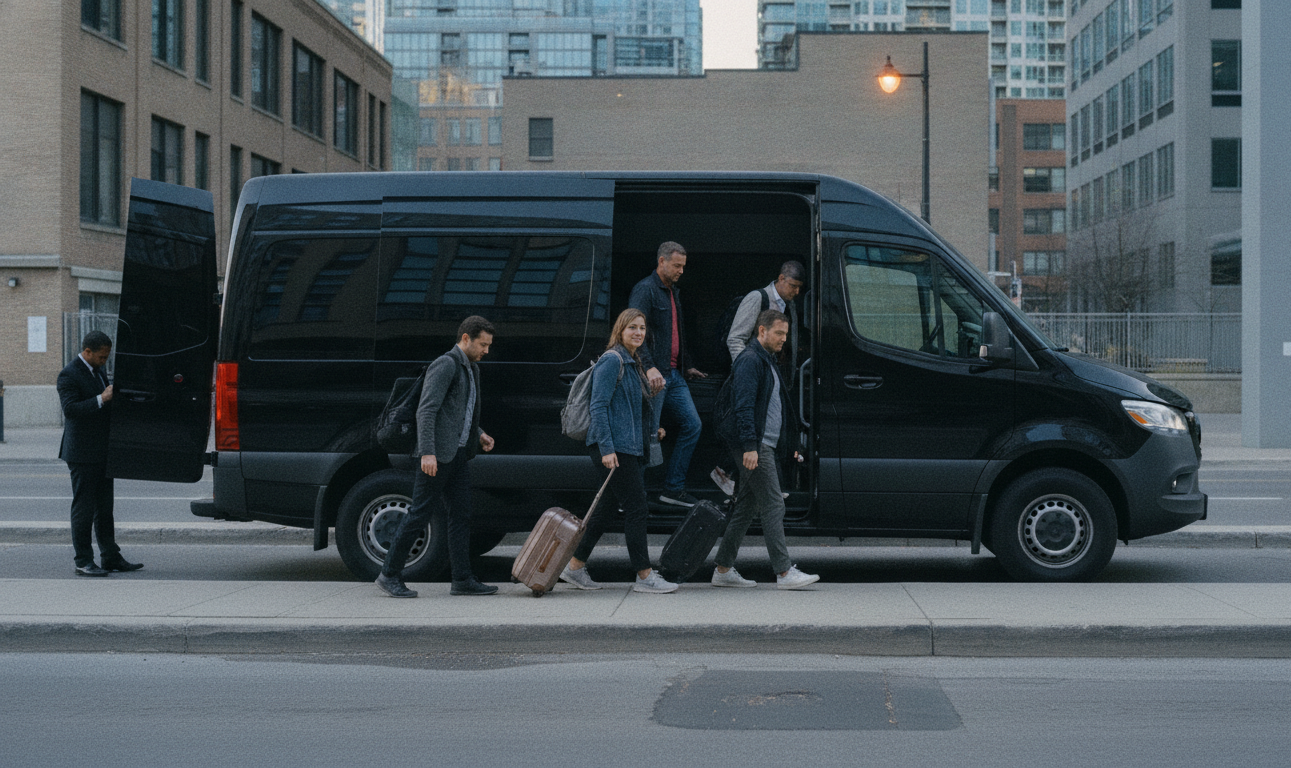
Check availability and book online, or request a written quote if you would rather we price it first.
What a CBSA Inspection of a Group Vehicle Actually Looks Like
The driver pulls up to the booth and hands over the manifest. That document lists every passenger by name, date of birth, and citizenship. The officer checks it against the group seated behind the driver. If the numbers match and the paperwork is clean, the process moves quickly.
Before the coach reaches the inspection plaza, name one trip leader as the group’s point of contact. That person should have the passenger manifest, trip purpose, destination and overnight address ready while each passenger keeps their own travel document accessible.
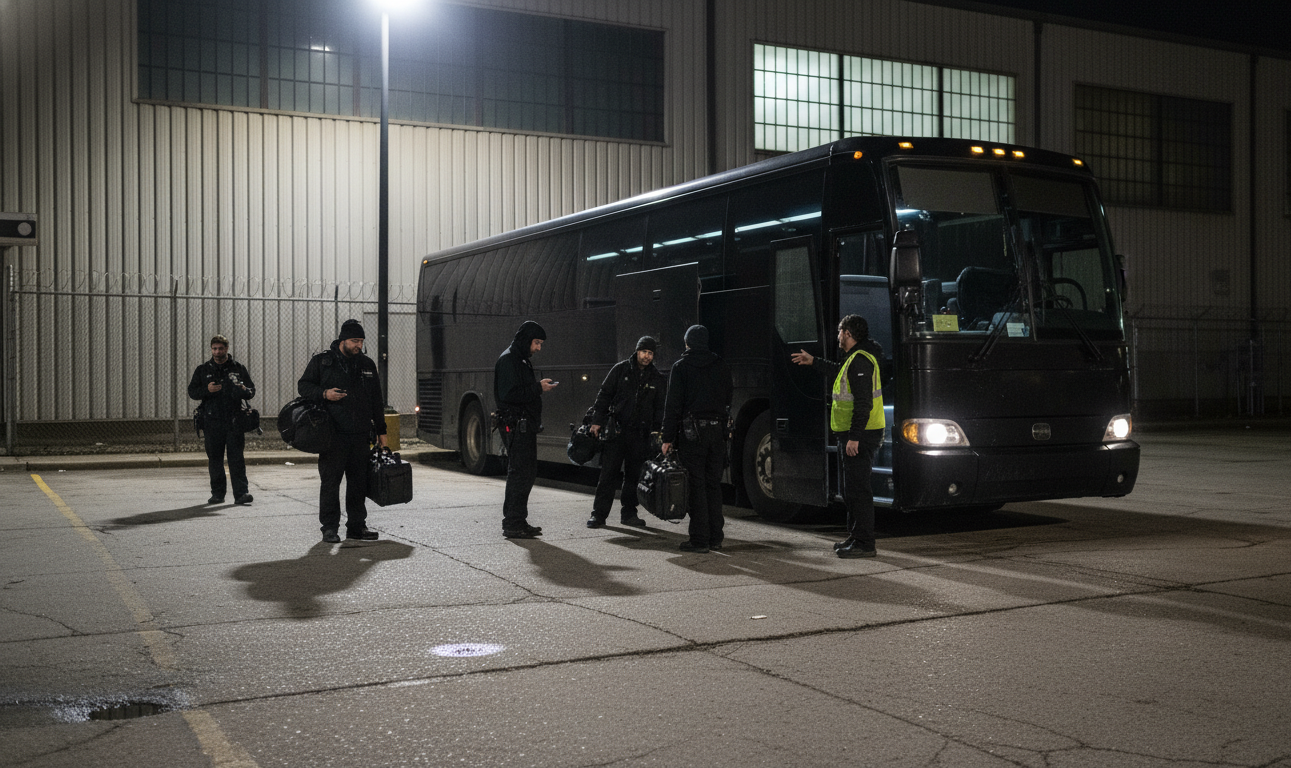
CBSA officers can board the vehicle. They walk the aisle, look at luggage racks, and ask a few questions. Sometimes they ask everyone to step off the bus and enter the inspection building. Passengers bring their bags inside. The vehicle stays in the lot while officers search it. This is routine. It is not a signal that something is wrong. Border crossings operate on a rhythm, and groups are part of that rhythm.
One passenger sets the pace for everyone. If a single person is slow to find their passport, or argues about getting off the bus, the whole group waits. If someone has a prohibited item in their bag, the search extends. Officers have seen every delay before. They are not surprised by any of it. But the group that moves together gets through faster.
A well-prepared group looks calm from the officer’s side. The driver has the manifest printed and ready. Every passenger carries their own document, not a pile of passports in one person’s hand. Birth certificates work for US citizens entering Canada by land, and CBSA accepts them for any age. Canadian citizens do not need a passport for land entry. But air travel in or out of Canada requires a passport for everyone, regardless of age.
For minors, Canada does not legally require a consent letter. Officers can still ask for one. A group with signed letters for every minor avoids the delay that comes when an officer asks and no letter exists. The letter is a precaution. It costs nothing to prepare and can prevent a long conversation at the booth.
If a passenger has a past DUI or any admissibility question, that is a matter for a licensed professional. Do not guess. Do not let the group assume. A border officer will make the final call, and no one should plan around an outcome that has not been confirmed.
Choose the crossing based on your vehicle. The Rainbow Bridge allows buses, including motorcoaches, but not trucks. Queenston-Lewiston allows trucks and has a dedicated NEXUS lane for Canada-bound travellers. NEXUS only works if every occupant of the vehicle holds a valid card. For a 27-seat mini coach or a 56-seat coach, that is rarely the case. The Detroit-Windsor Tunnel has a maximum vehicle height of 12 feet 8 inches. Motorcoach heights vary by model. Confirm your vehicle height before you commit to that route.
The inspection is a sequence, not a judgment. The driver presents the manifest. The officer decides whether to board, whether to search, and whether to send passengers inside. The group that is ready, quiet, and cooperative moves through. The group that is not, waits. That is the whole job.
How Much Time to Build Into a Cross Border Itinerary
Border wait times are published live by both CBSA and U.S. CBP. They swing with the day of week, the time of day, and holiday weekends. A group does not plan around a fixed number. It plans around a buffer. That buffer is the only reliable part of the schedule.
A coach processes slower than a car. The clock scales with the manifest. Every passenger presents a document, answers a question, and waits for the officer to review the entry. Twenty-seven passengers take longer than four. Fifty-six take longer still. The inspection is not one transaction. It is dozens, queued in sequence. A car with four people clears in minutes. A full coach can sit at the primary booth while the officer works through each name. That is the reality of crossing in a group vehicle.
Build the last rest stop before the bridge into the plan. Once the coach enters the inspection queue, there is no pulling over. No one steps off the bus. Passengers who need a washroom, a snack, or a moment to stretch will wait until the far side. A quick stop at the plaza on the U.S. side, before the approach, costs fifteen minutes. Skipping it costs more if a passenger is uncomfortable during a forty-five minute hold. The driver knows the route. The planner should know the stop.
A missed buffer does not just delay the crossing. It cascades. A dinner reservation at a downtown Toronto restaurant does not wait for a coach stuck at Queenston-Lewiston. A tee time at Glen Abbey starts without the group. A venue in Niagara-on-the-Lake locks its doors at the contracted hour. The late arrival is not a single missed moment. It is a chain of missed moments, each one paid for in advance. The group arrives frustrated. The venue staff reset tables. The caterer holds food. The schedule does not absorb the delay. It compounds it.
Check the live wait times the morning of departure. Check them again when the coach leaves the origin point. If the primary bridge shows a long queue, the dispatcher can reroute to an alternate crossing. Rainbow Bridge handles motorcoaches and commercial vehicles are not permitted there, so it moves differently than the truck-heavy Queenston-Lewiston span. The choice of bridge is a logistics decision, not a preference. The buffer is what makes that decision possible. Without it, the group is at the mercy of the queue. With it, the group holds the schedule.
Choosing a Bridge for a Group Vehicle
The first bridge decision for a US group heading into Ontario is usually the Niagara frontier. The Rainbow Bridge sits at the heart of Niagara Falls and is a practical choice for a passenger coach. It does not allow commercial vehicles or trucks, but it does allow buses, including full-size motorcoaches. That means a group vehicle avoids the truck traffic that builds up at other crossings. The Rainbow Bridge drops your group near the falls and the surrounding tourist district, which suits a day trip or an overnight stay.
The Queenston-Lewiston Bridge is a few minutes north and handles trucks as well as passenger vehicles. It has a dedicated NEXUS lane for Canada-bound travellers. That lane only helps if every occupant of the vehicle holds a valid NEXUS card. For a 27-seat mini coach or a 56-seat coach, that condition is almost never met. Plan for the regular lanes at Queenston-Lewiston, and expect it to carry more commercial traffic than Rainbow Bridge.
For groups coming from the Buffalo area, the Peace Bridge at Fort Erie is the main alternative. It connects the Queen Elizabeth Way directly to Buffalo and is a straightforward route for a coach. The plaza can get busy during peak travel windows, but it is a well-used crossing for passenger vehicles and buses. From downtown Buffalo to the Peace Bridge is roughly a ten minute drive, and once across, the QEW runs west toward St. Catharines, Hamilton, and Toronto. Visitors staying in Toronto for the weekend and driving up from New York follow the same route in reverse.
For a Michigan approach, the crossing options are the Detroit-Windsor Tunnel and the Ambassador Bridge. The Detroit-Windsor Tunnel has a maximum vehicle height of 12 feet 8 inches. Motorcoach heights vary by model, so the operator must confirm the exact height of the vehicle before committing to the tunnel. Do not assume the tunnel excludes most coaches. Some coaches fit within the limit, and some do not. The Ambassador Bridge has no comparable height restriction and is the more common route for larger buses. Both crossings put you into Windsor, with Highway 401 running east to London, Kitchener, and the Greater Toronto Area. A Detroit-to-Toronto touring itinerary that also stops at Niagara Falls follows this same corridor.
Timing at any of these crossings depends on the day and the hour. A Tuesday morning crossing at Rainbow Bridge moves faster than a Friday afternoon at the Peace Bridge. Build buffer time into the schedule. The group should have all documents ready before the vehicle reaches the booth. The driver should know the crossing choice ahead of time and the backup route if the primary bridge has a delay. The right bridge is the one that matches the vehicle height, the group size, and the destination. For a coach, Rainbow Bridge is a strong choice in Niagara. For a Michigan group, confirm the tunnel height first or default to the Ambassador Bridge.
Mixed Citizenship Manifests and Why They Slow a Group Down
A group crosses as fast as its least straightforward passenger. On a typical corporate or wedding manifest, that passenger is rarely the obvious one. You will have US citizens with passports. You will have Canadian citizens with driver’s licences. You will have permanent residents carrying a green card and a foreign passport. You will have visa holders whose entry status depends on paperwork issued months ago. Each of these people faces a different set of questions at the booth. The officer checks them one by one. The whole coach waits.
For a 56-seat coach, the difference between a smooth crossing and a long one is usually preparation. Collect document details from every passenger at booking, not at the kerb. Ask for citizenship status, passport country, and visa type. Ask for the document numbers and expiry dates. Store them in the manifest before the vehicle leaves Toronto. This is not about policing anyone. It is about knowing what the officer will see before the officer sees it.
US citizens entering Canada by land can use a birth certificate as proof of identity and citizenship. Canadian citizens never need a passport for land entry. But those rules do not cover everyone on your bus. A permanent resident of Canada who is a citizen of India, for example, needs a valid passport from India plus a Canadian permanent resident card. A US green card holder who is a citizen of the Philippines needs a Philippine passport and proof of US residency. A visa national from Brazil needs a valid Brazilian passport and a Canadian temporary resident visa, unless they hold a valid US visa and arrive under the electronic travel authorisation exemption. Each of these combinations is legal. Each also slows the line.
The practical fix is to flag complicated cases early. If a passenger has a past DUI, a criminal record, a prior refusal, or an expired visa, do not wait until the booth to find out. Route that person to a licensed immigration professional well before the trip. Do not guess. Do not assume the officer will be lenient. The officer has discretion, and the outcome depends on facts you cannot verify from a manifest. A licensed professional can review the file and advise on admissibility. That advice must come before the coach is parked at the inspection lot, not after.
Consent letters for minors are not legally required by Canada, but officers can ask for them. If a child under 19 travels with one parent or a non-parent, carry a signed letter. It costs nothing and can prevent a delay. Collect that letter with the same booking form you use for passports. The group moves faster when every document is in the folder before the wheels stop.
What Cannot Travel in the Cabin Across the Border
Open alcohol in the passenger cabin is the most common problem at a border crossing. A group celebrating a win, a wedding, or a milestone often has drinks in hand when the coach reaches the booth. That single detail changes a routine inspection into a lengthy one. In Ontario and New York, open containers in the passenger area of a motor vehicle are illegal. The rule applies to a 56-seat coach the same way it applies to a car. Every bottle, can, and cup must be sealed and stored in the luggage bays before the vehicle approaches the inspection plaza. Do not assume the driver will handle this. Assign one person to check the cabin before the crossing.
Cannabis cannot cross the border in either direction. Its legal status in Ontario or in a US state does not matter. A passenger carrying a personal amount from Toronto into New York is breaking federal law. The same applies to a group bringing product from the US into Ontario. CBSA and CBP treat cannabis as a controlled substance at the border. The consequence is not a fine and a warning. It can be a refusal of entry, a vehicle search, or a ban. Keep any cannabis out of the vehicle entirely, including edibles and oils.
Food, plants, and animal products have their own restrictions. Fresh fruit, meat, dairy, and cut flowers can be refused at either crossing. The rules change by season and by region, and they are not identical on both sides of the border. A box of sandwiches for the drive home might be fine. A bag of orchard apples from Niagara might not be. Check the current lists published by CBSA and CBP before departure. Do not rely on a page like this one or on what a driver remembers from last year.
Personal exemptions and duty allowances apply per traveller, not per vehicle. The officer calculates each passenger individually. The amounts change, and they depend on how long the group stayed in Canada or the US. Do not publish a dollar figure here because the current number will be wrong by the time you read this. Confirm the allowance on the official agency website for the direction you are crossing. The driver and the tour leader are not responsible for each passenger’s declaration, but a coach with 56 people who all under-declare will get extra attention. Tell your group to keep receipts and to be honest about what they bought.
When a Group Is Better Off With a Canadian Vehicle
A US coach can legally carry its own pre-booked group across the border and throughout Ontario. The law is not the obstacle. The question is whether one vehicle fits the shape of your trip. A 56-seat coach is the right tool for the long highway run from Buffalo to Toronto. It can be the wrong tool for everything else.
Consider the practical gaps. Your group checks into a downtown Toronto hotel on a Tuesday and does not board the coach again until Thursday morning. That coach sits idle in a hotel lot for two full days. You are paying for the vehicle and the driver whether they move or not. Meanwhile, your people need to get from the hotel to a dinner in Yorkville, to a reception at a winery in Niagara-on-the-Lake, or to an early morning flight at Pearson. The main coach cannot be in three places at once. A 14-passenger Sprinter and a 27-seat mini coach can cover those legs while the big bus stays parked.
There is also the split problem. A group of 40 rarely stays together for the whole visit. Some want the Distillery District. Others want the AGO. A single 56-seat coach forces everyone to move on the same schedule. Two smaller vehicles let the group divide naturally and still move on time. This is not about replacing the main coach. It is about having the right vehicle for each leg of the trip.
The rules on what a US coach can and cannot do in Ontario are specific, and they changed in July 2021 when the province ended its economic licensing system for charter bus routes. A visiting operator can bring its own group and carry that same group for the whole trip. It cannot pick up separate paying passengers for point-to-point trips inside Canada. The border crossing itself is straightforward: the Rainbow Bridge allows motorcoaches, and the Queenston-Lewiston Bridge allows trucks and offers a dedicated NEXUS lane for Canada-bound travellers. NEXUS only works if every single occupant of the vehicle holds a valid card, so it is rarely practical for a full coach.
We run 27-seat mini coaches, 35-seat limousine buses, 56-seat coaches, and 14-passenger Sprinters. If your group is better served by a mix of vehicles, we will say so. The full breakdown of what a US coach can do in Ontario, including cabotage rules and border documentation, lives on our dedicated page. That page covers the details. This page settles the practical question: one vehicle is often not enough.
Cross Border Group Questions, Answered
What is the minimum passport requirement for a 16-year-old on a school trip crossing from Ontario into the United States by road?
A US or Canadian citizen under 19 traveling with a school, religious, social, or sports team can enter the United States by land or sea with a birth certificate instead of a passport. This US CBP rule applies only to the US-bound leg. For all other minors under 16, a birth certificate is also accepted, but a passport is always the safest document.
Can a US citizen adult use a birth certificate to enter Canada by road in a 14-passenger Sprinter?
Yes, CBSA recommends a passport but accepts a birth certificate as proof of identity and citizenship for US citizens of any age when entering Canada by land. This applies to every passenger in your group, regardless of vehicle size. Air travel, however, always requires a passport.
Do we need a notarized consent letter for a minor crossing into Canada with only one parent?
Canada does not legally require a consent letter for a minor, but CBSA officials may ask for one. A signed letter from the non-traveling parent or guardian is recommended to avoid delays. It does not need to be notarized, but having it notarized adds credibility.
Is a provincial bus licence required for a 56-seat coach operating between the US and Ontario after 2021?
Ontario repealed its economic licensing system for charter and intercity buses on July 1, 2021, so no provincial operating licence is required for your pre-booked group crossing. However, the vehicle must still meet federal safety and registration standards. Ontario ended its economic licensing system for charter and intercity bus in 2021, and separate vehicle safety and registration standards still apply.
Can our US coach pick up additional passengers inside Ontario during our group trip?
No, cabotage rules prohibit a US coach from selling new rides or carrying separate paying passengers between points inside Canada. Your coach may only carry the pre-booked group that crossed with you. Any point-to-point carriage of new passengers inside Ontario is illegal.
Which bridge between the US and Ontario is best for a 35-seat limousine bus?
The Rainbow Bridge bans trucks but allows buses, making it a clean option for your 35-seat vehicle. The Queenston-Lewiston Bridge also allows buses and has a NEXUS lane, but NEXUS requires every occupant to hold a card, which is impractical for a 35-passenger group. Choose Rainbow for simplicity or Queenston-Lewiston if you prefer a wider crossing with truck traffic.
Can a 56-seat coach use the NEXUS lane at Queenston-Lewiston?
No, NEXUS lanes require every occupant in the vehicle to hold a valid NEXUS card. A 56-seat coach would need all 56 passengers plus the driver to have cards, which is rarely feasible. Use the regular lanes instead, and plan for standard inspection times.
What is the maximum height clearance at the Detroit-Windsor Tunnel for our 27-seat mini coach?
The Detroit-Windsor Tunnel has a maximum height of 12 feet 8 inches. Most 27-seat mini coaches are under this limit, but you must verify your specific vehicle’s height before booking. If your coach exceeds that, use the Ambassador Bridge or another crossing.
How much time should we buffer for a 14-passenger Sprinter crossing at Rainbow Bridge during peak hours?
Plan for 45 to 90 minutes at peak times, but off-peak crossings can take as little as 15 minutes. CBSA and CBP inspections for a 14-passenger van with a pre-booked group typically take 10 to 20 minutes if documents are ready. Add 30 minutes for traffic and lane changes, especially on weekends.
For a 56-seat coach, what is a realistic total crossing time including inspection at Queenston-Lewiston?
Expect 60 to 120 minutes total, including queuing and inspection, for a full coach at Queenston-Lewiston. The inspection itself for a pre-booked group with all documents ready usually takes 20 to 30 minutes. Off-peak hours, such as early morning on a weekday, can cut that to under 45 minutes.
What documents must each passenger have ready for a US-bound crossing from Ontario in a 27-seat mini coach?
Each US or Canadian citizen should have a passport or, for minors under 19 in a team group, a birth certificate. Permanent residents need their green card, and non-citizens need a valid visa or ESTA. Have all documents in hand before the officer approaches, and keep them organized by seat row. Travellers crossing specifically from the Buffalo side can check the exact document list for that crossing.
Can a wedding party of 35 people cross into Canada with only driver’s licenses?
No, driver’s licenses are not sufficient for US citizens entering Canada by land. CBSA accepts a passport or a birth certificate for US citizens of any age. A driver’s license alone does not prove citizenship, so each guest must carry a passport or birth certificate.
What happens if one passenger in our 14-passenger group has a criminal record?
We cannot predict admissibility outcomes, and CBSA or CBP officers make the final decision. A record may require a waiver or a review, and we strongly recommend consulting a licensed immigration professional before travel. Do not attempt to hide the record, as that leads to refusal.
Is the Rainbow Bridge open to commercial 35-seat limousine buses?
Yes, the Rainbow Bridge prohibits trucks but explicitly allows buses, including 35-seat limousine buses. There is no weight or passenger count restriction for buses. However, you must follow the posted height and weight limits for the bridge.
For a corporate group of 27 people, should we choose the Ambassador Bridge or the Blue Water Bridge?
The Ambassador Bridge connects Detroit to Windsor and has a 12-foot-8-inch tunnel alternative nearby, but the bridge itself has no bus restrictions. The Blue Water Bridge at Sarnia-Port Huron is often less congested for coaches. Choose based on your origin and destination, and check real-time border wait times.
How early should a 56-seat coach arrive at the border for a 10:00 AM crossing into Ontario?
Arrive at least 90 minutes before your target crossing time, so 8:30 AM, to account for traffic and inspection. Off-peak mornings on weekdays are fastest, but a full coach still needs buffer. If you have a tight schedule, add another 30 minutes as a safety margin.
Can a 14-passenger Sprinter use the Detroit-Windsor Tunnel?
Yes, the tunnel’s maximum height is 12 feet 8 inches, and most Sprinters are under that. The tunnel allows buses, but you must confirm your Sprinter’s height with the manufacturer. If it exceeds the limit, use the Ambassador Bridge instead.
What is the rule for a 16-year-old on a sports team crossing into the US without a passport?
US CBP allows US or Canadian citizens under 19 to enter the United States by land with a birth certificate when traveling with a sports team. This applies only to the US-bound leg, not when entering Canada. For the Canada-bound leg, a birth certificate is also accepted for US citizens of any age.
Are there any restrictions on a 27-seat mini coach using the Peace Bridge?
No, the Peace Bridge allows buses of all sizes, including 27-seat mini coaches. It has no truck ban, but bus traffic is routine. Expect similar wait times to other crossings, and use the regular lanes unless every passenger has NEXUS.
If our group crosses into Canada but returns to the US the same day, do we need different documents for each leg?
Yes, for the US-bound return leg, US CBP rules apply, so minors under 19 in a team group can use a birth certificate, but adults need a passport or other approved ID. For the Canada-bound leg, CBSA accepts a birth certificate for US citizens of any age. Always carry both a passport and a birth certificate to cover all scenarios.
Can a 56-seat coach park at the Rainbow Bridge for inspection, or is there a separate area?
Yes, the Rainbow Bridge has dedicated bus inspection lanes and parking areas at both the US and Canadian plazas. Coaches are directed to a separate area from cars, which can add 10 to 15 minutes to the process. Follow officer instructions and have all passengers stay seated until told otherwise.
What is the fastest crossing for a 35-seat limousine bus between Buffalo, NY and Niagara Falls, ON?
The Rainbow Bridge is often fastest for buses because it bans trucks, reducing congestion, but it can still back up on weekends. The Queenston-Lewiston Bridge has more lanes but includes truck traffic. For a 35-seat bus, check live wait times and choose the one with the shorter queue, typically Rainbow on weekdays.
Planning a Group Crossing Into Ontario
Tell us the manifest, the crossing and the schedule. We price the Ontario side and confirm it in writing.