

Taking a Youth Sports Team Into Canada: Documents, Consent Letters and Timing
What a team manager needs before a squad of minors crosses into Ontario for a tournament, and what the border actually asks for.
How Pricing Works for a Cross Border Trip
A tournament trip that crosses the border runs on a different clock than a local booking. It carries a ten hour minimum, and the total depends on where the team is travelling from in the United States, how many days the trip runs, and whether the driver needs to stay overnight. The figures below are what applies per additional hour once you are past that ten hour minimum, not a flat rate for the trip.
Regular Mercedes-Benz Sprinter
Up to 14 passengers · 10 hr min
$175 / hr after 10 hrs
+ overnight stay if needed
Executive Mercedes-Benz Sprinter
Up to 14 passengers · 10 hr min
$195 / hr after 10 hrs
+ overnight stay if needed
27-Seat Mini Coach
Up to 27 passengers · 10 hr min
$250 / hr after 10 hrs
+ overnight stay if needed
35-Seat Limousine Bus
Up to 35 passengers · 10 hr min
$250 / hr after 10 hrs
+ overnight stay if needed
56-Seat Coach Bus
Up to 56 passengers · 10 hr min
$300 / hr after 10 hrs
+ overnight stay if needed
Every team trip that crosses the border is quoted individually: ten hour minimum, the per-hour rate beyond that shown above, and driver accommodation added for any overnight leg, which varies by location and cannot be fixed in advance. Send the roster size, origin and tournament schedule and we return the full trip as a written quote before you travel, plus HST 13 percent and gratuity 15 to 20 percent.
The Under 19 Group Rule Most Team Managers Have Not Heard Of
The most useful fact for a team manager is one that most people miss until they are standing at the border. US Customs and Border Protection allows US and Canadian citizen children under 16 to present an original or a copy of a birth certificate instead of a passport when arriving by land or sea from contiguous territory. That rule changes for organized groups. For a school, religious group, social or cultural organization, or a sports team travelling together, the threshold is under 19. This is a US rule. It applies on the leg back into the United States.
Entering Canada is a separate matter, governed by the Canada Border Services Agency. CBSA recommends a passport for US citizens of any age, but it accepts a birth certificate as proof of identity and citizenship for land entry. Canadian citizens never need a passport for land entry. Air travel into or out of Canada requires a passport regardless of age. So a 17-year-old player with a birth certificate can legally cross into Ontario by land and then cross back into New York or Michigan under the sports team rule. Many managers assume one rule covers the round trip. It does not. The two countries have different standards, and the US side is the one that will ask for the under 19 rule.
This distinction matters on tournament day. Your team bus arrives at the Ambassador Bridge or the Rainbow Bridge. The US side checks documents for every minor on board. If you have a 17-year-old who left their passport at home, the birth certificate works for the return leg, provided they are with the team. But if that same player flies home from Toronto Pearson, the birth certificate is worthless. Air travel requires a passport, no exceptions. The same applies to a player who crosses separately with a parent instead of the team. The under 19 rule only applies to the organized group travelling together.
Our advice is plain. Have every player carry a passport. It removes the document question entirely and speeds up the line for everyone. But if a passport is not possible, a birth certificate is a legal fallback for the US leg for under 19 players travelling with the team, and CBSA will accept it for land entry into Canada. Carry the original or a clear copy. Keep a team roster with birth dates in the manager folder. Have a consent letter for each minor, signed by a parent or guardian, even though Canada does not legally require one. Officials can ask, and a letter prevents delays. It is a precaution, not a regulation.
For a 27-seat mini coach or a 56-seat coach bus, the border process is the same. The driver holds the manifest, and the manager walks the line with the roster. Plan for 45 minutes at the crossing on a tournament Friday. The under 19 rule is your backup, not your primary plan. Passports are the primary plan.
Check availability and book online, or request a written quote if you would rather we price it first.
Consent Letters for Minors: What Canada Actually Requires
Canada does not legally require a consent letter for a minor crossing the border. That is the starting point, and it is worth stating plainly because most of what a parent hears on this topic is overstated. CBSA officers can still ask for one. Airline staff and foreign authorities can ask for one too. If no letter exists, the result is usually a delay. In rare cases, it can mean a refusal of entry.
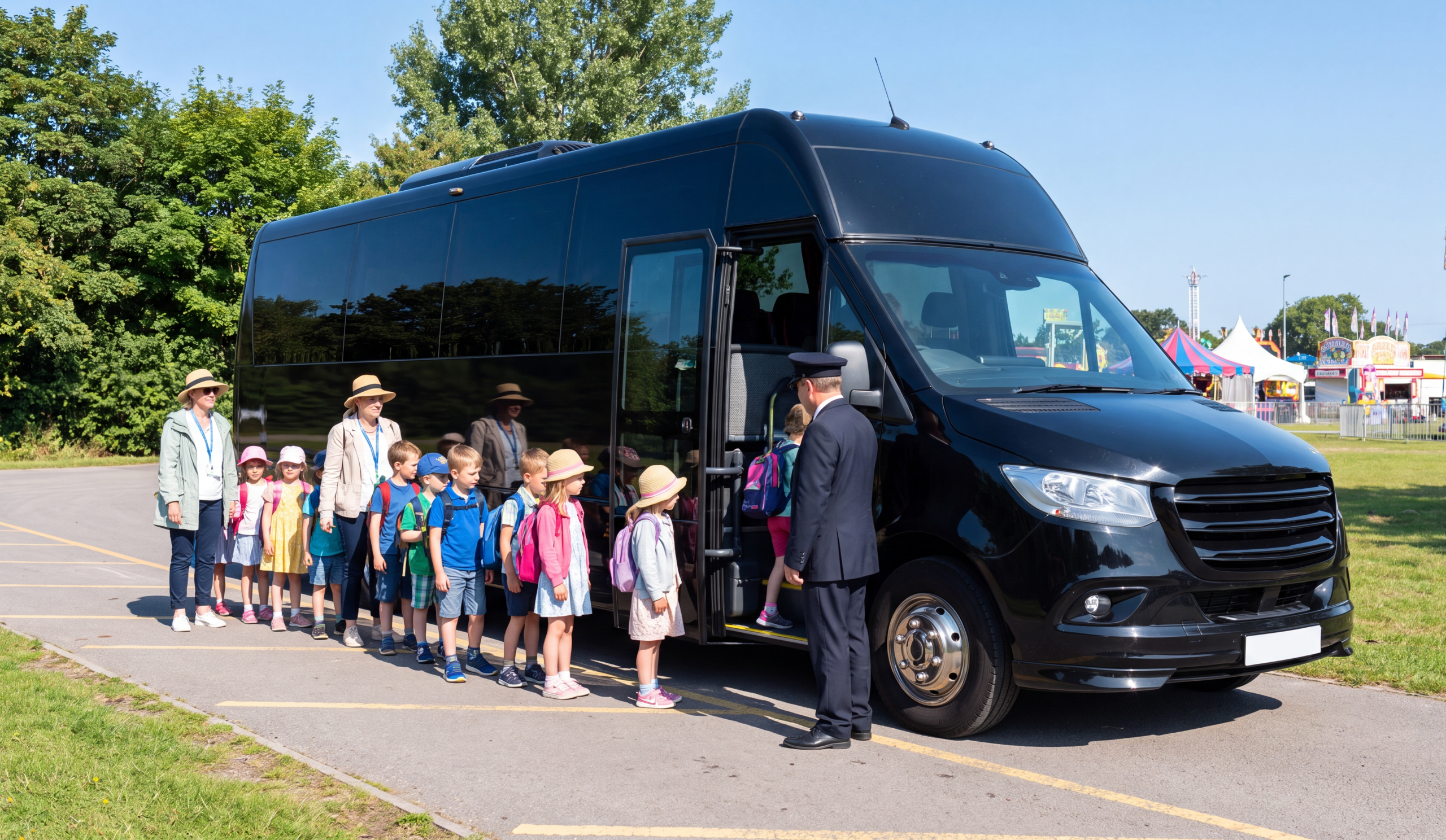
For a youth sports team, this matters because almost nobody on the bus is travelling with both parents. A typical 27-seat mini coach might carry 24 players, two assistant coaches, and one parent manager. Of those minors, perhaps two are travelling with a parent. The other 22 are travelling with one parent, a grandparent, a cousin, or no relative at all. Every one of those situations is a scenario where an officer could reasonably ask for documentation.
A useful letter is simple and practical. It names the child, the destination, the dates of travel, and the tournament. It states who is travelling with the child and that person’s relationship to the child. It lists the contact information for the signing parent or guardian. It includes a phone number that works while the team is in Canada. The Government of Canada publishes a sample consent letter on its official website, and that sample is a safe format to copy. Using it does not guarantee entry, but it gives the officer a familiar document to review.
The letter should be signed by both parents if both have legal custody. If one parent is not in the picture, a signed statement from the sole custodial parent is better than a forged second signature or an empty line. If a parent is deceased, a copy of the death certificate is a useful addition. The manager should not adjudicate custody disputes. Collect what each family can provide, and flag anything unusual to the officer before it is asked about.
The manager should hold a physical copy for every minor on the roster. Do not rely on families to bring their own. Parents forget. Bags get left in the trunk of a car that is not even on this trip. A three-ring binder with one letter per player, alphabetized, is the standard that works. It takes fifteen minutes to assemble and it removes the single most common cause of border delay for a team bus.
One more point: this is not a US rule. The US rule about under-19 sports teams applies when entering the United States from Canada. For a US team entering Ontario, the Canadian side does not require the letter. Carry it anyway. The officer on the Canadian side has discretion, and a prepared manager makes the officer’s job easier.
The Team Manager Border Checklist
Start the checklist at registration, not at the border. When a family signs up, collect the document type and number for every player and staff member. A passport number, a birth certificate number, or a Nexus card number. Write it down then. The bus door is the worst place to learn that a parent brought the wrong folder. You need this data weeks before departure so you can spot gaps and ask for the missing piece while there is still time to fix it.
Hold a consent letter for every minor who is not travelling with both parents. Canada does not legally require one, but a border officer can ask, and a letter prevents a long delay. The letter should name the child, the tournament, the dates, and the adult who has authority. Have the non-travelling parent or guardian sign it. Keep the originals in a single binder with you, the manager. Do not hand them out to individual parents. You are the one who will answer the officer's questions.
Print the roster. One page, no fine print. Each player's full name, date of birth, and an emergency contact that is not the person sitting next to them on the bus. Include every staff member and every chaperone. Mark which adult is responsible for which minors. A coach cannot account for fourteen children at a border booth. Assign groups of four or five players to one adult, and put those groups on the roster. If an officer asks who is watching the goalie, you can point to a name.
Confirm the coaching staff and any non-parent chaperones are documented. A volunteer dad who is not a legal guardian is not covered by the player's consent letter. He needs his own letter or a signed addendum naming him as an approved chaperone. Get that in writing before the trip, not in the lineup at the Rainbow Bridge.
Brief the parents once, in writing, after the roster is final. Tell them exactly which document each child will present, who holds the consent letters, and what the crossing order will be. Twenty families improvising at the booth is how a team loses an hour. One clear email prevents it.
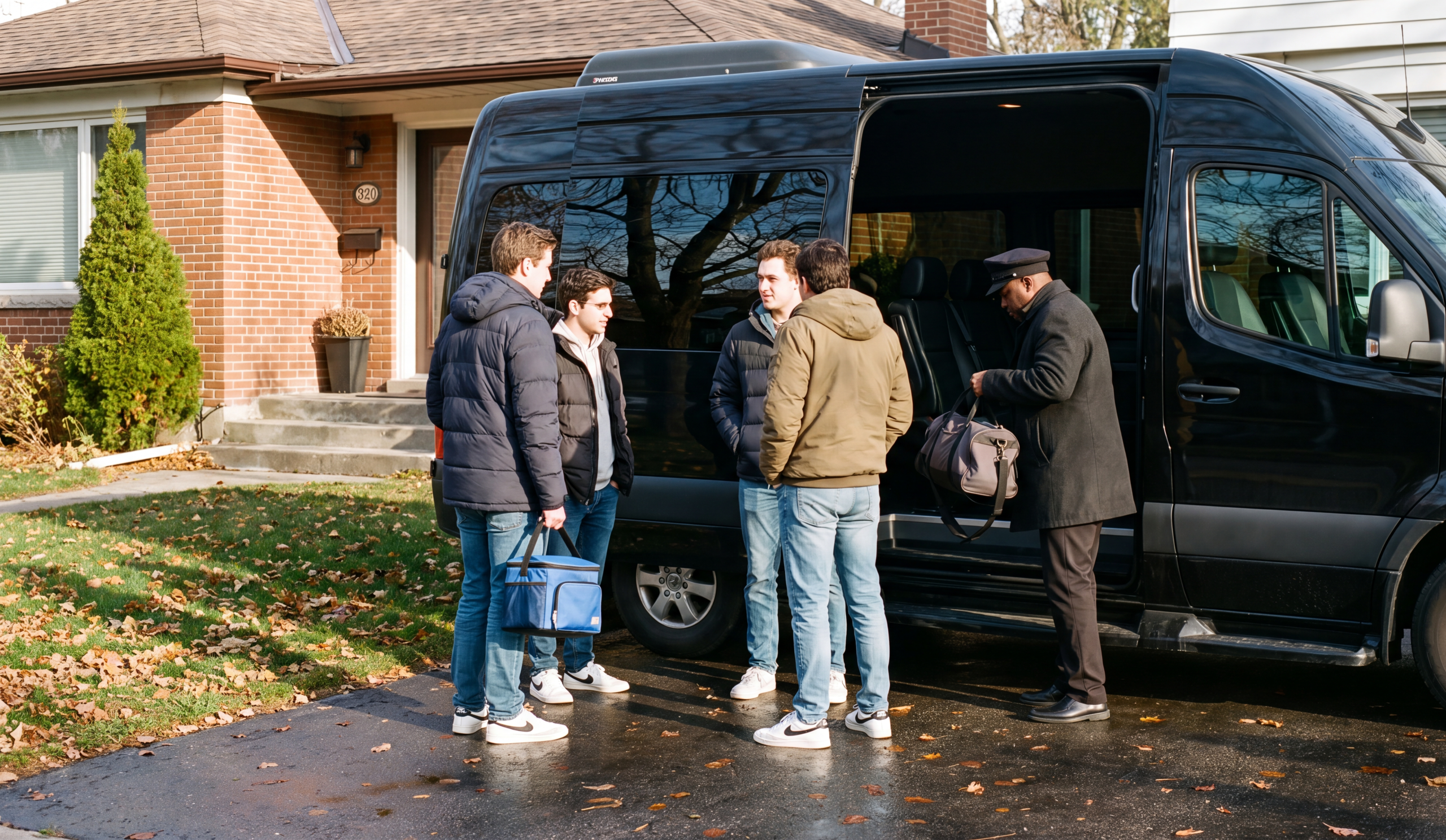
The driver needs the manifest before departure. Hand him the full list of names and document numbers at the hotel or the parking lot, not at the border. He has to know who is on the coach before he approaches the booth. Give him a copy that matches yours. If the officer asks, both of you answer with the same facts.
Building Border Time Into a Tournament Schedule
Tournament schedules do not flex. A team that misses its warm-up slot does not get a new one. The ice time belongs to the next game, and the first whistle happens whether the bench is full or not. So plan backwards from that whistle, not forwards from the driveway.
Start with the first game time, then subtract the arena check-in requirement, the warm-up period, and the time it takes to get twelve teenagers out of a coach and into the dressing room. That is the real deadline. The drive to the border is only part of the calculation. The crossing itself has to sit on top of that drive time, never inside it. A two-hour drive with a thirty-minute wait at the bridge is not a two-hour drive. It is a two-hour drive plus a thirty-minute wait, and the wait is the part you cannot control. A group working backward from a 1 PM kickoff at a Bills game does the same arithmetic, which is why we set out when to leave Toronto and which bridge to take hour by hour.
Friday afternoon is the worst case. The Ambassador Bridge and the Queenston-Lewiston crossing back up with commuters and other teams doing the same thing. Holiday weekends are worse. A team leaving Detroit for Windsor on a Friday before a long weekend should treat the crossing as a separate event in the schedule, not a minor interruption. Build in the buffer as if the border were a second destination, not a toll booth on the way to the rink.
For the return leg, the problem inverts. A team that plays a late final on Sunday is leaving after the arena empties and the other teams have already hit the road. The coach is loaded in the dark, the kids are tired, and the border is doing its own Sunday-night rush. The same rule applies: the crossing time sits on top of the drive, and the drive home has to absorb both. Do not promise parents a midnight arrival if the math puts the coach at the bridge at eleven.
The under-19 organised group rule adds a layer. Every player under 19 travelling with the team needs a consent letter from each parent or guardian, even though Canada does not legally require one. A border officer can ask, and a missing letter can turn a twenty-minute crossing into a two-hour delay while someone calls a parent who is watching the game from home. The volunteer manager carries the originals, not the kids. Keep a printed roster with birth dates in the same folder, because the officer will want to match names to faces.
Rainbow Bridge allows buses, including motorcoaches, and it keeps commercial trucks off the span. That makes it the practical choice for a 56-seat coach. The Detroit-Windsor Tunnel has a 12-foot-8-inch height limit, so confirm your vehicle height before committing. For a 27-seat mini coach or a 14-passenger Sprinter, the tunnel can work, but the operator has to know the exact number. A NEXUS card only helps if every single person in the vehicle holds one, which is not realistic for a full team. Do not plan around it.
Book the crossing window as a fixed block in the schedule. The team waits at the arena, not at the border.
Equipment, Sticks and Bags at the Crossing
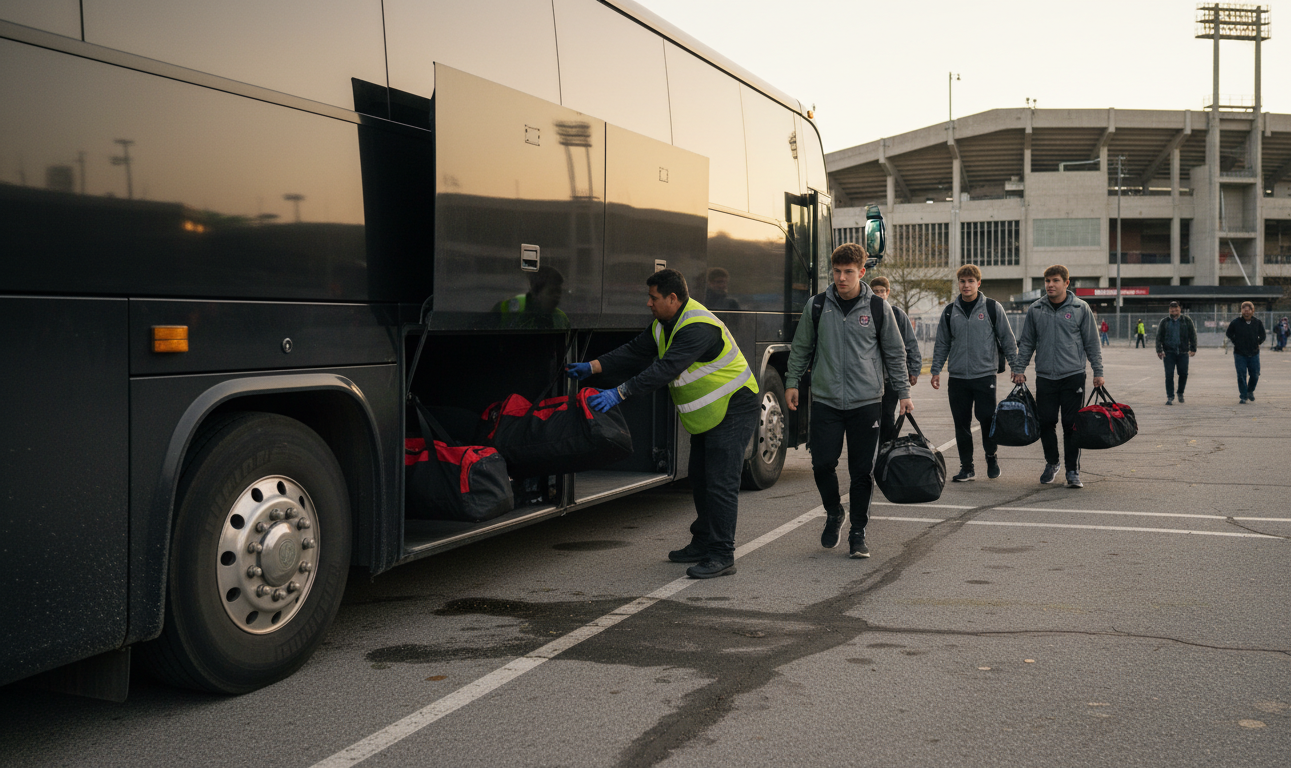
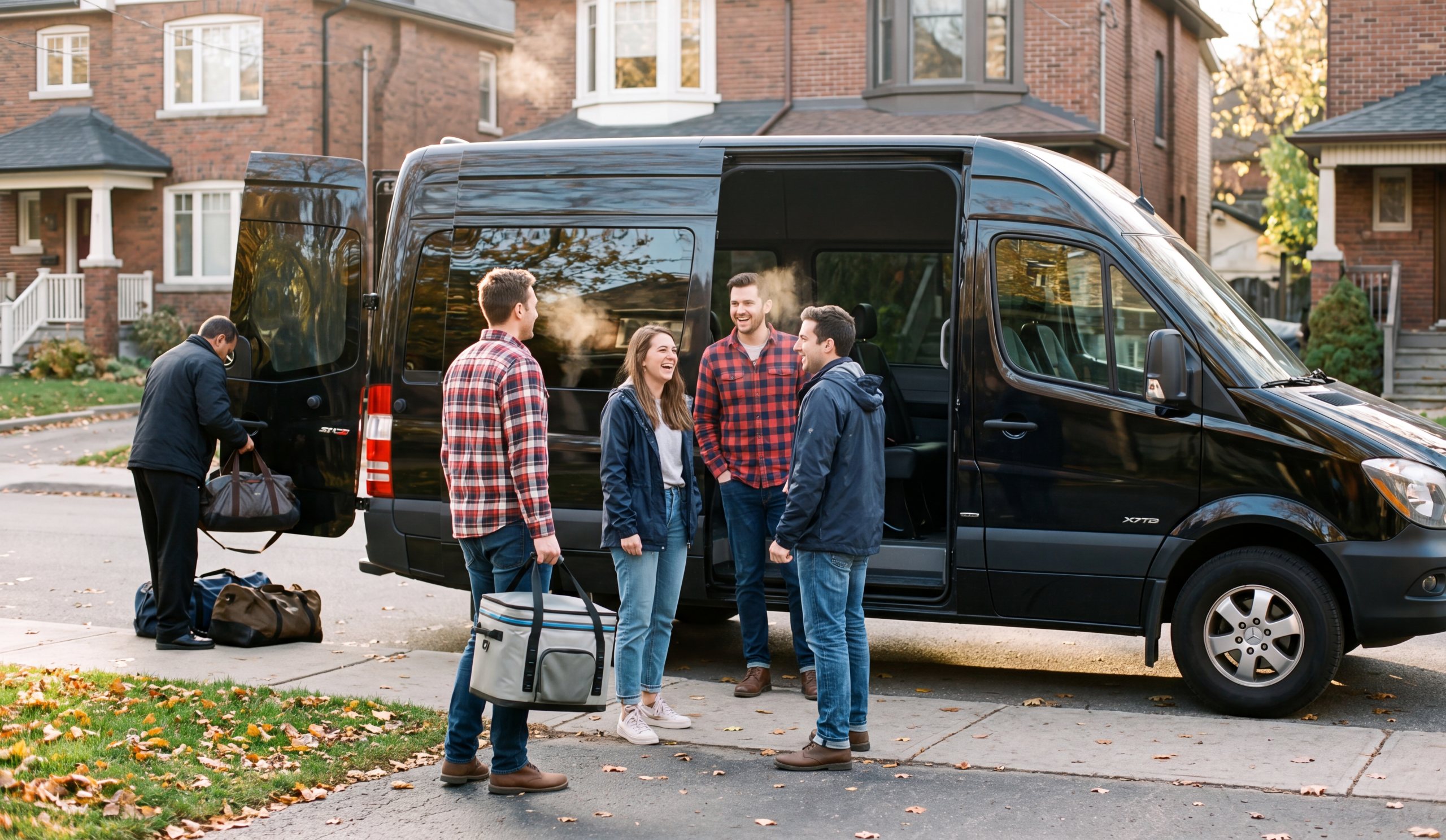
Gear changes the vehicle decision before the border is a factor. A 14-passenger Sprinter holds people, not 15 hockey bags plus sticks. For a full roster with goalie equipment, the 27-seat mini coach is the smallest realistic option. Cheer and dance teams travel differently: mats, pyramids, and costume trunks eat floor space fast. The 35-seat limousine bus gives you a rear bay that fits the long items. A 56-seat coach bus is for the large travel squads where every player brings a stick bag and a duffel.
Know your bay dimensions before you book. Measure the longest stick or mat. Compare it to the bay opening, not just the interior depth. A 65-inch lacrosse shaft angles in fine, but a 72-inch dance mat rolled tight needs a straight run. Load the bay in layers: flat items on the bottom, bags upright, sticks and poles on top where they do not crush anything. Leave a visible path to the rear wall. An officer who can see the back of the bay without climbing over gear moves the line faster.
Personal sports equipment crosses normally. That means used gear, worn items, and the occasional spare part. It does not mean new, sealed merchandise. If you have 30 identical team jackets in plastic wrap, that looks like inventory. If you have extra sticks to sell at the tournament, that is a commercial conversation. Keep the bay to what the team uses. A quick mental inventory before you leave the hotel helps: sticks, helmets, pads, uniforms, one team banner, one medical kit. Say it plainly when asked.
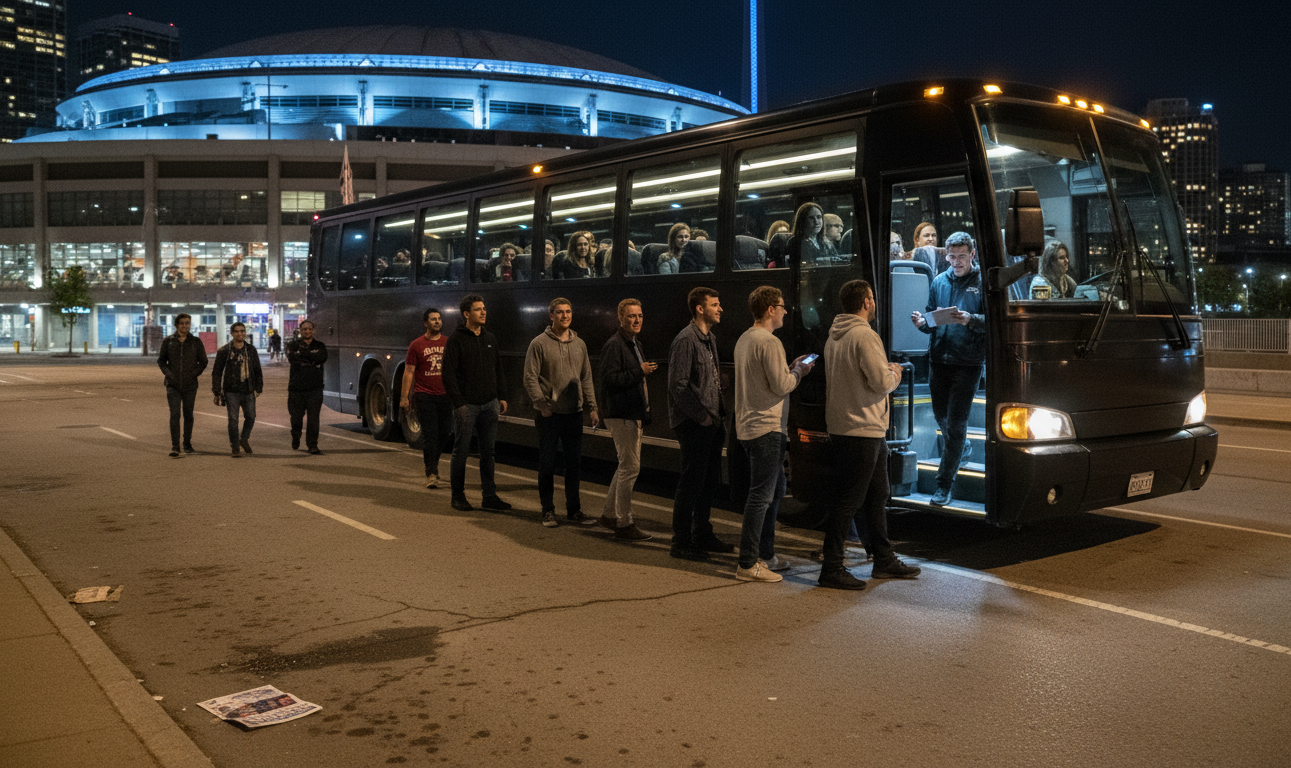
Consent letters stay in the cabin, not the bay. The driver does not hand over paperwork. The team manager carries the folder with every minor’s letter and a roster that matches the order of loading. If an officer asks to inspect, step out, open the bay, and walk them through it. Do not rush. Do not argue about what counts as personal gear. Answer the question, show the load, and move on.
The crossing itself is a timing question. A 27-seat mini coach with 20 players and gear clears the Queenston-Lewiston bridge faster at 9 a.m. than at 2 p.m. The Rainbow Bridge allows buses, but the approach backs up on tournament weekends. Build in 45 minutes of buffer. The bay is loaded the night before, the consent letters are in the manager’s bag, and the team is ready to answer one question: what is in the back.
What Happens If One Player Is Missing a Document
The scenario every manager fears is a player reaching the booth without the right paper. It is a problem, but it is not an automatic bus reversal. The officer at the booth deals with the individual, not the whole group. The coach stays put. The team waits on the shoulder or in the lot while the situation is sorted out. That wait can be twenty minutes or two hours. The decision belongs to that officer alone. No one can predict it from outside the booth.
What you can control is what happened before the bus left. The registration-time document collection covered earlier is the prevention. That is where a missing letter gets caught. That is where you check each birth certificate against the roster. That is where you confirm every minor has a consent letter signed by a parent or guardian, even though Canada does not legally require one. The officer can still ask. Not having one can cause delays and, in rare cases, refusal. The letter is cheap insurance against a long wait at the Rainbow Bridge or the Queenston-Lewiston crossing.
If the missing document is for a player, the officer may allow a parent to fax or email a copy to the manager's phone. That happens. It is not guaranteed. If the document never arrives, the officer may admit the rest of the team and leave the player behind with a chaperone. That is a call you do not want to force.
If the issue touches admissibility, like a past DUI on an adult chaperone, this page cannot help. No one can. A licensed professional must review that case well before the travel date. Do not rely on a border officer's mood or a forum post. The outcome is a legal question, and the answer depends on records, time, and rehabilitation. This page will not predict it, and neither should you.
For the document check itself, do it twice. Once at registration and once at the parking lot before boarding. A 27-seat mini coach or a 56-seat coach bus holds a lot of gear and a lot of noise. A quiet three-minute roster check at the hotel lot beats a two-hour wait at the booth. Bring a clipboard. Check names against birth certificates. Check that each consent letter matches the player's name. Collect them in one binder and keep it in the front seat. The officer will ask for it. Hand it over without shuffling.
Team Manager Questions, Answered
What documents do I need for a US minor crossing into Canada by bus for a tournament?
For land entry into Canada, CBSA recommends a passport for US citizens of any age, but accepts a birth certificate as proof of identity and citizenship. For the return US-bound leg, US CBP allows US citizen children under 19 to present a birth certificate instead of a passport when traveling with a sports team. Air travel into Canada requires a passport for every minor regardless of age.
Does Canada legally require a consent letter for a minor traveling with a team?
No, Canada does not legally require a consent letter for a minor, but it is recommended because border officials may still ask for one. A signed letter from each parent or guardian, including contact details and trip dates, reduces delays. Carry it for every minor even though it is not a legal mandate.
What is the US rule for a team of minors under 19 returning from Canada by land?
US CBP permits US or Canadian citizen children under 19 to present a birth certificate instead of a passport when entering the United States by land or sea as part of a school, religious, social, or sports team. This applies only to the US-bound leg, not to Canada entry. Each child still needs a birth certificate or other accepted proof of citizenship.
Can I use a NEXUS lane for a 27-passenger coach crossing into Canada?
No, NEXUS requires every occupant to hold a NEXUS card, so it is not usable for a 27 to 56 passenger coach because not all passengers will have cards. Use the standard lanes at Queenston-Lewiston or Rainbow Bridge. Rainbow Bridge bans trucks but allows buses, while Queenston-Lewiston allows trucks and has a NEXUS lane you cannot use.
What is the height limit for the Detroit-Windsor Tunnel for our coach bus?
The Detroit-Windsor Tunnel has a max height of 12 feet 8 inches, which does not exclude most coaches because standard 14-passenger Sprinters, 27-seat mini coaches, 35-seat limousine buses, and 56-seat coach buses typically fit under that clearance. Verify your specific vehicle’s height with the operator before departure. If your bus is taller, use the Ambassador Bridge instead.
Does our US coach need a special license to operate in Ontario for a pre-booked tournament?
Ontario repealed the Ontario Highway Transport Board Act and Public Vehicles Act effective July 1, 2021, ending the provincial economic licensing system for charter and intercity bus. No provincial operating license is required for your pre-booked group, but you must still comply with federal safety and insurance rules. Never claim no license of any kind is needed, as vehicle registration and driver credentials still apply.
Can our US coach pick up extra passengers inside Canada during the tournament?
No, cabotage rules allow a US coach to carry its own pre-booked group in Canada but prohibit selling new rides or doing point-to-point carriage of separate paying passengers inside Canada. Your coach may only transport the group that booked the trip from the US. Violating this can lead to fines or denial of future entry.
What is the manager checklist for crossing the border with minors?
Your checklist must include each minor’s birth certificate or passport, a signed consent letter from each parent or guardian, a team roster with emergency contacts, and a copy of the tournament schedule. Also carry the coach’s registration, insurance, and driver’s license. Verify every document matches the child’s name exactly before departure.
How early should we arrive at the border crossing on tournament day?
Arrive at least 90 minutes before your planned crossing time to account for inspection delays, especially on weekends when sports groups cross frequently. Have all documents ready in a binder per child for the officer. If you cross at Rainbow Bridge, note that trucks are banned but buses are allowed, so lane choices are simpler.
What happens if a minor’s parent is not traveling but both parents are divorced?
Carry a notarized consent letter from the non-traveling parent or legal guardian, plus a copy of any court order if sole custody exists. Canada does not legally require it, but officers may ask, and a missing letter can cause delays. If one parent is deceased, bring a death certificate to avoid confusion.
Can a minor use a photocopy of a birth certificate instead of the original?
No, CBSA and US CBP generally require original or certified copies of birth certificates for land crossings. Photocopies are not accepted as proof of citizenship. Carry the original birth certificate for each minor under 19 for the US return leg.
What is the tournament timing rule for our bus driver’s hours of service?
US and Canadian commercial driver hours of service limit driving to 10 hours after 8 consecutive hours off duty, and 15 hours on duty per day, with a 30-minute break after 8 hours. Plan your schedule so the driver has rest stops and overnight parking. Check Ontario’s specific rules because they align with federal standards but may have local enforcement.
Does the bus need any special equipment for winter travel in Ontario?
Ontario requires winter tires on all commercial vehicles from November 1 to April 30, and your coach must carry chains or an alternative traction device. Ensure the bus has a working defroster, heater, and emergency kit including blankets and a shovel. Verify tire tread depth before departure.
Can we bring hockey sticks and goalie equipment on the coach?
Yes, but you must secure all equipment in the cargo bays or overhead racks to avoid blocking aisles or exits. Hockey sticks should be bundled and tied, and goalie pads must be stored flat. The driver is responsible for ensuring the load does not exceed weight limits for a 14-passenger Sprinter or larger coach.
What if a minor forgets their passport and only has a birth certificate for the Canada entry?
For land entry into Canada, a birth certificate is accepted as proof of identity and citizenship for US citizens of any age, so the minor can enter. For the return to the US, the same birth certificate works if the minor is under 19 and part of a sports team. Do not attempt air travel without a passport.
Are there any restrictions on bringing sports equipment like lacrosse sticks or baseball bats into Canada?
Sports equipment is generally allowed into Canada for personal use, but items like bats and sticks must be declared and may be inspected. No special permit is needed for tournament gear. Ensure no prohibited items like pepper spray or bear mace are packed in the equipment bags.
How do we handle a minor who has a criminal record or a DUI?
Never predict an admissibility outcome; route any question about a record to a licensed immigration attorney or a Canadian border consultant. A minor with a record may face additional questioning or denial, but only a professional can assess the specifics. Carry all court documents and proof of rehabilitation if available.
What is the minimum age for a child to travel without a parent but with a team manager?
There is no minimum age set by Canada or the US for a minor to travel with a team, but the manager must have written consent from a parent or guardian for each child. For the US return, the under-19 sports team rule applies. Practical age limits depend on the child’s maturity and the team’s own policy.
Can we use a 35-seat limousine bus for a team of 30 minors and 5 adults?
Yes, a 35-seat limousine bus fits 30 minors plus 5 adults with no unused seats, but you must ensure seat belts are available for all. Check that the bus has a valid inspection sticker and that the driver is licensed for the vehicle class. Overloading beyond the registered seat count is illegal.
What documents does the bus driver need to carry for the cross-border trip?
The driver must carry a valid commercial driver’s license, a passport or enhanced ID for border crossing, the vehicle registration, proof of insurance, and a cargo manifest. Also bring a copy of the team roster and the consent letters. The driver must be able to present these at the border without delay.
Are there any tolls or fees for crossing the Rainbow Bridge or Queenston-Lewiston with a coach?
Both bridges charge tolls for commercial vehicles, and the amount varies by vehicle size and crossing direction. Pay with cash or a transponder, but note that NEXUS is not usable for a full coach. Check the current toll schedule online before departure and include the cost in your trip budget as quoted per vehicle and confirmed in writing per coach.
What is the protocol if a minor becomes ill or has an emergency during the border crossing?
Notify the border officer immediately; they will direct you to medical services or allow you to proceed to the nearest hospital. Carry a medical consent form for each minor authorizing the manager to seek treatment. Keep a first-aid kit on the bus and know the location of hospitals near the tournament venue.
Can we stop for meals or rest breaks while in Canada, or must we stay on schedule?
You can stop for meals and rest, but the driver’s hours of service limits still apply, so plan breaks into the schedule. Each stop must be safe and legal, and the driver must log all time. Avoid unplanned detours that could delay border crossing or violate cabotage rules.
Moving a Team Around Ontario
Send the roster size, the tournament schedule and the rink or field addresses. We price the Ontario ground legs and confirm in writing.