

CHAUFFEUROPOLIS / ONTARIO JOURNAL
Jewel of Georgian Bay: arranging a ride from Toronto
Toronto and Pearson departures to Jewel Of Georgian Bay, with the return planned around your stay.
What to budget for the transfer
Start with these approximate one-way budgets, then book online using your pickup, travel date and passenger details. If the vehicle or itinerary is not offered online, contact us for that arrangement.
| Vehicle | Passenger capacity | From YYZ, one way | From downtown Toronto, one way |
|---|---|---|---|
| Sedan | 2 to 3 passengers | Approx. $200 to $325 | Approx. $250 to $375 |
| SUV | Up to 6 passengers | Approx. $350 to $500 | Approx. $425 to $600 |
| Cadillac Escalade | Up to 6 passengers | Approx. $500 to $700 | Approx. $575 to $825 |
| Sprinter | Up to 14 passengers | Approx. $625 to $875 | Approx. $750 to $1,025 |
All amounts are CAD, plus 13% HST and 15% to 20% gratuity. Luggage, stops, waiting, tolls and vehicle selection can affect the total. Passenger capacity does not override property occupancy or access limits.
The YYZ ranges are planning estimates based on our published Barrie rates and the approximate road-distance difference. Downtown Toronto ranges are estimates using Union Station as the reference pickup, not published flat fares. Allowance ranges are not a guarantee of the final price. See our current rates.
Google Maps puts the driving distance at approximately 140 km from YYZ and 160 km from Union Station to the Waubaushene, Ontario area. These are locality reference routes, not measurements to a private cottage entrance. Distances depend on the route selected; some routes use toll roads. Enter the exact address for your booking.
The table covers one outward journey. Add the return when booking if you need both directions; these amounts do not include a driver staying with you or local trips during your visit.
A Toronto or Toronto Pearson group transfer to Jewel of Georgian Bay should be planned as an out-of-town journey to a private cottage in Waubaushene, followed by a separately specified return. Confirm the booked property’s address, permitted guests and vehicle access with the host before choosing the vehicle. Request a distance-based quotation for the actual itinerary, including bags and any stops, rather than applying a Toronto hourly rate to the trip.
The public Glamping Hub listing identifies Jewel of Georgian Bay as a waterfront cottage in Waubaushene, Ontario. It lists four bedrooms and describes water on three sides of the property. That makes this a cottage-arrival problem, not a hotel-coach arrival: the group needs the host’s handover instructions, somewhere suitable to unload and a plan for getting home after checkout.
For families and friends sharing a stay, travelling together can remove the need to coordinate several cars. But a single departure only works when the group shares a workable timetable. Airport arrivals, food shopping and the cottage’s check-in window deserve attention before anyone commits to a pickup time.
This article covers Toronto and YYZ to the cottage and back. It does not advertise destination-local rides around Georgian Bay. Accommodation reservations and Chauffeuropolis transportation are separate arrangements; no relationship with the property, host or booking platforms is implied.
On this page
- What the listing establishes
- Choose the vehicle around the stay
- Organize a Toronto departure
- Bring Pearson arrivals into the plan
- Pack for a shared waterfront stay
- Settle the final approach before departure
- Plan around check-in and checkout
- Write the return journey first
- Request a comparable quotation
- Questions about the trip
What the listing establishes
The Glamping Hub property listing places this cottage in Waubaushene, not elsewhere along Georgian Bay. Georgian Bay covers a much larger area, so use the specific listing when booking transport. A search result for a similarly described waterfront rental is not enough to give a driver a destination.
The listing describes a roughly 3,000-square-foot cottage, more than 500 feet of private shoreline and water on three sides. Those are the listing’s descriptions, not a surveyed site assessment. Its advertised features include parking, Wi-Fi, heating, a washing machine and kayaking or canoeing. The headline also mentions a pool table. Confirm which facilities and equipment are available for your dates before packing around them.
At retrieval, the page displayed 12 guests and four bedrooms. Treat those figures as published accommodation information, not permission to bring additional visitors or hold an event. The accepted reservation and current host rules determine who can stay or visit. A vehicle with spare seats does not increase the property’s permitted occupancy, and transport availability cannot authorize a larger gathering.
The listing says that the detailed location is provided after booking. There is no reason to publish or guess the private address. Once the reservation is confirmed, send the exact arrival location to the transport coordinator through the booking process. A map pin can help, but it should be checked against the host’s written instructions rather than replacing them.
This private-cottage context is the useful difference between planning for Jewel of Georgian Bay and reading a general regional transport page. A waterfront description tells you why guests might bring swim bags and outdoor equipment. It tells you nothing about whether a large vehicle can turn around at the entrance. Keep those two kinds of information separate.
Choose the vehicle around the stay
The right vehicle is the one that carries the confirmed party and its belongings to an approved unloading point. Start with passenger and luggage details, then ask which available arrangement fits. Do not choose by the largest advertised seating number or by a photograph of a cabin.
| Journey arrangement | Passenger and luggage considerations | Property access question | Quotation basis |
|---|---|---|---|
| Private car or SUV for a smaller party | Check the actual seats, child restraints and luggage space with all passengers aboard | Can the assigned vehicle unload at the host-approved point? | Out-of-town distance quotation for specified outward and return journeys |
| Passenger van or Sprinter for a shared arrival | Submit suitcase sizes, coolers and bulky equipment as well as the headcount | Confirm the approach, safe stopping point and space to leave without an unsafe manoeuvre | Distance quotation identifying the vehicle, stops and any waiting arrangements |
| Separate vehicles for different arrivals | Useful when flight schedules or return destinations differ; allocate bags and contacts to each vehicle | Obtain a suitable handover plan for each arrival, without assuming parking for every vehicle | Separate priced journeys, compared against a shared collection |
| Larger group vehicle considered by the operator | Only relevant if the party is host-approved and the vehicle has suitable baggage provision | Larger-vehicle access is unverified; do not book on the assumption that listed parking means coach access | Written itinerary-specific quotation after access and party-size review |
For a cottage stay, baggage can decide the answer before seats do. Several modest overnight bags produce a different load from large airline cases, coolers and folded mobility equipment. Ask the operator to assess the usable baggage provision in the proposed configuration. An empty seat is not a substitute for safe storage, and no loose item should obstruct an aisle or exit.
A larger vehicle is not automatically the better choice for the party shown on the accommodation listing. It might add cost or create an access problem without solving a real need. Conversely, splitting a full load between suitable vehicles can be more practical than squeezing everyone into a cabin whose luggage area is already committed.
Passengers needing step-free access or help boarding should have those needs reviewed before vehicle selection. Explain whether a mobility aid folds, whether the traveller remains seated in it and what assistance is required. These details affect the vehicle decision. Do not infer accessibility from the cottage’s size, a transport category name or a photograph.
Organize a Toronto departure
A single Toronto meeting point gives the organizer a clear headcount and one departure time. It also means guests must get themselves there with their bags. Choose a location that the operator can use legally and practically, with enough space for people to wait away from traffic. A convenient address on a map is not necessarily a suitable loading spot.
For a family gathering, one household may be willing to host the departure. For guests staying in Toronto, a hotel collection may make more sense. In either case, confirm the precise entrance and loading instructions. Avoid sending the group only a building name when the property has several doors or vehicle approaches.
Multiple home pickups can be requested, but they change the itinerary. Every stop brings another loading period and a possible delay before the northbound portion begins. Give the operator the complete pickup list at quotation stage so it can assess the sequence. Do not add a second neighbourhood collection to the group chat after the trip has already been agreed.
Set a ready-to-board time as well as a vehicle departure time. The first is for passengers; the second belongs to the itinerary. One organizer should count people, check that the last bags are loaded and tell the driver when the group is ready. A headcount based on names is more reliable than asking whether anyone thinks someone is missing.
Food shopping deserves its own decision. Loading groceries at the Toronto origin may keep the journey simpler, but it adds to the baggage assessment. A stop en route needs a location, an expected duration and agreement in the quotation. A driver should not discover a substantial shopping plan only after leaving the city.
Bring Pearson arrivals into the plan
For YYZ arrivals, use flight details rather than landing time alone. Passengers still need to leave the aircraft, complete any arrival formalities and collect checked baggage before they can meet a driver. Ask the operator for its confirmed meeting instructions and delay procedure. Do not tell guests to wait at an invented terminal door or curb position.
Share the airline, flight number, travel date and a reachable passenger contact. Identify which travellers are on the same reservation or flight and which are arriving separately. A Toronto phone number that belongs to someone already at the cottage may not help a guest who cannot find the pickup point after landing.
When flights arrive at different times, compare a shared collection with separate airport transfers. The first arrivals may face a long wait for the final passengers, while a delayed flight can make the whole group’s cottage arrival uncertain. Separate collections cost differently, but can keep an earlier party from spending its first afternoon waiting at the airport.
Do not combine a city pickup and airport collection simply because both appear to be on the way. The sequence has to work for the actual addresses, flight readiness and accepted check-in window. Ask the operator to compare the arrangements rather than promising a route or a journey time from a broad map view.
For international visitors, the organizer should send one short arrival note before travel: who to contact, how to receive the operator’s meeting instructions and what to do if bags are delayed. Keep accommodation access codes out of a widely shared travel document. Send those only to the guests who need them, using the host’s instructions.
Pack for a shared waterfront stay
The property listing’s waterfront setting and kayaking or canoeing features help explain why this journey may involve more than suitcases. Guests might also bring outdoor clothing, food and equipment for time by the water. Before choosing a vehicle, separate essential luggage from items that can be left at home or supplied through the accommodation arrangement.
Make the baggage count specific. A note saying “weekend bags” can hide a mix of hard cases, backpacks and large coolers. Record the number of each item and flag anything unusually long, heavy or difficult to stack. If guests plan to bring paddles, fishing equipment or other bulky items, ask the operator whether and how those can be carried.
Do not bring water-sports equipment solely because the listing mentions an activity. Ask the host what is provided, what guests may use and whether seasonal restrictions apply. The transport booking does not include an assessment of waterfront conditions, equipment suitability or supervision. Those questions belong with the accommodation host and the people responsible for the activity.
Plan the return load too. Damp clothing should be packed so it does not wet other passengers’ bags or the vehicle. Reusable food containers and remaining groceries still need storage, even if some supplies have been consumed. Keep medicines, documents and essentials for children accessible without opening the main luggage load at a roadside stop.
If children are travelling, provide their ages and restraint requirements when requesting transport. Obtain written confirmation of what will be supplied or what the family must bring. Do not assume that a larger vehicle removes the need to discuss safe, appropriate seating. The same restraint arrangement needs to work on the return journey.
Settle the final approach before departure
The listing advertises parking. It does not establish driveway width, overhead clearance, turning space, surface conditions or permission for a coach. Those are unanswered transport questions, not defects in the listing. Send the proposed vehicle category to the host and ask where it may safely arrive, unload and depart.
The host’s directions and the operator’s assessment need to agree. If either party identifies a limitation, resolve it before dispatch. A driver should not have to improvise a roadside transfer because a large vehicle was booked against an unverified map pin. Any alternative handover point needs explicit agreement and a practical way for all passengers and belongings to reach the accommodation.
Ask about the distance and surface between the unloading point and the entrance, especially when a guest uses a mobility aid or cannot carry luggage. A short walk for one traveller can be a serious obstacle for another. Do not describe the cottage as accessible unless the host has confirmed the features that the particular guest needs.
A person authorized to receive the group should be reachable at arrival. That may be the booking guest rather than an on-site host. Confirm how guests enter and what to do if access is not ready. The transportation provider is not responsible for opening the property or deciding whether early entry is allowed.
For colder-weather stays, ask the host about the expected condition of the arrival area and any seasonal access instructions. The operator must still assess conditions on the day. Avoid promising all-weather driveway access or a fixed last-mile approach. If the confirmed plan changes, communicate it to the driver and every arriving party rather than leaving competing instructions in separate messages.
Plan around check-in and checkout
The retrieved Glamping Hub listing shows check-in from 4 p.m. and checkout at 10 a.m. These are published listing times, not a substitute for the accepted reservation. Verify them with the host for your dates before the operator builds the schedule. Early arrival does not itself grant entry, and a transport delay does not extend checkout.
Use the approximate one-way budgets above to plan the trip, then book online with your actual pickup, destination, date, passengers and luggage. Add the return if needed. The selected vehicle and itinerary determine the final price; a GTA hourly rate is not the price of an out-of-town transfer.
A first-day meal plan can reduce confusion without turning the trip into a long shopping excursion. Decide whether the group brings food from Toronto, orders supplies independently or requests a specific stop. Each option affects baggage, timing or both. Make the choice before the vehicle is assigned, not when passengers discover that nobody has planned dinner.
On checkout morning, separate packing from loading. Ask guests to have bags closed and personal items collected before the driver is due. The organizer should finish the host’s checkout instructions without making the entire group wait in the vehicle. Leave time to check rooms for chargers, children’s belongings and travel documents before departure.
Where early airport departures conflict with the rest of the group’s plans, split the transport rather than forcing everyone onto one schedule. Likewise, a later vehicle pickup does not provide permission to keep using the cottage after checkout. Ask the host about any gap between leaving the accommodation and boarding; do not assume luggage storage or waiting facilities exist.
Write the return journey first
A return from Jewel of Georgian Bay to Toronto or Pearson should identify its own date, ready time, pickup point and destination. “Round trip” is not enough. The outward journey may collect everyone together, while the return divides between an airport terminal, a Toronto hotel and home addresses.
For a YYZ flight, give the operator the actual departure details and the airline’s arrival guidance. Work backwards from the required terminal arrival, allowing for loading and the road journey with an appropriate contingency. The driver cannot guarantee a connection, and a generic northbound travel estimate is not a safe basis for a southbound airport deadline.
Choose a return lead who will be awake, reachable and at the property before boarding. That person should have the final passenger list and know which bags belong to each vehicle. If one guest leaves independently, tell the organizer and operator. An unexplained missing passenger can delay everyone else.
The accepted quotation should state whether the transport consists of separate outward and return transfers or includes any vehicle retention. Do not assume that the driver waits at the cottage during a multi-night stay. Nor should a guest expect an unbooked local ride because the outward journey was arranged through the same company.
Keep the return instructions in the same final travel note as the outbound plan. Guests often read the first pickup message carefully and overlook the departure from the cottage. Put the return ready time and destination allocation where everyone can find them without scrolling through a weekend of photographs and informal messages.
Request a comparable quotation
Use the approximate one-way budgets above to plan the trip, then book online with your actual pickup, destination, date, passengers and luggage. Add the return if needed. The selected vehicle and itinerary determine the final price; a GTA hourly rate is not the price of an out-of-town transfer.
- Travel dates, Toronto origin or YYZ flight details, and requested arrival window.
- Host-confirmed property location and approved vehicle handover instructions.
- Confirmed passenger count, children, mobility needs and a named group contact.
- Suitcases, coolers and unusual items, with sizes where relevant.
- Every planned pickup, shopping stop and other stop in each direction.
- Return destinations, flight deadlines and whether separate vehicles are needed.
Compare proposals on the same facts. A direct transfer and a journey with several pickups and a shopping stop are different services even if both say Toronto to Waubaushene. Ask whether taxes, gratuity, waiting, parking or other applicable charges are included, excluded or conditional. An unanswered item should stay a question, not become an assumed inclusion.
Before accepting, check that the proposed vehicle and baggage arrangement match the final group list. If a traveller adds a large case or a second family joins, request a review. The operator may need to change the arrangement, and the host must separately approve any change to accommodation guests.
You can get a quote once the itinerary is ready, or use the booking page to submit the journey details. Keep accommodation confirmation and transport acceptance together, but treat them as separate commitments. Neither one proves the other is complete.
Questions about the trip
Where is Jewel of Georgian Bay?
The cited Glamping Hub listing places Jewel of Georgian Bay in Waubaushene, Ontario. It describes a waterfront cottage and says the detailed location is supplied after booking. Use the host-confirmed private address for transport, not a general Georgian Bay destination or an inferred address.
Can a group travel from Toronto or YYZ together?
A shared transfer can be requested when the confirmed party, luggage and arrival timing fit an available vehicle and the property’s approved handover plan. Provide those details before selecting the arrangement. Separate collections may work better for travellers whose flights arrive far apart.
Does the listing’s guest count determine the vehicle size?
No. The retrieved listing displays 12 guests, but the accepted reservation determines permitted occupancy. Vehicle choice also depends on the actual travellers, luggage and access. Booking more seats does not permit more people to stay at or visit the cottage.
Can a coach drive onto the property?
Coach access has not been verified. Listed parking is not proof of adequate approach clearance, turning space or permission for a large vehicle. Ask the host and operator to agree on a suitable arrival arrangement before booking that vehicle category.
What time should the group arrive and leave?
Use the check-in and checkout times in your confirmed reservation. The retrieved listing shows check-in from 4 p.m. and checkout at 10 a.m., but the host must confirm your arrangements. Schedule unloading and return loading around those instructions rather than assuming early entry or late departure.
Should groceries and coolers be included in the luggage count?
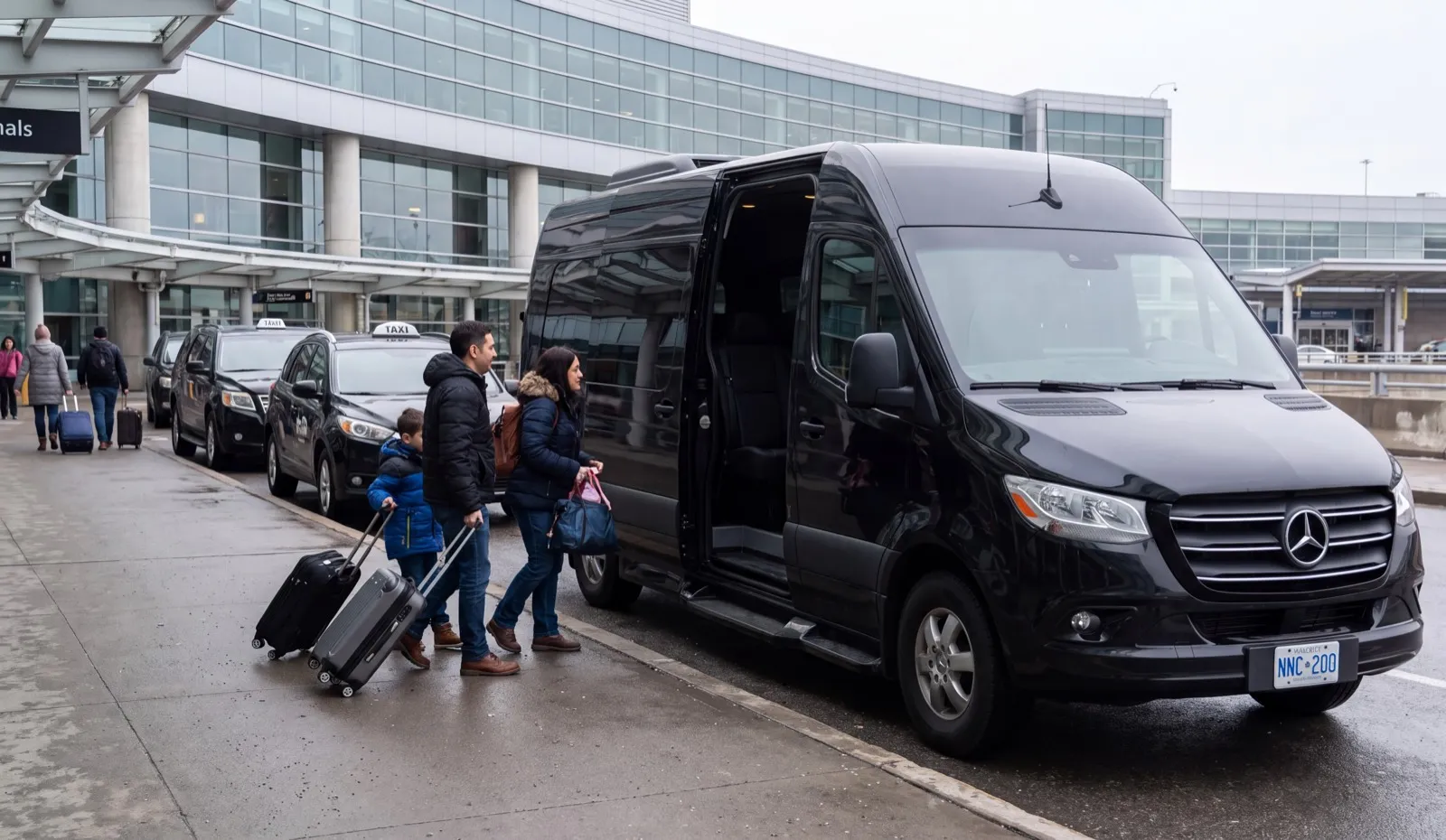
Yes. Groceries, coolers and bulky outdoor items take space alongside suitcases and need appropriate storage. Send the full load to the operator before vehicle selection. If shopping requires a stop, include its location and expected duration in the quotation request.
Is the driver available for local trips during the stay?
Do not assume local trips or a retained vehicle are included. This article concerns Toronto or Pearson transfers to the cottage and the return journey. The written transport agreement must identify what is booked; an outward transfer does not establish on-call transportation during the stay.
How is the return to Pearson planned?
Plan it from the flight departure details and the airline’s required arrival guidance, then confirm a pickup time with the operator. Include packing, loading and a suitable road contingency. Give the return journey its own passenger list and terminal destination instead of relying on the outward booking notes.
Is Chauffeuropolis affiliated with the cottage?
No affiliation is claimed. Book the accommodation with the host or platform and arrange transportation separately. Property descriptions in this article are attributed to the public listing; they do not represent an endorsement, site inspection or guarantee by Chauffeuropolis.