

CHAUFFEUROPOLIS / ONTARIO JOURNAL
The Rosewood on Rosseau: a group journey from Toronto
Toronto and Pearson departures to Rosewood On Rosseau, with the return planned around your stay.
What to budget for the transfer
Start with these approximate one-way budgets, then book online using your pickup, travel date and passenger details. If the vehicle or itinerary is not offered online, contact us for that arrangement.
| Vehicle | Passenger capacity | From YYZ, one way | From downtown Toronto, one way |
|---|---|---|---|
| Sedan | 2 to 3 passengers | Approx. $400 | Approx. $375 to $550 |
| SUV | Up to 6 passengers | Approx. $590 | Approx. $550 to $800 |
| Cadillac Escalade | Up to 6 passengers | Approx. $880 | Approx. $850 to $1,175 |
| Sprinter | Up to 14 passengers | Approx. $1,210 | Approx. $1,175 to $1,600 |
All amounts are CAD, plus 13% HST and 15% to 20% gratuity. Luggage, stops, waiting, tolls and vehicle selection can affect the total. Passenger capacity does not override property occupancy or access limits.
The YYZ column uses our published Muskoka regional guide prices. Downtown Toronto ranges are estimates using Union Station as the reference pickup, not published flat fares. Allowance ranges are not a guarantee of the final price. See our current rates.
Google Maps puts the driving distance at approximately 220 km from YYZ and 240 km from Union Station to the Rosseau, Ontario area. These are locality reference routes, not measurements to a private cottage entrance. Distances depend on the route selected; some routes use toll roads. Enter the exact address for your booking.
The table covers one outward journey. Add the return when booking if you need both directions; these amounts do not include a driver staying with you or local trips during your visit.
A Toronto or Toronto Pearson group transfer to Rosewood on Rosseau should be planned as a cottage arrival, with a host-confirmed address, a vehicle that fits the party and its bags, and a separately scheduled return. The supplied property link identifies The Rosewood, an entire cottage in Rosseau, Ontario, on Lake Rosseau. It is not a booking for JW Marriott The Rosseau. Request an out-of-town, distance-based quotation for your actual itinerary rather than applying a Toronto hourly rate to the journey.
The important decision is not how big a bus you can reserve. It is how to bring the people staying at this particular cottage, with their weekend luggage, to an agreed unloading point at the right time. A small travelling party can still have a substantial load: suitcases, groceries, a folded stroller and equipment for days by the water. Seats alone do not answer that question.
This article covers travel from Toronto or YYZ to The Rosewood and back. It does not describe a destination-local shuttle service, promise property access for a particular vehicle or imply any affiliation between Chauffeuropolis and the accommodation host. Accommodation and transportation remain separate reservations.
On this page
- Match the booking to the right Rosewood
- Choose the vehicle around bags and final access
- Make the Toronto departure practical
- Pearson arrivals have a different starting point
- Pack for a self-catering lakeside stay
- Connect the transfer to cottage check-in
- Ask about the last part of the approach
- Book the return before everyone settles in
- Keep accommodation changes separate from transport changes
- Request a quote that covers the actual trip
- Questions about Toronto and YYZ transfers to The Rosewood
Match the booking to the right Rosewood
The Airbnb link supplied for Rosewood on Rosseau resolves to a listing titled “Luxury Lake Rosseau- Muskoka Cabin Hot tub & Beach.” Its description calls the cottage “The Rosewood,” and the location section says Rosseau, Ontario, Canada. Keep the listing link with your accommodation confirmation. That is a stronger identifier than a destination name typed from memory into a map.
The listing describes an entire cottage with four bedrooms and two bathrooms, a kitchen, a screened-in Muskoka room, a private dock, a sand beach and a hot tub. Those features explain the kind of journey being planned: people arriving for a stay together, rather than passengers dispersing through a large hotel. They do not establish a reception desk, luggage assistance or a commercial bus entrance.
The public listing withholds the exact location until after booking. Do not substitute the centre of Rosseau, a nearby resort or a map result for another similarly named property. The person holding the reservation should obtain the host’s directions and send the necessary arrival details privately to the transport provider. There is no need to publish a private cottage address in the group invitation.
Read the current reservation as well as the public description. The visible house rules displayed a maximum of eight guests when checked, but the accepted booking and host’s confirmation control your stay. A vehicle with spare seats does not authorize extra overnight guests, visitors or an event. If the travelling party changes, settle the accommodation question before changing the passenger count on the transfer.
Choose the vehicle around bags and final access
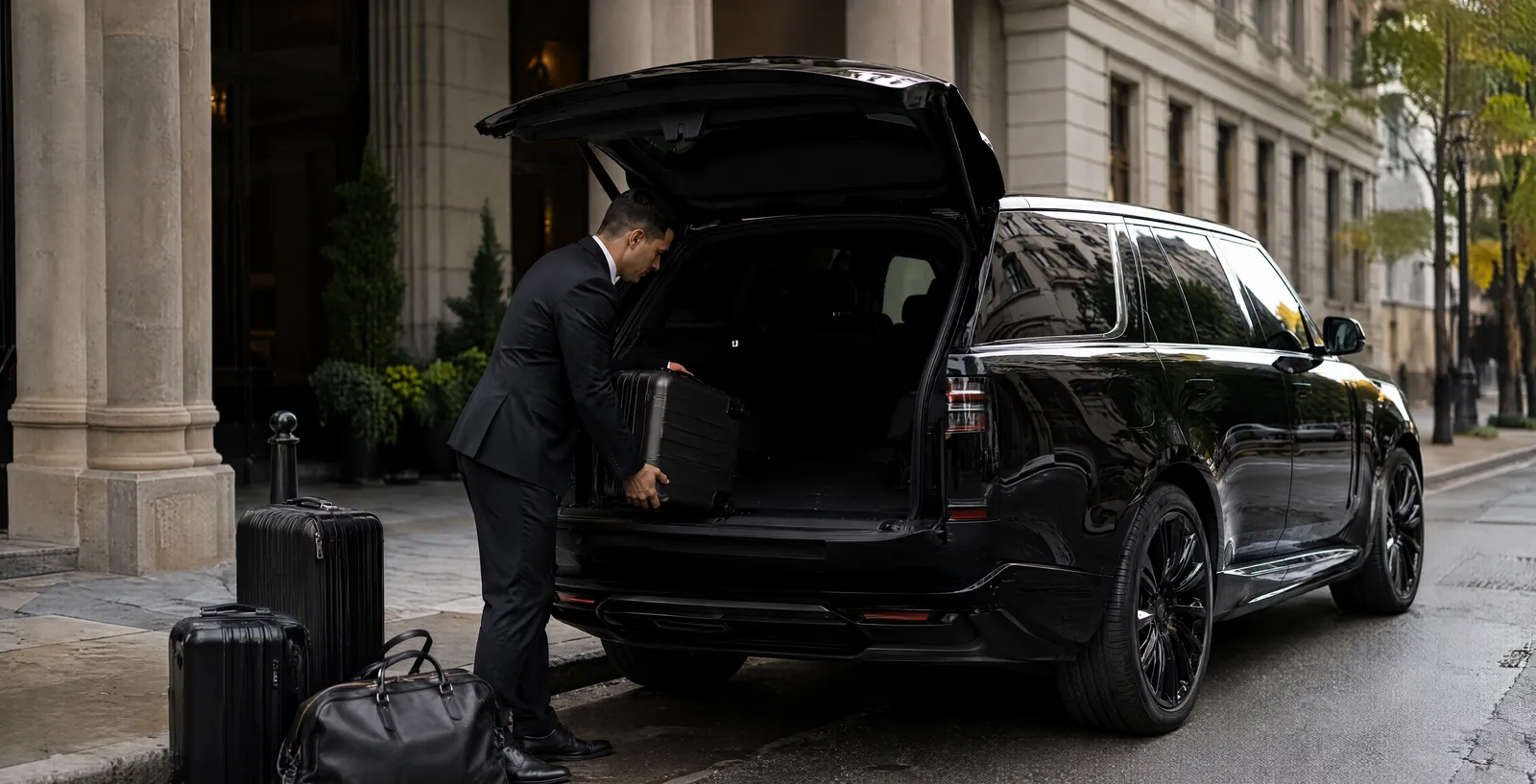
For this cottage, start by comparing a smaller private vehicle, a passenger van or Sprinter arrangement, and separate collections for guests with different origins. A mini bus is a comparison option only if the load or wider itinerary calls for it and access is confirmed. It should not be the default simply because the request uses the words group transfer.
| Journey arrangement | When it may fit | Bags and access questions | Quotation basis |
|---|---|---|---|
| Private car or SUV | A smaller party travelling on one schedule | Confirm usable luggage space with all seats occupied, plus the agreed unloading point | Actual Toronto or YYZ itinerary, distance and return requirements |
| Passenger van or Sprinter | The cottage party wants to travel together | Give the operator the full bag inventory; confirm the specific vehicle and approach with the host | Out-of-town distance quote including declared stops and both directions |
| Separate Toronto and YYZ collections | Guests are split between the city and arriving flights | Keep luggage with the correct party and send the same confirmed property directions to each driver | Each collection and return leg quoted as specified |
| Mini bus, only if justified | A load or broader permitted itinerary cannot be met by the smaller options | Do not infer turning room or unloading permission from parking availability | Vehicle and access review before a distance-based quotation |
Vehicle category names are not capacity commitments. Ask for the actual seating and luggage arrangement offered for your date. The same number of people can need different vehicles depending on whether they carry small overnight bags or checked suitcases and bulky equipment. An attractive cabin photograph cannot establish how much storage remains behind the occupied seats.
The property advertises free parking on the premises. That is useful information for accommodation planning, but it does not prove that a long vehicle can enter, turn, wait or unload at the door. Ask the host about the proposed vehicle, then let the transport operator assess the answer. If access cannot be confirmed, resolve an acceptable handover arrangement before the booking is finalized. Do not invent a roadside meeting point on arrival day.
Make the Toronto departure practical
Choose a collection point where the whole party can assemble with luggage and board without rushing. A Toronto hotel may suit guests staying downtown; another group may prefer one agreed residential pickup. In either case, the driver needs the precise entrance and a contact who will answer the phone. A building name without an entrance can leave people waiting on different sides of the same block.
Several door-to-door pickups can feel convenient when first proposed. They also create a sequence: the first passengers are aboard while later stops still have to happen. Compare that arrangement with meeting at one location before choosing. Declare every pickup in the quotation request, rather than circulating a different route through the group chat after the vehicle has been booked.
Set a passenger meeting time before the booked departure, with enough room to count bags and help anyone who needs more time to board. Keep the two times distinct in the travel note. “Meet downstairs” is not the same instruction as “the vehicle leaves.” One organizer should be responsible for checking who is present and telling the driver when the group is ready.
Avoid promising a fixed Toronto-to-cottage journey time without the private destination and date being checked. The pickup sequence, road conditions and any planned stops all belong in the schedule. Work backwards from the host-approved arrival window and ask the operator for a departure recommendation. That produces a usable plan without turning a general online estimate into a guarantee.
Pearson arrivals have a different starting point
For YYZ, provide the arrival date, flight number, airline, terminal if known and a passenger contact who can receive messages after landing. Add the number of checked bags, not just the cabin bags people expect to carry aboard the vehicle. Landing is only one step in reaching the pickup point; baggage collection and arrival formalities happen before the party is ready to leave.
Get the airport meeting instructions from the transport provider for the actual booking. Do not promise that a driver will wait inside the terminal with a nameboard or tell guests to go to an arbitrary curb. Forward the same instructions to everyone on that collection, including anyone whose phone number is not on the original quotation request.
If guests arrive on different flights, compare one shared departure with separate collections. A shared transfer may suit arrivals close enough together that everyone accepts the wait. When the flights are widely separated, making the first party remain at the airport can consume much of its arrival day. Separate vehicles may protect the schedule, but they require separate contacts and an agreed way for both parties to enter the cottage.
A delayed flight can also change the cottage arrival. Designate one person to tell the host if the group will be later than expected, while the passenger contact handles the transport update. The two conversations solve different problems. Before accepting the transfer, ask how flight delays, waiting and changes to the booked collection are handled and which charges, if any, could follow.
Pack for a self-catering lakeside stay
The Rosewood listing describes a kitchen and outdoor space as part of the stay. That makes groceries and supplies a real transport consideration, even though they are not passengers. Count shopping bags and coolers alongside suitcases before requesting a vehicle. A group that reports only eight people has not told the operator whether it is carrying eight compact bags or a week’s worth of supplies.
Send a short load list with practical descriptions. Include large suitcases, cabin bags, folded strollers, mobility equipment, coolers and any unusually long items. Ask about dimensions where something may not fit ordinary luggage storage. Keep medication, travel documents and anything needed during the journey in a small accessible bag rather than buried under the rest of the load.
Do not assume water equipment is either supplied by the cottage or accepted in the vehicle. The listing’s waterfront features are not a transport allowance for boards, paddles or other awkward items. Confirm what you intend to use with the host, then declare anything you plan to bring to the operator. Removing an unnecessary large item can change the most sensible vehicle choice.
If a grocery stop is needed, put it in the itinerary before requesting the quote. Name the intended stop or ask the operator to assess a proposed location, and agree the time allowance. Shopping after an airport arrival can take longer than collecting an order that is already packed. Either way, the stop changes both the passenger schedule and the load for the final part of the trip.
Connect the transfer to cottage check-in
The visible Airbnb house rules showed check-in after 4 p.m. and checkout before 11 a.m. when reviewed. Treat these as planning information to reconfirm against your reservation, not a transport promise. An early vehicle arrival does not create permission to enter the cottage, leave luggage or use the waterfront before the accommodation booking begins.
For a morning flight, discuss the gap between airport readiness and property access before selecting the transfer time. You might arrange a later collection or agree a specific stop as part of the booked journey. What matters is that the plan is accepted by the people responsible for it. Do not build an itinerary around an unconfirmed early check-in and leave the driver to resolve the difference at the property.
The listing advertises self check-in with a smart lock. Confirm who will hold the current access instructions and who will be first through the door. Transport arrangements do not give the driver responsibility for operating the accommodation booking or troubleshooting its lock. Keep entry codes out of a public itinerary and share only what is necessary with the appropriate people.
If the group splits between Toronto and Pearson collections, the booking holder may arrive on the later vehicle. Deal with that before departure. Ask the host how the earlier guests should be admitted, and make sure they have a working contact. Otherwise, a sensible split-transfer decision can produce a second problem: one party reaches the correct cottage but cannot begin its stay.
Ask about the last part of the approach
The useful access question is specific: can the proposed vehicle reach the agreed unloading point and leave safely on the travel date? Send the host the vehicle category under consideration and ask for any approach instructions the operator should review. Parking, turning and unloading are separate matters. Permission to park a guest car does not answer all three for a passenger van or mini bus.
For an arrival after dark, confirm how the group will recognize the correct entrance and where the vehicle should stop. Keep the host’s directions with the trip contact rather than relying on a screenshot buried in a long conversation. If the host provides a gate instruction or a seasonal restriction, relay it without rewriting the wording into an assumption about what a larger vehicle can do.
Passengers with mobility needs should describe the assistance and equipment they require before the vehicle is selected. Ask both the host and the transport provider about their respective parts of the arrival. A suitable vehicle does not establish an accessible path into the cottage, and a ground-level room would not by itself establish step-free access from the unloading point.
Where the host and operator cannot agree on direct access, pause that part of the booking. An alternative drop-off requires permission, a safe place to stop and a workable plan for people and luggage to reach the property. It is not enough to say that everyone can walk the last stretch. That assumption may fail for children, mobility equipment, poor weather or a heavily packed group.
Book the return before everyone settles in
The return from Rosewood on Rosseau deserves the same detail as the Toronto or YYZ departure. Specify the date, pickup point, passenger count, bag count and final destinations. Do not leave it as “back to Toronto on Sunday” if some guests need Pearson and others need a downtown hotel. The order of those stops affects the journey and should be quoted in advance.
Start with the earliest immovable requirement. For an airport return, that is the airline’s required arrival or check-in timing for the actual flight, not the cottage checkout alone. Ask the operator to work backwards from it using the confirmed address, date and route. Include the time needed to load luggage and any stop that is part of the agreed transfer.
A later flight does not automatically solve checkout. If the accommodation must be vacated before the airport-bound vehicle is due, confirm where the group and its bags can wait. Do not assume that the host can store luggage or that the driver can remain on site between transfers. An agreed earlier departure or a separately planned stop may be more practical than an unsupported promise of waiting space.
On the final morning, finish packing before the pickup rather than treating vehicle arrival as the signal to begin. Set aside one bag for the journey, check the rooms for chargers and medication, and follow the host’s departure instructions. The driver should receive a clear readiness update from the trip contact. This keeps a cottage checkout task from becoming an airport delay.
Keep accommodation changes separate from transport changes
A guest joining late, a pet coming along or an extra overnight stay can affect more than one reservation. The listing currently includes pets among its amenities, but the host’s rules and the vehicle provider’s acceptance are separate questions. Obtain agreement from both where relevant. Do not infer a transport policy from an accommodation amenity.
For children, provide the details the operator needs to assess appropriate restraints and seating before accepting the vehicle. A child’s luggage, stroller and car seat can change the load. Avoid making assurances about equipment provision until the operator has confirmed the actual arrangement. The cottage listing’s family-oriented features do not establish anything about the booked vehicle.
Use one written itinerary as the record of the agreed transport. When a change is accepted, replace the old version and circulate the revised one. The host needs updates that affect the accommodation arrival; the transport provider needs updates that affect vehicles, passengers, stops or timing. Sending every conversation to every guest is less useful than giving each party a clear current instruction.
Keep the scope honest as well. A Toronto-to-cottage return reservation does not include an unspecified vehicle on standby for restaurants or outings during the stay. If your trip requires more than the intercity journeys described here, disclose that when enquiring rather than assuming it is covered. This article does not promise local transport availability around Rosseau.
Request a quote that covers the actual trip
An out-of-town quotation should describe the journey you intend to buy. Give Chauffeuropolis the Toronto or Pearson origin, the host-confirmed property destination, dates, passenger and luggage details, and the proposed return. Include flight information for airport collections and departures. Explain any unresolved access question instead of filling the gap with a guessed street address.
Use the approximate one-way budgets above to plan the trip, then book online with your actual pickup, destination, date, passengers and luggage. Add the return if needed. The selected vehicle and itinerary determine the final price; a GTA hourly rate is not the price of an out-of-town transfer.
The most useful request can be short: identify the property by its listing link, give the confirmed private address through the booking channel, state who is travelling and what they carry, then list outbound and return movements separately. If one part is still undecided, label it as undecided. That gives the operator a question to resolve instead of an apparent instruction to price an incomplete trip.
Request a quotation with those details, or use the Chauffeuropolis booking page when you are ready to provide the itinerary. Keep the accommodation confirmation alongside the accepted transfer details. Neither reservation replaces the other.
Questions about Toronto and YYZ transfers to The Rosewood
Is this the same destination as JW Marriott The Rosseau?
No. The supplied Rosewood on Rosseau link identifies an entire cottage whose listing description calls it The Rosewood. Use that listing and the host-confirmed address for the transfer, not a resort name selected from a map search.
Can the whole cottage party travel in one vehicle?
Possibly, once the actual passenger count, luggage load and property access have been assessed. The cottage’s visible guest limit is an accommodation rule, not a vehicle specification. Ask the operator to identify the offered vehicle and its usable luggage provision before confirming.
Can a coach drive to the cottage door?
Coach access has not been verified. The listing advertises parking on the premises, but it does not establish coach turning space or an approved coach unloading point. Obtain property-specific confirmation and an operator assessment before selecting a large vehicle.
Can we travel directly from Pearson?
Request a YYZ-to-property transfer with the flight details, passenger contact and full luggage count. The booking should specify airport meeting instructions and how delays are handled. Coordinate the expected arrival with the host’s check-in arrangements rather than assuming landing time is departure time.
Should the return to Toronto or YYZ be booked separately?
Include the return as an explicit leg in the original enquiry, even when the quotation covers both directions. State its date, pickup time or required airport arrival, and every destination. A general return request is not a confirmed schedule for guests with different flights.
Do we need to send the cottage address publicly?
No. The listing says the exact location is supplied after booking. Share the confirmed destination privately with the transport provider and the people who need it. Use the property name and listing link in general planning notes without exposing access codes or private arrival instructions.
What if we want a grocery stop on the way?
Declare it before the quotation is accepted. Agree the stop, its time allowance and the additional luggage it creates. A shopping stop is part of the itinerary, not an automatic inclusion in a direct transfer.