

CHAUFFEUROPOLIS / ONTARIO JOURNAL
The Alpine Ridge: travelling privately from Toronto
Toronto and Pearson departures to The Alpine Ridge, with the return planned around your stay.
What to budget for the transfer
Start with these approximate one-way budgets, then book online using your pickup, travel date and passenger details. If the vehicle or itinerary is not offered online, request a quote for that arrangement.
| Vehicle | Passenger capacity | From YYZ, one way | From downtown Toronto, one way |
|---|---|---|---|
| Sedan | 2 to 3 passengers | Approx. $425 to $600 | Approx. $400 to $550 |
| SUV | Up to 6 passengers | Approx. $625 to $875 | Approx. $575 to $825 |
| Cadillac Escalade | Up to 6 passengers | Approx. $950 to $1,300 | Approx. $875 to $1,225 |
All amounts are CAD, plus 13% HST and 15% to 20% gratuity. Luggage, stops, waiting, tolls and vehicle selection can affect the total. Passenger capacity does not override property occupancy or access limits.
The YYZ ranges are planning estimates based on our published Muskoka rates and the approximate road-distance difference. Downtown Toronto ranges are estimates using Union Station as the reference pickup, not published flat fares. Allowance ranges are not a guarantee of the final price. See our current rates.
Google Maps puts the driving distance at approximately 270 km from YYZ and 250 km from Union Station to the Percy Lake, Haliburton, Ontario area. These are locality reference routes, not measurements to a private cottage entrance. Distances depend on the route selected; some routes use toll roads. Enter the exact address for your booking.
The table covers one outward journey. Add the return when booking if you need both directions; these amounts do not include a driver staying with you or local trips during your visit.
A private transfer from Toronto or Toronto Pearson (YYZ) to The Alpine Ridge should be planned around a confirmed house reservation, the group’s luggage and the property’s arrival instructions. The exact Airbnb listing describes The Alpine Ridge as an all-season lakehouse on Percy Lake in North Haliburton and places the home in Dysart et al, Ontario. Request an out-of-town, distance-based quotation for the outward journey and the return to Toronto or Pearson. Vehicle access and the final unloading point need confirmation before a vehicle is assigned.
This is a house-stay journey, with a different rhythm from a hotel arrival. Friends may be bringing groceries, children may have bulky equipment, and the person holding the reservation may not be travelling in the first vehicle. Sorting those details before departure protects the part of the trip everyone actually wants: time together at the lake house.
The article covers Toronto-based intercity transportation in both directions, not short local rides around Haliburton. Accommodation and transportation are separate bookings. Chauffeuropolis is not presented as an affiliate of The Alpine Ridge, and transport availability does not establish accommodation availability.
On this page
- Choose the journey before choosing the vehicle
- What makes this a lake-house stay
- The final approach deserves its own conversation
- Leaving Toronto with everyone ready
- Pearson arrivals need a separate plan
- Coordinate arrival around the house reservation
- Luggage, food and the return load
- Book the return as carefully as the outward trip
- What belongs in a useful quote request
- Questions before reserving a transfer
Choose the journey before choosing the vehicle
Start with the confirmed guest list and everything that must travel. A passenger count alone does not describe a cottage-weekend load. Hard-sided suitcases, food containers, a stroller and mobility equipment all compete for space. Share the number and size of these items when requesting a vehicle, rather than asking for the smallest vehicle with enough seats.
| Journey arrangement | When it is worth considering | Luggage and access checks | Quote basis |
|---|---|---|---|
| Private car or SUV | A couple, family or small party travelling on one schedule | Confirm usable luggage space with the actual bags; establish the permitted unloading point | Out-of-town distance quote for the specified pickup and destination |
| Passenger Sprinter | One staying group that benefits from travelling together | Match the particular cabin to passengers and bags; have the property’s approach and turning space checked | Distance quote with requested stops and separate return details |
| Separate smaller vehicles | Guests have different flights, departure times or loading needs | Give each driver the same host-confirmed destination; identify who can enter the house first | Quote each movement rather than assuming a combined group fare |
| Larger vehicle request | Only where the actual party and luggage justify it | Do not infer access from a parking symbol; property permission, turning space and unloading suitability remain unresolved | Written itinerary quote after access review, not an advertised Toronto hourly rate |
A bigger vehicle is not automatically the better choice. Extra seats do not help if the luggage arrangement is unsuitable or the vehicle cannot use the confirmed arrival area. Nor do those seats increase the number of people allowed to stay at the house. The accommodation booking controls occupancy; the transport booking controls how the agreed party travels.
Treat the table as a way to discuss requirements, not a fleet availability promise. If the outbound party and returning party differ, specify both. Someone joining from Pearson on arrival may return to a Toronto hotel while the rest of the group flies home. That is a different itinerary from a simple reversal of the outward trip.
What makes this a lake-house stay
The source Airbnb listing names The Alpine Ridge and describes an all-season lakehouse on Percy Lake in North Haliburton. It advertises a wood-burning fireplace, sauna, lake views, Wi-Fi and a chef’s kitchen. These advertised features do not establish permission to bring additional visitors or host an event; confirm essential amenities with the host for your dates.
The advertised kitchen makes food planning worth doing before the vehicle arrives. Decide whether the party will bring groceries from Toronto, request a shopping stop or make separate arrangements with the host. A grocery stop should be included in the transport request with a realistic shopping allowance. It should not be added casually when a vehicle is already loaded and a host is expecting the group.
Pack for the stay you have booked. Discuss bedding, baby equipment and any items essential to an individual guest with the host. Getting those answers early can reduce unnecessary bags. Do not remove essential equipment from a packing list merely because a general amenity description appears to cover it.
The source Airbnb listing identifies a house in Dysart et al, Ontario. Its current title emphasizes a lakehouse, sauna and stargazing. The word Alpine in the property name is not evidence of ski-in access, a ski resort, lift tickets or a resort shuttle. This journey is to the booked residence, not to an assumed ski facility with a similar name.
The final approach deserves its own conversation
Use the arrival instructions supplied with the actual booking as the operational reference. Send them privately to the transport provider. There is no need to circulate a private home’s full address through an open group invitation or a public itinerary. Guests need a confirmed meeting plan; the driver needs the precise approved destination and any host instructions relevant to access.
Ask the host where unloading should occur and whether the selected vehicle can turn around there. If the answer is uncertain, resolve it before committing to a larger vehicle. Do not assume permission for coach access, overnight commercial-vehicle parking or permission for a driver to wait on site.
For winter travel, ask about the approach close to the trip date, including any instructions following snow or ice. This is a question about the planned journey, not a claim that the road is impassable or that special equipment guarantees access. The transport provider should assess conditions and vehicle suitability. No driver should be expected to continue into an unsafe unloading area to preserve a promised door-to-door description.
A fallback needs to be agreed, not improvised. If the house cannot be reached by the chosen vehicle, the group needs an authorized alternative that works for people and baggage. Do not assume guests can walk an unspecified distance with luggage, or that a second vehicle will be waiting. Any change to the final handover needs the host, lead traveller and transport provider to agree on the same arrangement.
Leaving Toronto with everyone ready
For a Toronto departure, one agreed meeting point is often simpler than collecting every guest separately. Choose a pickup location that works for the group and can accommodate legal loading. A building entrance can look convenient on a map while being unsuitable for a vehicle to wait beside. Give the transport provider the exact entrance, not just the building name.
Keep the meeting time separate from the departure time. Guests need time to bring bags down, check that children’s belongings are present and identify items that should remain within reach. The driver cannot solve a missing key or a guest who is still shopping by driving faster. Assign one person to confirm that the entire departing party is ready.
Multiple Toronto pickups can still make sense, especially when a guest has a mobility need or the party is spread across the city. Include the full sequence when asking for the quote. The order changes the journey for everyone already aboard and can affect whether a planned meal or check-in window remains comfortable. Avoid describing a multi-stop collection as a single direct transfer.
Keep essentials in a small bag that travels with the passenger. Medication, a phone charger, children’s immediate needs and the host’s contact details should not disappear into a suitcase buried under other luggage. For anyone who needs assistance boarding, describe the practical requirement before vehicle selection. General descriptions such as comfortable or spacious do not establish that a vehicle fits that person’s needs.
Build the departure schedule from the house’s confirmed arrival window, then let the transport provider advise on the road plan for the date. This article does not publish a fixed Toronto-to-property travel time. The pickup location, requested stops, weather and traffic all matter, and an estimate is not a guarantee of arrival at a precise minute.
Pearson arrivals need a separate plan
A Pearson pickup starts with the flight details, not just a clock time. Provide the arrival date, flight number, terminal if known, passenger names for the lead contact and a telephone number that will work after landing. Include checked luggage and oversized items in the vehicle request. A group with the same headcount can need a different loading arrangement after an international flight than after a Toronto hotel stay.
Landing time is not the time everyone will be ready to leave. Allow for the arrival process and baggage collection when discussing pickup. Follow the specific meeting instructions in the confirmed transportation booking rather than expecting an unannounced driver inside the terminal. If the plan changes, the lead traveller should contact the transport provider through the agreed channel.
When guests arrive on separate flights, compare a shared departure with separate vehicles. Waiting together can suit a party whose flights are close enough and whose members are comfortable with the arrangement. Separate journeys can be more practical when flights are far apart or some guests need to rest. Ask how a late flight affects the shared booking before deciding, rather than assuming everyone can wait indefinitely without consequences.
Do not commit the first arrivals to accepting the house on behalf of everyone unless the host permits it. The person named on the reservation may have check-in responsibilities. If that person lands later, resolve entry with the host before scheduling the first vehicle. Transport coordination cannot override accommodation identification, access or check-in requirements.
A grocery stop after a flight deserves particular care. Guests may be tired, bags may fill the available storage, and the house may have a defined arrival arrangement. A preplanned stop with a clear shopping list is different from asking the driver to find somewhere suitable on the way. Confirm whether the stop, waiting time and extra loading are included in the written quotation.
Coordinate arrival around the house reservation
A lake-house arrival works best when one person carries the operational details. That person should know the host’s contact method, the agreed check-in arrangement, where the party may unload and what to do if the journey runs late. Share a short version with the travellers, but keep entry codes and private booking details within the people who need them.
Accommodation accessibility has not been established here. Ask about the actual path from the unloading point, any steps, the required bedroom or bathroom arrangement and the equipment a particular guest uses. Transportation accessibility and accommodation accessibility are separate checks, and both must work for the same traveller.
A child’s place in the vehicle also needs planning independently of the house’s facilities. Give the transport provider the child’s age and the restraint requirement when booking, and confirm the arrangement in writing. Do not arrive at pickup relying on an unconfirmed equipment arrangement.
Divide the arrival jobs. One person can deal with the house handover while another checks the vehicle for phones, bags and small items. Keep enough of the party together to avoid leaving luggage unattended while everyone explores the property. Once the vehicle leaves, retrieving an overlooked item may disrupt the rest of the day; a deliberate final check is easier.
If the party plans a hosted meal or another reservation after arrival, leave room between the handover and that commitment. Guests may need to unpack or rest. A transport schedule that ends at the address is not the same as a schedule that has everyone ready for dinner. Plan the human part of arrival, not only the driving part.
Luggage, food and the return load
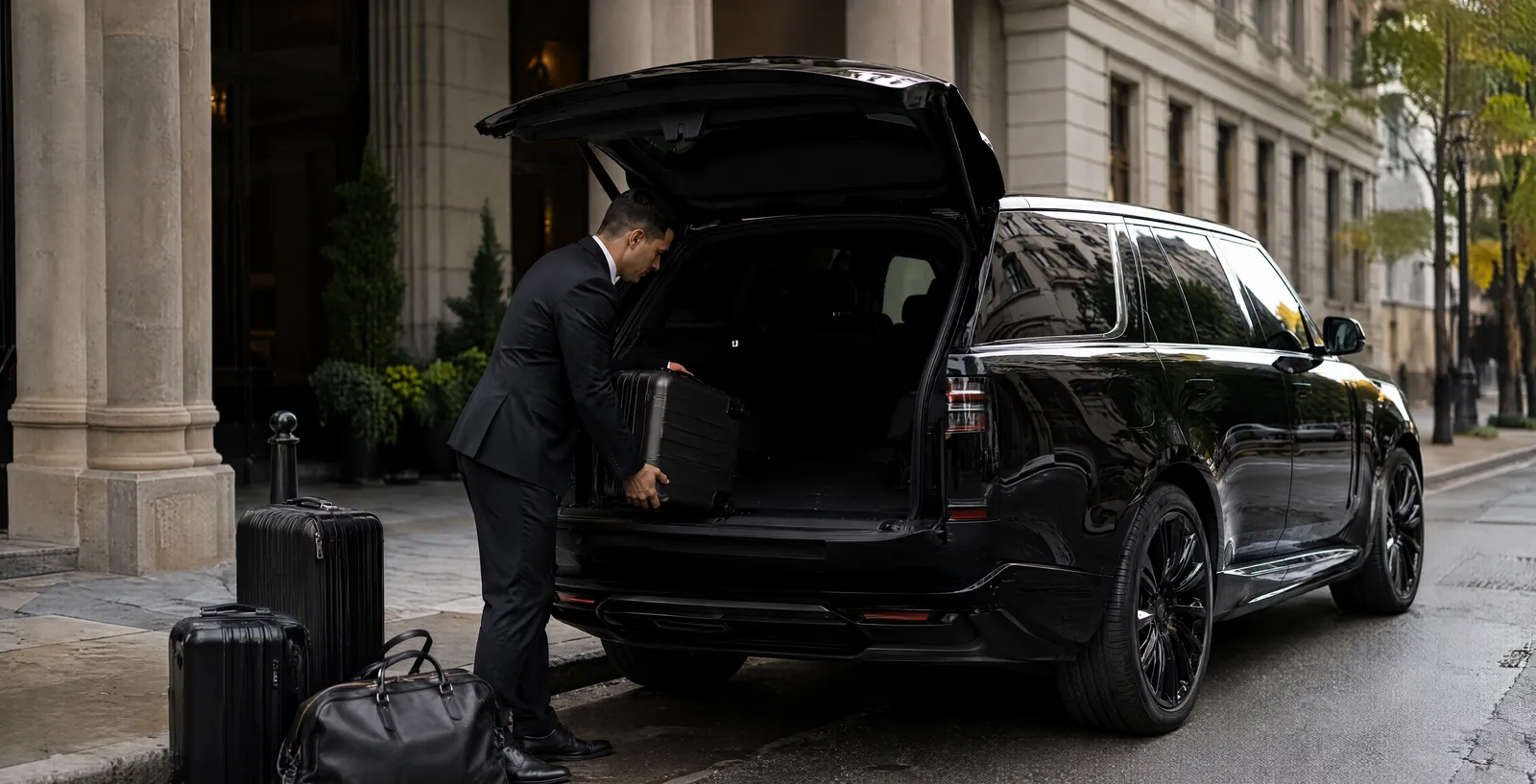
For this kind of stay, a shared luggage list is more useful than asking everyone to pack lightly. List checked-size suitcases, cabin bags, soft bags, food containers, a stroller and any mobility equipment separately. Give dimensions for unusually bulky pieces. The transport provider can then assess the real load against the chosen vehicle rather than guessing from a passenger total.
Food needs an owner. Decide who is buying it, how it will be packed and whether there is room to transport it safely with the passengers’ luggage. Do not assume a vehicle offers refrigerated storage. If food needs temperature control, arrange appropriate containers and keep the journey plan consistent with safe handling. A chef’s kitchen at the destination does not resolve storage during the drive.
Ask the host about any outdoor equipment you hope to use, including availability, condition and rules. If you want to take your own equipment, describe it at quotation stage and ask whether the selected vehicle can carry it securely.
Revisit the list before returning. Wet clothing, leftover groceries and purchases can change how bags are packed even when the passenger count stays the same. Contain damp items and have luggage ready before the pickup window. Tell the provider promptly if an added item changes the load substantially; a return vehicle is not an unlimited storage allowance.
Book the return as carefully as the outward trip
Confirm the return movement when planning the outward journey. State the date, the party travelling, luggage expectations and the exact Toronto destination or Pearson departure details. A stay at the property does not mean a chauffeur remains nearby for the duration. Any requested waiting arrangement is a separate part of the itinerary and needs explicit confirmation.
For a Toronto return, agree on the final drop-off pattern. One shared destination may be simpler than several home addresses, but convenience should be weighed against the needs of the actual passengers. Supply all intended stops before the quote is finalized. A return to a downtown hotel followed by a separate airport trip is not the same service as going directly to Pearson.
For a Pearson departure, work backwards from the airline’s recommended airport arrival time. Give the provider the flight number, departure time and any factors that affect the airport process. Add room for loading at the house and road uncertainty. Do not use a best-case map estimate as the entire buffer for a flight that cannot wait.
House checkout and vehicle pickup should agree with each other. Allow time for the host’s departure instructions and a final room check before the vehicle needs to leave. If some guests are staying longer, make clear who is responsible for the house after the first group departs. The driver should not have to infer whether the accommodation has been properly handed back.
Changes need one coordinator. If a guest’s flight changes or someone decides to remain in Toronto, update the return details through the lead traveller rather than sending different instructions from several phones. Ask the provider to confirm the revised plan and any effect on the quotation. A message requesting a change is not proof the change has been accepted.
What belongs in a useful quote request
Request an out-of-town distance quote for the actual route. Do not multiply a Toronto hourly rate by an estimated driving time and treat the result as a cottage-transfer price. The outward movement, the return, any waiting arrangement and requested stops should be clear enough for the provider to price the service you intend to use.
A useful request can be short, but it needs the right details:
- Travel dates, Toronto pickup location or Pearson flight details, and the confirmed accommodation destination.
- Passenger numbers in each direction, children requiring restraints and any boarding or mobility needs.
- A luggage inventory, including groceries, bulky equipment and items that must remain accessible.
- The host’s vehicle-access instructions, arrival window and agreed unloading point.
- All requested stops, the return destination and any flight that determines the return schedule.
Ask the written quotation to explain applicable taxes, gratuity, waiting, extra stops and change terms. This article does not state a current fare or promise that any of those items is included. Accommodation charges and host-arranged services remain separate. Compare quotations against the same itinerary so an omitted return or shopping stop does not look like a saving.
Send these details through Chauffeuropolis booking when requesting the transportation arrangement. Keep the house reservation reference available for coordination without placing private access information in a public comment. A confirmed quote should describe what has been agreed, including the limits of the final approach, rather than leaving the group to discover those limits at arrival.
Questions before reserving a transfer
Is The Alpine Ridge a ski resort?
The exact Airbnb listing describes an entire home and a lakehouse, not a ski resort. Do not infer ski-in access, lift access or a resort shuttle from its name. If skiing is part of your stay, discuss those plans separately with the host and transport provider.
Can the whole group travel in one Sprinter?
Possibly, but the particular vehicle must fit the confirmed passengers and luggage, and its access to the agreed unloading point must be checked. A seating figure alone is not enough to select it. The house’s permitted guest count remains a separate accommodation condition.
Does the property have parking for a larger vehicle?
The exact Airbnb evidence reviewed here does not establish access or parking permission for a larger passenger vehicle. Ask the host about the selected vehicle and have the transport provider review the answer before promising an arrival arrangement.
Can we travel from Pearson and return to downtown Toronto?
Yes, you can request that itinerary as two separately specified movements, subject to service confirmation. Give the arriving flight details for the outward pickup and the exact Toronto destination for the return. Do not describe it as the same route in reverse.
Are meals or chef services included with transportation?
No meals or chef services are included or promised by this article. Make any meal arrangements separately and schedule transportation around confirmed plans, not assumed inclusions.
What if our flight arrives later than planned?
Contact the transport provider using the confirmed booking instructions and tell the host if the house arrival will change. Ask about delay, waiting and rescheduling terms before booking. A delayed flight does not automatically extend the house’s arrival arrangements or settle the transport charges.
What accessibility details should we confirm?
Accessibility has not been verified for this property. Confirm the unloading route, steps and required indoor facilities with the host. Then confirm boarding and equipment arrangements separately with the transport provider.
Is the chauffeur available for local trips during our stay?
Do not assume local availability. This article concerns prearranged Toronto or Pearson transfers to the residence and the booked return. Any additional movement or waiting request needs its own explicit agreement; a round-trip reservation does not place a vehicle on standby throughout the stay.