

CHAUFFEUROPOLIS / ONTARIO JOURNAL
A Wolegib Muskoka stay with transport from Toronto
Toronto and Pearson departures to Wolegib Muskoka, with the return planned around your stay.
What to budget for the transfer
Start with these approximate one-way budgets, then book online using your pickup, travel date and passenger details. If the vehicle or itinerary is not offered online, contact us for that arrangement.
| Vehicle | Passenger capacity | From YYZ, one way | From downtown Toronto, one way |
|---|---|---|---|
| Sedan | 2 to 3 passengers | Approx. $400 | Approx. $375 to $525 |
| SUV | Up to 6 passengers | Approx. $590 | Approx. $550 to $775 |
| Cadillac Escalade | Up to 6 passengers | Approx. $880 | Approx. $825 to $1,150 |
| Sprinter | Up to 14 passengers | Approx. $1,210 | Approx. $1,125 to $1,550 |
All amounts are CAD, plus 13% HST and 15% to 20% gratuity. Luggage, stops, waiting, tolls and vehicle selection can affect the total. Passenger capacity does not override property occupancy or access limits.
The YYZ column uses our published Muskoka regional guide prices. Downtown Toronto ranges are estimates using Union Station as the reference pickup, not published flat fares. Allowance ranges are not a guarantee of the final price. See our current rates.
Google Maps puts the driving distance at approximately 210 km from YYZ and 235 km from Union Station to the Huntsville, Ontario area. These are locality reference routes, not measurements to a private cottage entrance. Distances depend on the route selected; some routes use toll roads. Enter the exact address for your booking.
The table covers one outward journey. Add the return when booking if you need both directions; these amounts do not include a driver staying with you or local trips during your visit.
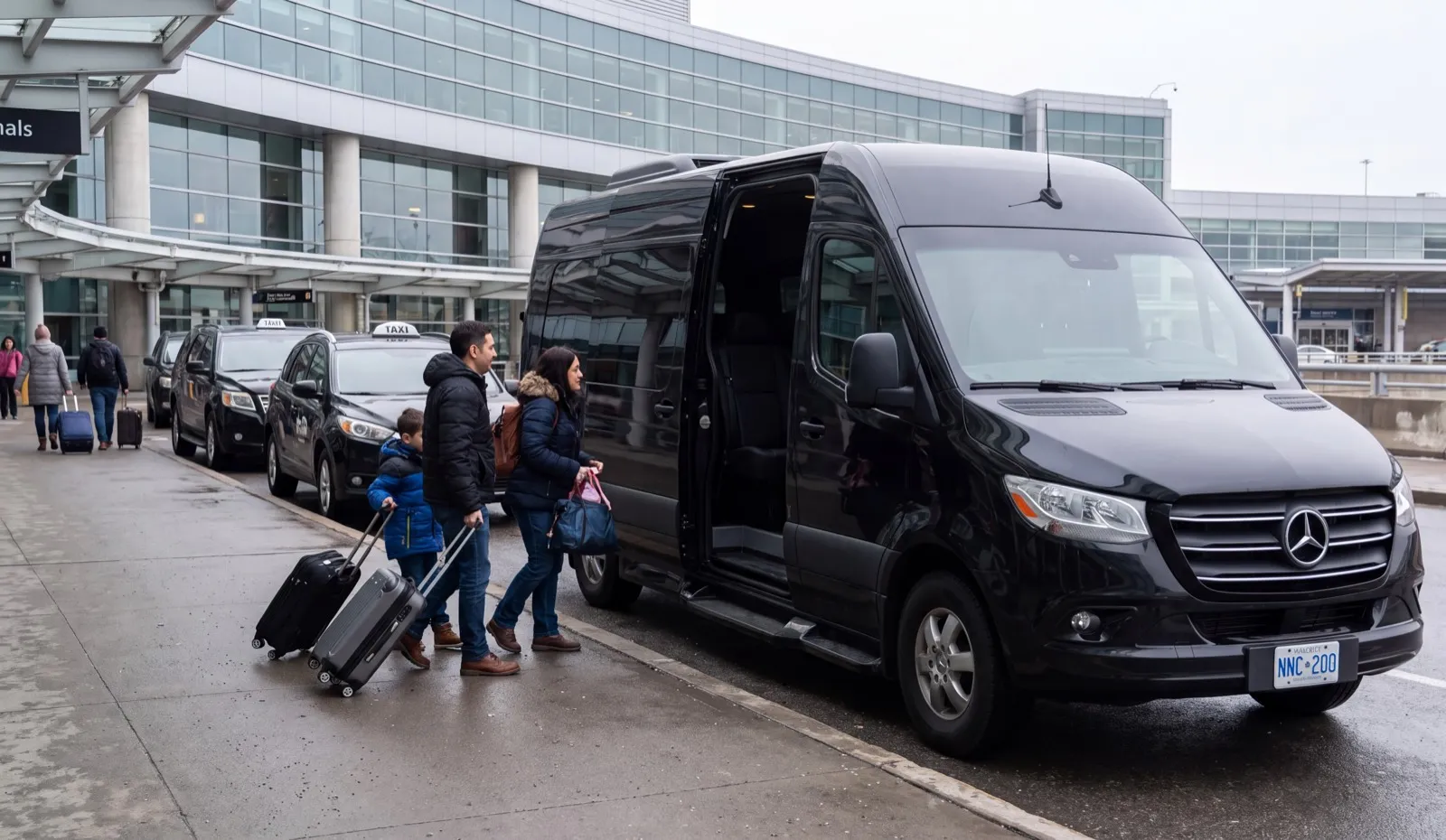
A private transfer from Toronto or Toronto Pearson (YYZ) to Wolegib Muskoka should be planned around a small cottage party, its luggage and a confirmed property arrival point. The host describes Wolegib as an eight-guest waterfront cottage near Huntsville, with three bedrooms and a private Nordic spa. Arrange the return to Toronto or Pearson at the same time, and request a distance-based out-of-town quotation for the actual itinerary. Vehicle access must be confirmed before booking.
Wolegib is a different sort of destination from a resort with a reception desk and a coach forecourt. Its appeal is a private stay: the same people sharing the house, the waterfront and the journey north. The transport decision is less about choosing the largest vehicle and more about arriving with the right supplies, enough luggage space and no awkward gap before the cottage is available.
This article covers Toronto-based intercity journeys to Wolegib and back. It does not promise local rides around Huntsville, a vehicle stationed at the cottage or an accommodation package. Chauffeuropolis transportation and the cottage reservation are separate bookings; no relationship with the property is implied.
On this page
- Choose the vehicle around the stay
- What makes Wolegib worth a dedicated journey
- Plan the Toronto departure
- Coordinate Pearson arrivals
- Pack for a private waterfront stay
- Confirm the last part of the journey
- Build a stay without an assumed local driver
- Book the return before leaving Toronto
- Understand the transfer quotation
- Questions before booking
Choose the vehicle around the stay
Start with the people who are actually staying at Wolegib, not the seat count in a vehicle photograph. The host’s property page advertises eight guests. That accommodation figure is not a statement about transport capacity, permission for visitors or permission to hold an event. A vehicle with unused seats does not increase the number of people allowed at the cottage.
A smaller party may suit a private car or SUV, while a fuller cottage party with overnight bags may need a passenger van. Neither is a confirmed recommendation until the operator has the passenger list, luggage inventory and access information. A vehicle’s seat count alone cannot tell you whether hard-shell cases, a stroller and a cooler will fit safely together.
| Journey choice | When to consider it | Luggage and access questions | Quote basis |
|---|---|---|---|
| Private car or SUV | A couple or small party travelling together | Confirm the actual vehicle’s seats, case space and any child restraints; do not assume an SUV fits every cottage load | Distance-based itinerary from the exact Toronto pickup or YYZ, with the return specified |
| Passenger van or Sprinter | A larger share of the booked cottage party travelling on the same schedule | Check luggage space for the chosen interior and obtain property access approval for that vehicle | Distance-based outbound and return legs, plus any agreed stops or waiting |
| Separate smaller vehicles | Guests with different flight arrivals, departure dates or luggage needs | Each vehicle needs its own passenger list and arrival instructions; the property occupancy limit still applies | Separate journeys quoted against their actual origins, dates and endpoints |
| Larger bus | Not the default for this small cottage stay | No coach access, turning area or large-group occupancy is established; resolve suitability before considering it | No assumed bus fare or access promise |
The useful comparison is often one van versus separate smaller vehicles, rather than a car versus a coach. One shared journey keeps a group together. Separate journeys can make more sense when some guests land much later or when the return party splits between Pearson and downtown Toronto. Ask for both arrangements if those differences would affect the holiday.
What makes Wolegib worth a dedicated journey
The Wolegib property page describes a Scandinavian-inspired cottage on three private acres, with floor-to-ceiling windows and protected conservation land across the water. Its current accommodation summary lists three bedrooms and two bathrooms. The linked direct booking listing names the property “Wolegib Muskoka | Private Nordic Spa + Beach.” Those are useful details for understanding the stay, rather than reasons to assume a particular transport arrangement.
For this stay, waterfront access and the spa are the main attractions. The host lists a private beach, dock, sauna, hot tub and cold plunge, with the spa overlooking the Muskoka River. A group intending to spend much of its time at the property has different arrival needs from travellers using a hotel as a base for several outings. Getting food, personal items and the whole booked party to the cottage can matter more than arriving near a restaurant at a particular hour.
The bedroom layout also helps explain why this is a small-party transfer article. The host lists a king bed in the main bedroom, another king bed in the second bedroom and a queen-over-queen bunk in the third. Agree the sleeping arrangements with your travelling companions before arranging transport. Eight advertised guests does not mean eight separate beds, and a shared cottage does not offer the room allocation flexibility of a hotel.
Families may be interested in the listed outdoor playground, books, games and ping pong table. These amenity listings do not establish that supervised activities are provided. Parents still need to plan suitable restraints for the road journey, keep essentials accessible and make their own decisions about the waterfront. Ask the host about age suitability and seasonal availability rather than assuming every photographed feature will be usable during your dates.
The host describes year-round stays, but a winter visit and a summer visit create different packing and arrival questions. For summer, think about wet gear and food storage. For winter, think about boots, coats and the condition of the final approach. Neither season makes a general drive-time estimate a reliable pickup plan. Use the confirmed address and travel date when arranging the transfer.
Plan the Toronto departure
Choose a departure that fits the cottage’s entry arrangements. The host page currently lists check-in after 4:00 pm and checkout before 10:00 am; your own reservation instructions should settle the applicable times. An early Toronto pickup is not automatically helpful if it puts everyone at a private house before access is available. Unlike a hotel lobby, an early waiting area has not been established here.
For a group staying at one Toronto hotel, agree a single pickup entrance and a time when everyone will already be downstairs with bags. Send the hotel name and street address, not just the neighbourhood. The operator can then confirm an appropriate loading point. Do not assume a vehicle can wait at any door or occupy a busy frontage while guests finish packing upstairs.
If people are starting from several homes, compare individual pickups with meeting at one practical location. Extra stops change the route and can make the first passengers spend substantially longer in the vehicle. A meeting point reduces that complexity, but only if everyone can reach it reliably with luggage. The right answer depends on the actual origins, not a general rule that a shared pickup is always better.
A grocery stop belongs in the plan before the quote is accepted. Give the operator the intended stop and whether the group wants a short collection or time to shop. A pre-ordered collection may be easier to schedule, but it still requires a workable collection window and enough cargo space. Do not place a food order for an arrival time that has not been agreed with the transport provider.
Keep the first evening modest. If entering the cottage, unpacking and preparing dinner are the priorities, say so. That is more useful than requesting the fastest possible arrival and then adding errands on the day. One group organiser should hold the host’s arrival instructions and the transport confirmation, so changes to either booking reach the right person without being lost in several chat threads.
Coordinate Pearson arrivals
A Pearson arrival needs a pickup plan tied to the flight and the passengers’ readiness, not just the scheduled landing time. Supply the airline, flight number, arrival date, terminal if known and a reachable lead passenger. The group still has to leave the aircraft, complete any entry formalities and collect luggage before it can meet its vehicle. Follow the pickup instructions issued for the confirmed booking.
For travellers arriving on the same flight, nominate someone to report when the whole party has its bags. A message from the first person outside can create confusion if another passenger is still resolving a missing suitcase. Keep medicines, travel documents and anything needed immediately at hand. A checked-bag problem should not leave the organiser unable to contact the operator.
Different flights require an explicit decision about waiting together or travelling separately. If two arrival times are close, one vehicle may be worth discussing. If they are far apart, the early arrivals may prefer to depart rather than wait through another flight’s uncertainty. The cottage’s permitted check-in time still matters in both cases. An earlier vehicle cannot assume the host will let it deliver guests before access is available.
Ask what happens if an inbound flight is delayed and who should report a change. Waiting, rebooking and cancellation terms belong in the transport confirmation. They are not established by this article, and the cottage’s cancellation terms are a separate matter. Keep the two confirmations accessible so the group can distinguish a property deadline from a vehicle deadline.
For broader airport transport options, the Toronto airport to Muskoka shuttle page covers the regional service question. Wolegib adds a narrower concern: synchronising a private cottage handover with a particular group and its bags. Do not substitute a general Muskoka drop-off description for the host’s exact instructions.
Pack for a private waterfront stay
Count luggage as objects, not as a vague promise to travel light. Tell the operator how many large suitcases, cabin bags, soft bags and unusual items the party will bring. Add strollers, child seats, mobility aids and coolers separately. If an item is bulky, its approximate dimensions or a photograph can help the operator judge the fit. Bags should not be assigned to passenger seats or an aisle as a workaround.
A cottage load often grows after the transport is booked. One guest adds groceries, another brings a folding cot and someone else arrives with equipment for the water. Agree what the property supplies before packing duplicates. The host describes waterfront amenities, but that description does not establish which equipment will be available, suitable or included during your dates. Confirm those details with the accommodation provider.
Separate what must travel within reach from what can stay packed. Medication, warm layers, a child’s change of clothes and essential documents should not be buried under food boxes. Food that needs temperature control requires its own plan. Neither the vehicle type nor a longer journey automatically means refrigerated storage is available.
For children, request the appropriate restraint arrangement before confirming the vehicle. Provide the information the operator needs to assess suitability and agree who supplies the restraint. For passengers with limited mobility, describe the practical requirement: assistance entering a vehicle, space for a folded aid, difficulty with steps or the need to remain in a wheelchair. Do not infer accessible transport or step-free cottage entry from photographs.
Plan the return load too. Wet clothing should be packed to protect other luggage, and anything bought during the stay needs a place in the vehicle. If the return passengers differ from the outbound group, update the luggage count instead of carrying over the original number. This small check can prevent a surprise at checkout, when there is less room to improvise.
Confirm the last part of the journey
Obtain the exact destination and arrival instructions from the confirmed accommodation booking. The public listing establishes Wolegib’s identity and general setting, not a driver-ready handover plan. A map pin, a property name and a postal address serve different purposes. The operator needs the approved arrival point and enough information to assess whether the chosen vehicle can reach it safely.
Ask the host where passengers should be unloaded, whether there are access restrictions and where a vehicle can turn. If there is a gate, confirm how it is opened without publishing the access code in a general group document. Share private directions only with the people arranging or carrying out the journey. Do not send a driver towards a guessed waterfront entrance because it looks closer on a map.
Do not assume the cottage’s dock is an approved road-transfer handover point. The advertised boat slips do not establish the driveway layout, parking area or suitability for a taller vehicle. Keep those questions separate. If the host proposes an alternative meeting point, establish who will carry luggage from there and whether the arrangement works for every passenger before accepting it.
Winter adds a condition check. Ask the host about the final approach and the current unloading area, and let the operator decide whether the booked vehicle is suitable. A guest review describing a previous drive cannot certify today’s conditions. A forecast is also not evidence that a private approach has been cleared. Avoid a plan that depends on unloading people and bags somewhere the group has not agreed to use.
On arrival, the lead guest should be able to follow the entry instructions without searching through an old email chain. Check that everyone and every bag has left the vehicle before it departs. The transport booking does not make the driver responsible for inspecting the cottage or resolving an accommodation access dispute. Have the host’s contact details ready for those issues.
Build a stay without an assumed local driver
A transfer there and back does not provide a car during the stay. That distinction is especially important at a private waterfront cottage. If the group expects to spend its days at Wolegib, arrange supplies accordingly. If it expects frequent meals out or separate activities, settle those transport needs independently before committing to a car-free visit. This article does not offer a destination-local shuttle.
The host’s spa and waterfront descriptions support a stay focused on the property. They do not guarantee operating hours, treatment services, lifeguards or every amenity in every season. Check the current house instructions for safe use and any restrictions. The advertised sauna and cold plunge should not be described as a staffed spa appointment, and a private beach should not be treated as a supervised swimming facility.
A quiet family stay also needs a different plan from an event. The host page states a no-partying and no-smoking policy and says pets are not allowed. Confirm the rules in your own reservation before inviting visitors or arranging a celebration. Transport availability does not override house rules. Do not turn the eight-guest listing into a larger gathering by booking extra vehicle seats.
Think through the first meal and the last morning together. Food bought for arrival may leave leftovers at departure, and checkout tasks can compete with packing. Assigning those tasks in advance is useful for a small group sharing a kitchen. It also makes the return pickup less likely to be delayed by an unfinished clean-up or one person’s belongings still scattered through the house.
Book the return before leaving Toronto
Set the return pickup as a distinct journey with its own date, destination and passenger list. A cottage-to-Toronto transfer and a cottage-to-Pearson transfer have different endpoints and timing pressures. If the party divides between the airport and downtown, tell the operator before booking. A second destination is not an incidental detail when someone has a flight to catch.
For Pearson departures, work backwards from the airline’s current arrival guidance and the confirmed flight. Allow for loading, the road journey and a sensible contingency agreed with the operator. There is no fixed departure time in this article because an exact address, date and airport reporting requirement are needed to make that decision. A promotional driving estimate is not a flight-protection promise.
Reconcile the vehicle pickup with checkout. The host currently lists checkout before 10:00 am, which may be much earlier than the group’s flight. That gap needs a plan rather than an assumption that luggage can remain at the cottage or that the driver will wait. Ask separately about any accommodation flexibility and obtain a transport quote for any changed itinerary.
The evening before departure, confirm the number travelling, the pickup point and the lead passenger’s phone. Pack what can be packed and settle the cottage tasks that do not have to wait until morning. On departure day, finish loading before treating the party as ready to leave. Check bedrooms, charging points and shared spaces while there is still time to retrieve a forgotten item.
Understand the transfer quotation
Request an out-of-town, distance-based quote for the actual trip. Do not apply a Toronto hourly figure to the journey north or use a cottage rental price as a transport estimate. No current transfer rate is quoted here. Ask for a written breakdown that makes clear which journeys, stops and waiting arrangements are included, and how tax, gratuity and any additional charges are treated.
Send the same itinerary when comparing options. Include the Toronto address or flight details, the host-confirmed destination, travel dates, passenger count and luggage. Add the return endpoint, requested stops and access information. Otherwise, a lower quote may describe a different journey, a different vehicle or fewer included arrangements rather than a better offer for the same plan.
Before accepting a quote, identify who can authorise changes for the group. A guest who asks the driver for another stop may not be the person paying for the booking. Agree how route changes will be confirmed, and send the final itinerary to the passengers who need it. Keep the operational version concise: pickup point, ready time, destination, agreed stop, return details and contact number. Private house entry codes do not belong in a document shared with every traveller or forwarded to unrelated contacts.
Read the terms before accepting. Ask how a delayed flight, a changed pickup time or a cancelled stay affects the transport reservation. Check whether outbound and return services are both confirmed rather than assuming one automatically includes the other. Availability remains subject to confirmation, and the accommodation booking is not secured by booking a vehicle.
Request a quotation with both legs of the Wolegib itinerary, or use the booking page when the details are ready. The most useful request is specific: who is travelling, what they are bringing, where they must be collected and when the return needs to happen.
Questions before booking
Can we arrange a Toronto to Wolegib private transfer?
Request a private intercity journey from your Toronto pickup or Pearson arrival to the host-confirmed Wolegib arrival point, with a separately specified return. Availability, vehicle choice and property access must be confirmed for your dates. This is not a promise of local transport during the stay.
How many people can stay at Wolegib?
The host’s current property page lists eight guests, three bedrooms and two bathrooms. Follow the occupancy terms in your own reservation. A vehicle’s spare seats do not permit extra cottage guests, visitors or an event.
Is a Sprinter necessary for the trip?
Not necessarily. A smaller party may suit a car or SUV, while a larger booked party with cottage luggage may need a van. The final choice depends on the actual passenger and bag counts, the vehicle configuration and confirmed property access.
Does the transfer include a grocery stop?
Only include a grocery stop in your plans once it is agreed in the transport quotation. Specify the location and whether you need collection time or shopping time. Groceries and coolers also need space in the selected vehicle.
Can a coach drive to the cottage?
Coach access is not established by the sources used for this article. Ask the host and operator to confirm the arrival area, turning space and vehicle suitability. Wolegib’s small advertised accommodation capacity is a separate limit from the capacity of any bus.
What happens between checkout and a late flight?
Arrange that gap before the trip. The host currently lists checkout before 10:00 am, but late checkout, luggage storage and vehicle waiting are not assumed. Confirm any accommodation flexibility with the host and any added transport arrangement with the operator.
Are cottage amenities part of the transport booking?
No. Accommodation and amenity access are governed by the property reservation, not by the vehicle booking. The host advertises a Nordic spa and private beach, but guests should check current availability, house rules and seasonal conditions directly.
Where should we send the private address and entry details?
Share the host-confirmed arrival point and necessary directions with the transport operator through the booking process. Keep private access codes out of public documents. The lead guest should retain the accommodation instructions and host contact details for the handover.