

CHAUFFEUROPOLIS / ONTARIO JOURNAL
A High Acre getaway with transport from Toronto
Toronto and Pearson departures to The High Acre, with the return planned around your stay.
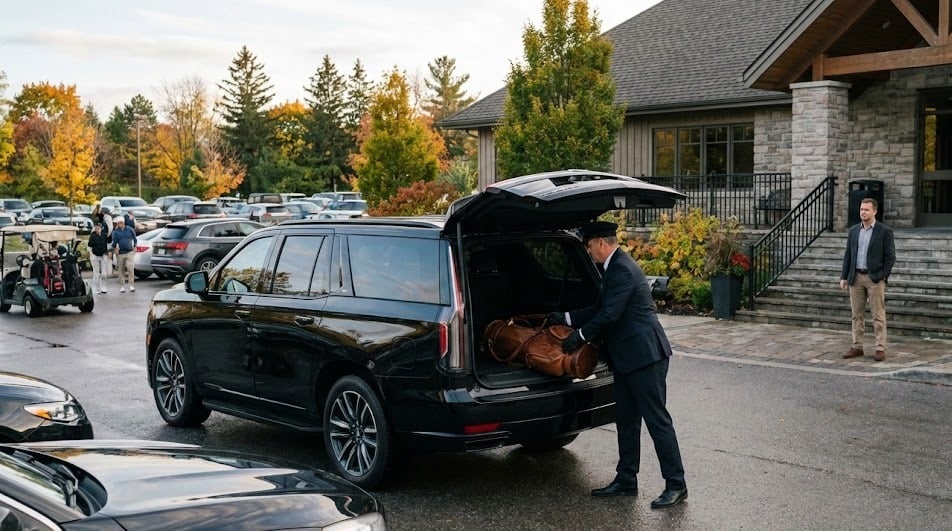
What to budget for the transfer
Start with these approximate one-way budgets, then book online using your pickup, travel date and passenger details. If the vehicle or itinerary is not offered online, contact us for that arrangement.
| Vehicle | Passenger capacity | From YYZ, one way | From downtown Toronto, one way |
|---|---|---|---|
| Sedan | 2 to 3 passengers | Approx. $125 | Approx. $100 to $175 |
| SUV | Up to 6 passengers | Approx. $190 | Approx. $175 to $275 |
| Cadillac Escalade | Up to 6 passengers | Approx. $270 | Approx. $250 to $375 |
All amounts are CAD, plus 13% HST and 15% to 20% gratuity. Luggage, stops, waiting, tolls and vehicle selection can affect the total. Passenger capacity does not override property occupancy or access limits.
The YYZ column uses our published Hamilton regional guide prices. Downtown Toronto ranges are estimates using Union Station as the reference pickup, not published flat fares. Allowance ranges are not a guarantee of the final price. See our current rates.
Google Maps puts the driving distance at approximately 70 km from YYZ and 75 km from Union Station to the destination. Distances depend on the route selected; some routes use toll roads. Enter the exact address for your booking.
The table covers one outward journey. Add the return when booking if you need both directions; these amounts do not include a driver staying with you or local trips during your visit.
A group transfer from Toronto or Toronto Pearson (YYZ) to The High Acre should be planned around a confirmed stay, the party’s luggage and an agreed arrival point. The boutique inn is at 667 Harvest Road in Dundas, Ontario. Arrange the return to Toronto or Pearson at the same time, and request an out-of-town, distance-based quotation for the actual itinerary rather than applying a city hourly rate to the journey.
The High Acre is an unusual destination for a group transport discussion. Its official website lists four suites and describes private ensuite spa accommodation, not a large conference hotel. Travelling together may suit friends who have booked separate suites, but the number of seats in a vehicle says nothing about how many people the property permits to stay or visit. Start with the room reservations. Choose the vehicle afterwards.
This article covers Toronto-based intercity journeys to the inn and back, including Pearson arrivals and departures. It does not describe a Dundas local car service. Accommodation and transportation are separate bookings, and no affiliation between The High Acre and Chauffeuropolis is implied.
On this page
- What makes this a small-group stay
- Choose the journey and vehicle together
- Build a Toronto departure around one useful meeting point
- Handle Pearson arrivals without a curbside guessing game
- Give the arrival enough room
- Pack for an overnight stay, not a seat count
- Plan the return before switching off
- Compare written quotes for the same trip
- A practical sequence for a shared stay
- Questions about transfers to The High Acre
What makes this a small-group stay
The inn’s official home page names Grightmire, Stotnick, Hudson and Eastman as its four suites. Its house page describes the restoration and modernization of an 1867 farmhouse. Those facts give the trip a different scale from a coach arrival at a convention property. The useful transport question is how to bring the confirmed guests together without making their arrival more complicated than the stay itself.
The private ensuite spa description also matters. Friends can share the road journey while having separate room reservations and private time after arrival. There is no need to turn a shared transfer into a fully programmed group retreat. A simple outward collection and a booked return may fit better than retaining a vehicle throughout a stay when nobody has requested additional travel.
On its Grightmire suite page, the inn identifies that room as the largest of the four. Largest does not mean suitable for a gathering, nor does it establish an occupancy number. If one guest proposes using a suite as the group’s meeting place, ask the property first. Transport planning should follow the accommodation arrangement that has actually been accepted, not a plan inferred from photographs.
Keep the suite names on the organizer’s private rooming list if that helps match guests to reservations. The driver mainly needs the passenger names, relevant assistance requirements, bags and arrival instructions. There is little reason to circulate every guest’s room information to the entire travelling party. One organizer can hold the accommodation details while giving the transport provider only what is needed for the journey.
The booking page offers direct assistance with stays and publishes the Dundas address. Use that contact route to settle room availability, permitted occupancy and arrival arrangements. A four-suite description is not proof that all four can be booked together on your dates. It is also not confirmation of a whole-property buyout, event permission, day access or an included group programme.
A confirmed suite booking gives the transport enquiry a useful starting point. Add the guests’ origins, luggage and return commitments before discussing vehicle size. For a broader city-to-city journey without a stay at this inn, the existing Toronto to Hamilton transportation page addresses that different enquiry.
Choose the journey and vehicle together
Use the comparison below to frame an enquiry, not as a promise of availability. Each arrangement requires a named vehicle or confirmed category, a real luggage assessment and permission for its arrival at the property. The simplest option is the one that fits the accepted guest list and both travel directions.
| Arrangement to discuss | Passenger and luggage fit | Access or scheduling constraint | Quote basis |
|---|---|---|---|
| Private car or SUV | Smaller party with bags that fit the specified vehicle | Confirm boarding needs and the approved unloading point | Out-of-town distance quote for each dated journey |
| Passenger van or Sprinter | Guests sharing a departure who need more room than a car provides | Cabin layout and luggage space must be checked together; property access remains unconfirmed | Distance-based itinerary quote with agreed stops |
| Separate airport and city collections | Guests whose arrival times or origins differ substantially | Avoid making one party wait for another without agreement | Each collection and its passenger list priced explicitly |
| Separate outward and return transfers | Overnight stay with no requested vehicle standby | Return pickup is a new appointment, not an assumed vehicle waiting outside | Written round-trip quote naming both dates and times |
| Mini bus or coach enquiry | Only an independently confirmed larger party with a legitimate property booking | Not a default for a four-suite inn; occupancy, unloading, turning and parking require separate approval | Bespoke itinerary quotation, subject to access confirmation |
A passenger van can be worth discussing even when its seat count exceeds the number travelling. Suitcases, cabin bags and mobility equipment may be the deciding load. Conversely, a smaller vehicle might be entirely suitable for guests travelling light. The provider needs the actual luggage inventory to distinguish those cases; an attractive interior photograph cannot answer the storage question.
Compare a shared departure with separate transfers when the group has different needs. A couple already in Toronto may want to leave after lunch, while friends arriving at Pearson may not be ready until later. Combining them can add a city detour or a long wait. Paying for a single vehicle movement is not automatically the most useful arrangement if it consumes the first afternoon of the stay.
For a larger enquiry, do not use the table as evidence of coach access. The property must confirm where the proposed vehicle may stop and whether it can safely enter, unload and leave. If a different handover point is required, the passengers’ onward movement and bags need an agreed plan before booking. Do not solve an access uncertainty by promising that guests can simply walk the last part.
Build a Toronto departure around one useful meeting point
A good Toronto meeting point is an address the whole party can reach and the selected vehicle can legally serve. It might be a hotel, office or another agreed collection address. Ask the building contact about the loading position before sending guests a pin. The entrance used by pedestrians is not always the place where a passenger vehicle can wait.
Give guests an assembly time and a departure time. They serve different purposes: assembly allows the organizer to account for people and bags, while departure is the agreed start of the road movement. If someone must collect luggage from a hotel storage room, that task belongs before boarding. The rest of the party should not discover it after their bags are already loaded.
Multiple pickups should earn their place in the itinerary. Collecting from several homes may sound considerate, but it introduces several loading windows before the drive to Dundas begins. Compare that plan with one shared location and decide which is easier for the actual passengers. There is no universal best answer; someone with a mobility need may reasonably require a different arrangement from friends travelling with small overnight bags.
Tell the provider about any stop that matters, including collecting another passenger, picking up supplies or pausing for food. A direct transfer and a trip with an intermediate appointment are different requests. The stop needs an address, an expected duration and a suitable place to load again. Do not treat an unplanned errand as a small change simply because it looks close on a map.
Keep the destination precise in every confirmation: The High Acre, 667 Harvest Road, Dundas. A general reference to Hamilton may help a guest understand the wider area, but it is not a substitute for the inn’s address. The arrival instructions should then add the approved handover point rather than leaving the driver to infer it from the street address alone.
Handle Pearson arrivals without a curbside guessing game
For a YYZ collection, the flight’s landing time is only the starting point. Passengers still need to complete arrival formalities, collect their luggage and reach the agreed meeting point. Send the flight number, arrival date and a reachable lead passenger’s contact details. Obtain the transport provider’s pickup instructions instead of telling the group to look for a vehicle outside any terminal door.
A mixed-flight party needs a decision about waiting. If everyone is arriving together, one collection can make sense. If the flights are spread apart, separate transfers may protect more of the stay and avoid tying an early arrival to a delayed one. Make the choice openly with the passengers, especially when some are travelling after an overnight flight.
Airport readiness should be reported only when the party and its bags are ready under the provider’s instructions. Missing luggage changes that situation. The lead passenger should contact the provider rather than moving the rest of the group to a loading location while one person is still resolving a baggage issue. Waiting allowances and delay handling belong in the booking terms; no unlimited waiting policy is implied here.
Avoid attaching an inflexible first appointment at the inn to an optimistic road estimate. A Pearson departure and a downtown Toronto departure have different starting conditions, and airport processing is separate from driving time. Ask for timing advice for the exact date and origin, then coordinate that arrival window with the property. This article does not give a guaranteed journey duration.
Keep essentials with their owners. Passports, medication, phones and the contact details for both bookings should not be packed where they cannot be reached until unloading. Guests arriving from outside Canada should also decide how they will communicate after landing. A working contact method is more useful than a carefully written pickup message that nobody can receive.
Give the arrival enough room
A quiet stay can begin badly if the vehicle arrives before the guests can be received. Confirm the property’s check-in arrangements and the acceptable arrival window, then schedule the transfer around them. Early arrival is not automatically helpful. The sources reviewed for this article do not establish early room access, luggage storage or a reception service that can receive a group at any hour.
Ask the property where the selected vehicle should unload and who, if anyone, will meet the party. Keep the instruction short enough to be useful in the driver’s trip notes. A building name, permitted stopping point and contact for an arrival problem are more useful than a long description of the weekend. Do not assume the driver can remain at the entrance while guests decide what to do.
The final approach needs its own accessibility conversation. Tell the transport provider what boarding assistance is required and ask the inn about the route from the unloading point to the booked accommodation. A vehicle that suits a passenger does not establish that every part of the property does. Equally, a heritage-building description alone is not a reason to assume a particular barrier. Get the relevant facts from both parties.
The official house page presents the restored farmhouse and common spaces, but its photographs do not certify coach clearances, step-free routes or parking arrangements. That is why access questions should be asked before choosing the vehicle rather than left for the driver to resolve on arrival. If the answers change the transport plan, revise it while the booking can still be reviewed.
For unloading, nominate someone to check the luggage count while another guest handles the accommodation handover. Keep the group together until all bags are accounted for. Similar cases are easy to confuse when guests immediately separate into their suites. A brief check at the vehicle avoids interrupting everyone’s first hour with a search for a bag left behind.
Pack for an overnight stay, not a seat count
Ask each traveller for a bag count before accepting a vehicle recommendation. Separate full-size suitcases from cabin bags, soft overnight bags and items that cannot be folded or stacked. Mention a mobility aid and its dimensions where relevant. The question is not merely whether the passengers can sit down, but whether their belongings can travel safely with them.
Different passenger-van layouts can leave different amounts of storage. A cabin chosen for more personal space does not necessarily provide more room for suitcases. Ask about the actual vehicle proposed for the trip and avoid relying on a generic model name. Bags must not obstruct aisles or exits, and unused seats should not be treated as an improvised baggage compartment.
Pack for the confirmed stay rather than assumptions about spa supplies. The inn’s private ensuite spa description does not tell a guest everything that will be provided in their particular suite. Check the accommodation confirmation before leaving something essential at home or bringing bulky duplicates. The transport provider cannot settle questions about room amenities, treatments or property services.
Be practical about shared purchases. If someone plans to bring supplies for the group, include those items in the load rather than counting only personal luggage. Confirm any property rules that affect what you intend to bring. Transportation does not grant permission for a gathering, outside visitors or a particular activity at the inn.
On the return, count again. A guest may have bought something, changed plans or arranged to leave separately. The organizer’s final list should describe what is actually going back to Toronto or Pearson, not simply repeat the outward list. Keep small valuables under personal control and check the cabin before the vehicle leaves at the final drop-off.
Plan the return before switching off
Book the return as a dated journey with a collection time, an agreed meeting point and named destinations. “After checkout” is not a pickup appointment. The inn’s departure arrangements and the vehicle’s collection need to fit together, so establish both before travel. If there is a gap between leaving a suite and boarding, ask the property what is possible rather than assuming guests can wait inside with their bags.
A Toronto return can be simpler if everyone goes back to one address, but that is not always what the passengers need. Confirm the final drops and their order in the quote. A route that ends at a downtown hotel is different from one that continues to several homes. Additional stops also affect the time at which the last passenger arrives.
For Pearson departures, work backwards from the airline’s current check-in and baggage deadlines, the passengers’ airport requirements and a road allowance for the actual travel date. Do not use a guessed driving duration as the whole departure plan. Guests with checked bags, mobility assistance or international travel requirements should flag those needs while the collection time is being chosen.
If only part of the group is flying, compare a separate airport transfer with a combined return. Taking everyone to Pearson first may be inconvenient for guests returning to Toronto, while taking everyone downtown first may undermine the airport passengers’ schedule. The useful comparison is the complete itinerary for each person, not simply the number of vehicles.
A vehicle is not assumed to remain nearby during an overnight stay. If standby or retained service is required, request it explicitly and confirm the scope, waiting location and price. Otherwise, treat the return as a fresh collection and make sure the lead passenger remains reachable. Share any change through the booking contact, not only through the friends’ group chat.
Compare written quotes for the same trip
Ask Chauffeuropolis for an out-of-town, distance-based quotation covering Toronto or YYZ to The High Acre and the return you actually want. No current fare is quoted in this article. A Toronto hourly figure would not establish the total cost of this itinerary, and a room price from the inn would not establish any transport inclusion.
Give each provider the same journey description if comparing options. Include the dates, exact collection addresses, arrival constraints, passenger count, bags, proposed stops and return destinations. Otherwise, one price may describe a direct one-way transfer while another covers a round trip with waiting and several drops. Those are not equivalent offers.
Read the inclusions and conditions as carefully as the total. Ask how taxes, gratuity, airport-related charges, waiting and changes are treated where applicable. Request the cancellation and rescheduling terms in writing. Do not infer a fee is included because it was absent from an initial message, or assume the accommodation’s cancellation terms apply to transport.
For a shared booking, decide who approves changes. Several passengers independently contacting the provider can create contradictory instructions about pickup times or stops. One organizer should hold the final itinerary and circulate its approved version. Individual assistance needs can still be handled privately with the relevant provider.
The accommodation should be confirmed before the group makes commitments based on a vehicle suggestion. A transport quote does not reserve suites, and a room reservation does not reserve a car. When either arrangement changes, review the other promptly. That matters particularly for a small property where a change in suite availability can change who travels and when.
A practical sequence for a shared stay
Consider friends who have separately confirmed suites at The High Acre and want to travel together from Toronto. This is an illustrative planning sequence, not a package sold by the inn. First, they align their accepted arrival window. Next, they compare a shared pickup with individual starting points, then send the combined passenger and luggage information for a vehicle recommendation.
Once the vehicle and final handover point are agreed, the organizer sends a short travel note. It contains the assembly address, departure time, destination, contact method and luggage reminder. The return details appear in the same note so nobody has to search through an old conversation during checkout. Accommodation confirmations remain separate, with each guest responsible for their own reservation details.
For a party combining Toronto guests and Pearson arrivals, the sequence changes. The flight information comes first, followed by a decision about whether everyone should share a collection. If separate arrivals make more sense, the friends can still share the return when their schedules align. Togetherness on the way home does not depend on forcing every passenger into the same outward journey.
Keep the stay itself lightly scheduled unless the property has confirmed a specific arrangement. The High Acre’s four-suite, private-spa format is a reason to be careful about promising a hosted group programme. A useful transfer plan gets the booked guests to their accommodation, gives them a clear way home and leaves room for the private stay they chose.
Questions about transfers to The High Acre
Where is The High Acre?
The High Acre publishes its address as 667 Harvest Road, Dundas, Ontario, Canada, L9H 5K3. Use that full destination on the transfer request, together with the property’s confirmed unloading instructions. A general Hamilton destination is not precise enough for the booking.
Does a group transfer include accommodation or spa reservations?
No accommodation or spa booking is implied by a transfer enquiry. Arrange the stay directly with the property and confirm what is included in the booked suite. Chauffeuropolis transport and The High Acre reservations are separate, with no partnership represented here.
Is a coach the right choice for this inn?
A coach is not the default recommendation for a property whose official website lists four suites. Confirm the permitted party and purpose of the visit first, then ask about vehicle suitability and access. A coach’s passenger capacity does not establish the inn’s occupancy or permission to host a gathering.
Can guests travel directly from Pearson?
A direct YYZ-to-property transfer can be requested for a confirmed itinerary, subject to availability and access arrangements. Supply flight information, bags and the lead passenger’s contact details. Obtain the provider’s pickup instructions and waiting terms before travel rather than assuming a particular terminal meeting point.
How long does the journey from Toronto take?
Journey time needs an estimate for the actual origin, date and departure window. Downtown Toronto and Pearson are not interchangeable starting points, and airport processing is additional to road travel. Confirm an arrival window with the property instead of treating a general map estimate as a guaranteed appointment.
Should the return be booked in advance?
Arrange the return alongside the outward journey so the collection time and destination are settled before the stay. A return vehicle is not assumed to remain at the inn. For Pearson, choose the pickup around the airline’s requirements and the provider’s advice for that departure date.
How is an out-of-town transfer priced?
Use the approximate one-way budgets above to plan the trip, then book online with your actual pickup, destination, date, passengers and luggage. Add the return if needed. The selected vehicle and itinerary determine the final price; a GTA hourly rate is not the price of an out-of-town transfer.
What should the organizer send with the enquiry?
Send the outward and return dates, exact Toronto or YYZ origin, confirmed property arrival window, passenger and bag counts, assistance needs, agreed stops and final destinations. Include the property’s vehicle instructions when available. Name one organizer who can approve the final itinerary and relay changes to the party.
Arrange the two journeys, then enjoy the stay
Start with the confirmed High Acre reservation and a realistic list of people and bags. Settle how the group reaches Dundas, where it unloads and how it returns to Toronto or Pearson. That is enough structure to let guests stop managing the journey once they arrive.
Request an itinerary quote or book your transfer online. Vehicle availability, luggage fit, property access and the final price require written confirmation.