

CHAUFFEUROPOLIS / ONTARIO JOURNAL
Zeta’s Beachfront Cottage: a private ride from Toronto
Toronto and Pearson departures to Zeta’s Beachfront Cottage, with the return planned around your stay.
What to budget for the transfer
Start with these approximate one-way budgets, then book online using your pickup, travel date and passenger details. If the vehicle or itinerary is not offered online, contact us for that arrangement.
| Vehicle | Passenger capacity | From YYZ, one way | From downtown Toronto, one way |
|---|---|---|---|
| Sedan | 2 to 3 passengers | Approx. $325 to $450 | Approx. $350 to $500 |
| SUV | Up to 6 passengers | Approx. $525 to $750 | Approx. $575 to $825 |
| Cadillac Escalade | Up to 6 passengers | Approx. $675 to $925 | Approx. $725 to $1,025 |
All amounts are CAD, plus 13% HST and 15% to 20% gratuity. Luggage, stops, waiting, tolls and vehicle selection can affect the total. Passenger capacity does not override property occupancy or access limits.
The YYZ ranges are planning estimates based on our published Blue Mountain / Collingwood rates and the approximate road-distance difference. Downtown Toronto ranges are estimates using Union Station as the reference pickup, not published flat fares. Allowance ranges are not a guarantee of the final price. See our current rates.
Google Maps puts the driving distance at approximately 200 km from YYZ and 220 km from Union Station to the Wiarton, Ontario area. These are locality reference routes, not measurements to a private cottage entrance. Distances depend on the route selected; some routes use toll roads. Enter the exact address for your booking.
The table covers one outward journey. Add the return when booking if you need both directions; these amounts do not include a driver staying with you or local trips during your visit.
A private transfer from Toronto or Toronto Pearson (YYZ) to Zeta’s Beachfront Cottage should be planned around the booked guests, their luggage and the property’s confirmed arrival instructions. The cottage’s Airbnb listing identifies it as an entire cottage in Wiarton, Ontario, on Georgian Bay. Arrange the outbound journey and return collection together, using an out-of-town, distance-based quotation rather than a Toronto hourly rate. The private address and suitable vehicle handover point need confirmation before the itinerary is accepted.
The attraction of arriving together is simple: nobody has to volunteer to drive the cottage weekend. But a beachfront stay brings a different packing list from a hotel night. Coolers, food, children’s equipment and outdoor clothing can take more room than the suitcases. Choosing the vehicle from passenger numbers alone is the easiest detail to get wrong.
This article covers travel from Toronto or Pearson to the cottage and back. It does not offer local rides around Wiarton, promise a vehicle will fit the driveway or imply a partnership with the host. Accommodation and transportation are separate bookings.
On this page
- A cottage booking, not a resort arrival
- Choose luggage space before spare seats
- What the waterfront changes about packing
- Build the Toronto departure around check-in
- Pearson arrivals need a separate clock
- Agree the final handover with the host
- Plan a stay that does not depend on local rides
- Children, changing weather and the return load
- Give the return journey its own plan
- Send a quote request that covers both directions
- Questions about Toronto to Zeta’s Beachfront Cottage transfers
A cottage booking, not a resort arrival
Zeta’s own Airbnb listing describes four bedrooms, six beds and three bathrooms, with a listed maximum of ten guests. It also describes a pebble beachfront, a kitchen, decks, a loft workspace and indoor recreation areas. Those details explain why the transport enquiry needs more than a destination name: the stay may involve several households sharing one kitchen and bringing supplies for several nights.
The public location is Wiarton, Ontario, while the neighbourhood description names Georgian Bluffs. Airbnb states that the exact location is provided after booking. Use the address supplied through the confirmed reservation, not a town centre, a map guess or a similarly named cottage. The listing identity is room 902139121931908989. Send that link with the transport enquiry if there is any doubt about which property you mean.
The guest limit is a property rule, not a vehicle specification. A vehicle with extra seats does not allow extra overnight guests, day visitors or an event at the cottage. The listing says additional visitors are not allowed unless approved and states that parties and events are not permitted. Keep the passenger list consistent with the accommodation reservation rather than treating spare seats as invitations.
There is another useful distinction. The listing advertises free parking on the premises, but that does not establish turning space for a long vehicle, a safe place for a chauffeur to wait or access to the waterfront. Those questions need an answer from the host. Transportation should end at an agreed safe unloading point, with the final walk and any stairs understood before anyone arrives.
Choose luggage space before spare seats
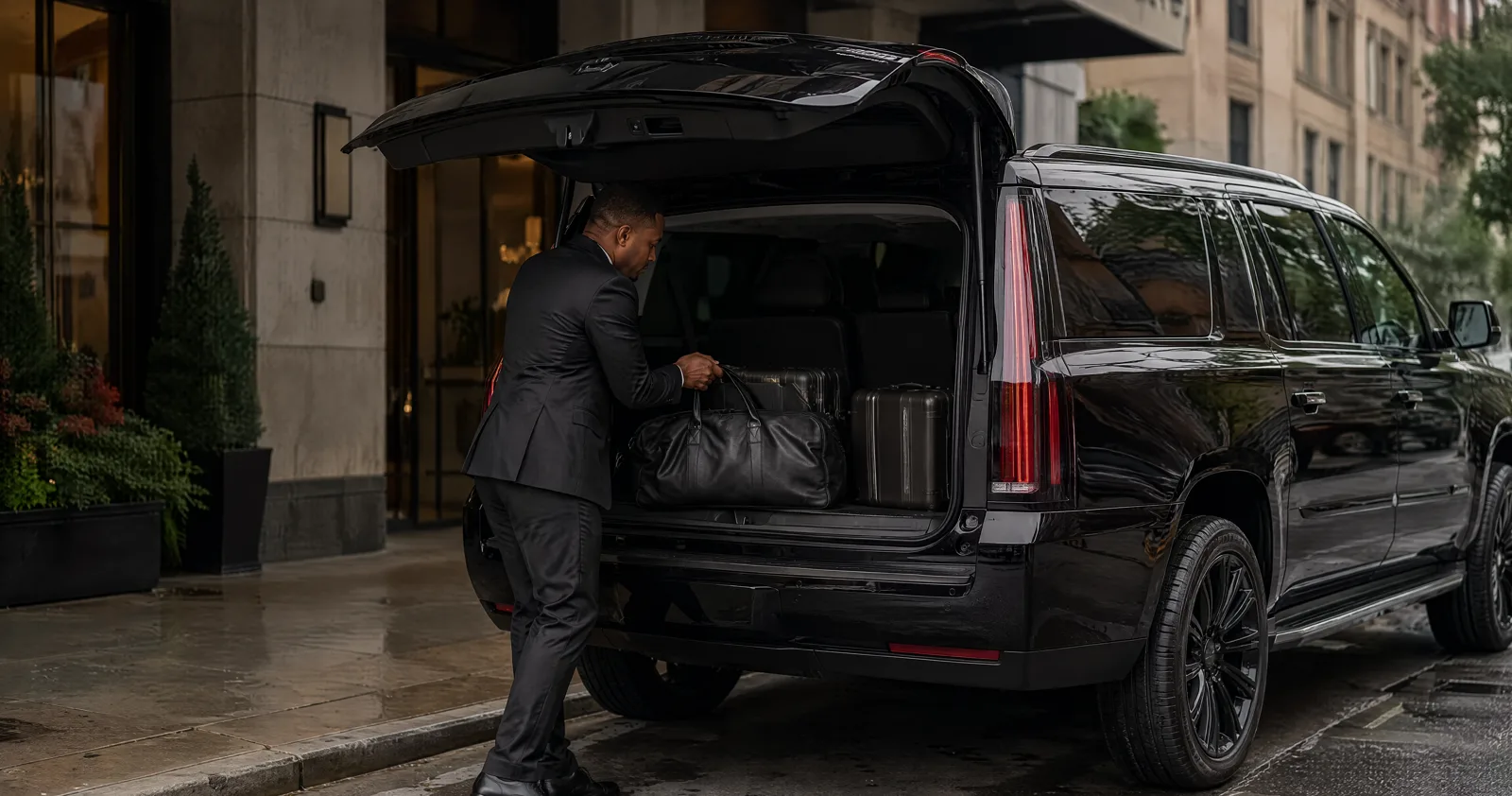
For this trip, the useful comparison is between a smaller private vehicle, a passenger van and separate arrivals. A coach is not the natural starting point for a cottage advertised for ten guests. Discuss the actual passenger and bag count with the transport provider before selecting a class; available layouts and luggage provision need confirmation.
| Journey choice | When to discuss it | Luggage and access constraints | Quote basis |
|---|---|---|---|
| Private car or SUV | A smaller party travelling on one schedule | Confirm suitcase, cooler and child-equipment space; do not infer capacity from the vehicle name | Out-of-town distance quote for the confirmed addresses and stops |
| Passenger van or Sprinter | Booked cottage guests want to travel together | Check the offered seating layout and usable luggage space, plus host-approved unloading and turning arrangements | Distance-based itinerary quote with passenger count, bags and both dates |
| Separate airport and Toronto collections | Travellers have widely separated arrival times | Each party needs its own luggage allowance and a valid cottage arrival plan | Quote each leg explicitly; do not assume a combined booking includes extra pickups |
| Separate outbound and return transfers | A multi-night stay without a vehicle retained on site | Confirm return access independently and explain where everyone will wait with bags | Written quotation identifying both transfers and any agreed stops |
A larger vehicle should not be chosen simply because it has generous seating. Its turning and unloading requirements may make it less suitable, and the permitted cottage occupancy remains unchanged.
Describe the luggage in ordinary terms: several large suitcases, folded stroller, cooler, grocery bags and a mobility aid, if applicable. A photograph or dimensions of an unusually bulky item can be more useful than calling everything “a few bags.” Ask how the equipment will be secured and keep aisles and exits clear. Passengers should not have to hold heavy supplies throughout the journey.
What the waterfront changes about packing
The host describes approximately 100 feet of pebble beachfront and recommends water shoes. That is more useful to the packing plan than a generic promise of a beach holiday. Put footwear and outdoor layers in an accessible bag rather than beneath groceries and suitcases. Beach equipment that fits a private car boot may not fit alongside every guest’s luggage in a fully occupied passenger vehicle.
The listing also describes a canoe and two kayaks. Their presence is not a reason to promise that guests can use them in every season or in every weather condition. Check current availability and the host’s instructions before deciding whether to bring equipment. Transporting personal paddles or other long items needs separate discussion; a passenger transfer does not automatically include carriage of outdoor sporting gear.
Do not turn the host’s waterfront description into a safety guarantee. The listing warns that stone steps and stairs towards the water may be slippery in wet or snowy conditions. For someone who finds stairs difficult, ask about the route from the unloading point to the entrance and the rooms they expect to use. Waterfront access, building access and vehicle access are three separate questions.
A cottage meal plan affects the vehicle, too. The listing describes a kitchen, so it is reasonable to expect that some parties will choose to bring food. Decide which household is supplying groceries before departure. Several people each bringing a large cooler can change the luggage requirement substantially, even though the passenger count has not changed.
If a grocery stop is needed, include it in the enquiry rather than requesting it after the journey begins. State the intended stop, expected duration and likely purchases. The driver needs an itinerary that allows the stop and a vehicle with room for what is bought. Neither a stop nor shopping assistance should be assumed to be included.
Build the Toronto departure around check-in
The public house rules currently list check-in after 4:00 p.m. and checkout before 11:00 a.m. Confirm those times against the reservation before using them to set the transport schedule. The aim is to arrive when the booked guest can enter, not merely when the vehicle can reach the area.
For a Toronto departure, choose a pickup point where the party can gather and load safely. A single collection is often easier to coordinate than collecting every household separately, but convenience depends on the actual addresses. If several pickups are necessary, provide all of them at quotation stage. The order of collection affects both the route and when the last passengers join.
Separate the meeting time from the departure time. People need time to bring bags downstairs, fit any agreed child restraints and check that no supplies have been left behind. An organiser can help by collecting the luggage list in advance and giving every household the same final travel note. The note should identify the exact pickup point, not just the building name.
Do not treat the listing’s promotional driving-time estimate as a transport commitment. A Toronto hotel, a residential pickup and Pearson are different origins. The confirmed address, traffic, planned stops and conditions on the travel day all affect scheduling. Ask for an itinerary-specific departure recommendation once the actual route is known.
Early arrival at the cottage is not an alternative to early check-in permission. If the host has not approved access before the stated time, the itinerary needs another arrangement. Discuss a later departure or an agreed stop before accepting the quotation. A chauffeur should not be expected to wait indefinitely outside a private home while the party hopes the door will become available.
Pearson arrivals need a separate clock
For an airport pickup, provide the flight number, date, arriving terminal if known and a reachable passenger contact. Landing time is not the same as meeting the driver. Passengers still have to leave the aircraft, complete any entry formalities and collect luggage before they are ready to travel.
Ask how the pickup meeting point, flight changes, waiting time and delayed baggage will be handled. Those terms belong in the accepted booking; this article does not promise that any particular allowance is included. Keep essential contact details available without relying on a laptop packed inside a suitcase.
An early flight can create a gap before the cottage’s check-in window. A late flight creates a different problem: the party may need to arrive quietly and locate the correct entrance after dark. The listing advertises smartlock self check-in, but that does not grant unrestricted arrival hours or remove the need to follow the host’s instructions. Confirm the permitted arrival arrangement with the host.
If friends are landing on different flights, decide how much waiting the first arrivals are willing to accept. One shared vehicle may sound simpler, but a delayed final flight can change everyone’s afternoon. Compare one agreed meeting time with separate collections. Make sure the cottage booking holder can give each arriving group lawful access without publishing the entry code in a broad travel chat.
Travellers already in Toronto should not be added to an airport itinerary casually. A city collection after Pearson changes the route. Send the full plan before the quote is prepared so the agreed timing reflects both groups rather than an airport transfer with an unpriced detour.
Agree the final handover with the host
The most important unanswered route detail is the last part of the arrival. Ask the host where the booked vehicle may stop, whether it can turn without difficulty and where passengers should carry their luggage. A note that ordinary guest parking is available does not answer those questions for every vehicle class.
Keep the request practical. Tell the host what type of vehicle is being considered and whether anyone needs help with a short walk or steps. Share any restrictions with the transport provider before final vehicle selection. If access is unsuitable, the parties need an agreed alternative that is safe and usable, not a driver improvising at the roadside.
There is no basis here to promise a driveway-to-waterfront drop-off. The cottage has several levels, and its listing specifically mentions stairs and stone steps. Guests with mobility needs should obtain a clear description of the entrance and sleeping arrangements. Ask the provider separately about vehicle boarding and the handling of mobility equipment; neither side’s answer substitutes for the other’s.
Quiet arrival matters at this property. The host prohibits outdoor music and describes noise restrictions, including no noise before 8:00 a.m. or after 11:00 p.m. Read the current full rules rather than relying only on this summary. Avoid making the unloading area a gathering place, and keep luggage organised so the vehicle can leave promptly once the handover is complete.
Share the private address and access instructions only with people who need them. The public listing link belongs in the initial enquiry; the confirmed private address belongs in the booking details. Door codes are not material for a public itinerary or an article.
Plan a stay that does not depend on local rides
A booked transfer gets the party to the cottage. It does not leave a vehicle available for restaurants, shopping or day trips throughout the stay. Decide before departure whether the group intends to remain at the property or has plans that need separately confirmed transportation. This article is not an offer of destination-local service.
The listing describes indoor options including a foosball table, ping pong, books and board games, alongside the kitchen and waterfront. Those are useful reasons to plan some time at the cottage without relying on another journey. Check the current amenity list if a particular feature is important to the booking, and do not assume that internet access or an outdoor activity will perform exactly as it would at home.
For shared meals, agree supplies and responsibilities before loading the vehicle. The host says firewood is not supplied, but that does not mean the transport provider will carry any quantity of wood or other bulky purchases. Discuss such items first. The same principle applies to extra bags created by shopping during the stay: the return vehicle needs an accurate load description.
Pets require two separate permissions. The listing describes one pet per stay, with conditions including notifying the host and a non-shedding requirement. Confirm the accommodation permission through the reservation and ask the transport provider about acceptance, restraint and space. A pet-friendly listing is not proof that the proposed vehicle booking accepts an animal.
Children, changing weather and the return load
A family booking needs a little more detail than an adult passenger count. Tell the transport provider the children’s ages and ask what restraint arrangements can be accepted for the proposed vehicle. Confirm who supplies and installs any required seats before departure. Do not assume that a van, an SUV and a coach have identical equipment or that an empty seat settles the question.
Keep the items needed during the journey separate from the cottage supplies. A child’s change of clothes, medication, water and a snack should not be buried under a weekend’s groceries. If motion sickness or a medical need makes a rest stop important, explain that while setting the schedule. The provider can then discuss a plan rather than being asked to recover time after an unexpected delay.
The host presents Zeta’s as a four-season cottage. That describes the accommodation, not an assurance that every outdoor amenity or approach will be equally usable throughout the year. Before a cold-weather visit, ask about the condition of the unloading area and the walking route to the door. Guests should have suitable footwear and coats with them in the vehicle, especially if the final handover includes a walk outside.
Wet beach clothing needs a packing plan on the way home. Bring bags that contain damp footwear and towels, and keep them separate from dry luggage. Check the vehicle before unloading is finished so a small bag does not remain beneath a seat. The organiser who booked the ride may not recognise every child’s backpack or shopping bag.
The host also sets limits on the waste left after a stay and says excess garbage must be removed by guests. Read the rule for your booking length before the final morning. A passenger transfer is not automatically a waste-removal service; neither a refuse stop nor carrying extra garbage belongs in the itinerary without explicit agreement. Reducing packaging before leaving Toronto is easier than discovering a transport problem during checkout.
Finally, compare the return luggage list with the outbound one. A party may have less food but more purchases, damp equipment or items brought by friends who arrived separately. Send material changes to the transport provider before collection. The return should be booked for the people and belongings actually travelling, not a copy of an earlier estimate that nobody has checked.
Give the return journey its own plan
Arrange the return when booking the outbound transfer. Record the date, collection time, cottage handover point and the final Toronto address or Pearson terminal. “Return on Sunday” leaves too many decisions until the morning everyone is packing.
Checkout and pickup should work together. If the party must leave the cottage before the vehicle arrives, confirm a suitable place to wait with luggage. Do not assume the host offers storage, an indoor waiting room or continued access to the property. A private cottage does not operate like a staffed hotel lobby.
Allow time to carry bags from bedrooms, check shared rooms and complete the host’s departure instructions. The person responsible for the accommodation should not be expected to lock up while also coordinating passengers and answering the driver’s call. Choose another traveller to check the passenger count and keep the group ready at the agreed point.
For a return to Pearson, work backwards from the airline’s recommended airport arrival time, not only from the flight departure. The transfer schedule also has to account for the actual route and travel conditions. If the required collection falls outside the property’s quiet-hours expectations, discuss a low-noise departure with the host before the travel day.
A late flight does not create late checkout rights. If there is a long gap between the cottage checkout and the desired airport arrival, consider a separately agreed stop or a revised travel plan. Any waiting, stops or different final destination should appear in the accepted itinerary. Do not leave the driver and host to negotiate the gap on departure morning.
Send a quote request that covers both directions
Request a distance-based out-of-town quotation for the complete journey. No fare, hourly figure or minimum charge is stated here because the price depends on the accepted itinerary and current terms. Ask what is included and how taxes, gratuity, stops, waiting and changes are treated before comparing offers.
Supply the Toronto pickup address or flight details, the confirmed cottage address, travel dates, desired arrival and return times, passenger count and a realistic luggage inventory. Identify children who need restraints, mobility requirements, pets and bulky equipment at the start. These details can affect the vehicle choice even when the head count is modest.
The written response should identify the proposed vehicle arrangement and both booked legs. Check that a cottage return is included rather than assuming a one-way price covers it. If the party splits on departure, list each required endpoint. A Toronto drop-off and a Pearson drop-off are not interchangeable descriptions of the return.
You can request a quotation or submit the itinerary through Chauffeuropolis booking. Confirm availability and accepted terms before treating either journey as reserved. The accommodation reservation remains a separate arrangement with the host.
Questions about Toronto to Zeta’s Beachfront Cottage transfers
Is Zeta’s Beachfront Cottage in Wiarton?
The Airbnb listing identifies the property as an entire cottage in Wiarton, Ontario, and names Georgian Bluffs in its neighbourhood description. The exact location is supplied after booking. Use the confirmed reservation address for transport rather than a general Wiarton map point.
How many cottage guests can travel together?
The listing states a maximum of ten guests, but the appropriate vehicle depends on the booked party and luggage. Vehicle seating does not override the property’s occupancy or visitor rules. Ask for the offered layout and bag allowance before choosing one vehicle for everyone.
Can a large vehicle enter the property?
Large-vehicle access is not verified. The listing advertises parking on the premises without establishing coach turning space or a suitable loading area. Confirm the vehicle class and unloading point with the host and transport provider before accepting the itinerary.
Can we arrive directly from Pearson?
Request a Pearson-to-cottage transfer with the flight details, passenger count and luggage inventory. Coordinate the expected arrival with the host’s confirmed check-in arrangements. Airport waiting, flight changes and any stop before the cottage need agreed terms rather than assumptions.
Does the booking include shopping or sightseeing?
Only the stops and journeys listed in the accepted transport booking should be treated as included. Add a proposed grocery stop to the initial quote request, including time and additional luggage. The cottage transfer does not imply local vehicle availability during the stay.
Can we bring a pet?
Obtain permission from both the host and the transport provider. The listing describes one pet per stay subject to conditions, including host notification and a non-shedding requirement. Vehicle acceptance, restraint arrangements and the space needed must be confirmed separately.
What time should the return vehicle collect us?
Set the pickup around confirmed checkout requirements and the return destination. For Pearson, work backwards from the airline’s advised airport arrival time and an itinerary-specific journey allowance. The listing currently states checkout before 11:00 a.m.; do not assume late checkout or luggage storage.
Is Chauffeuropolis affiliated with the cottage?
No affiliation is claimed. This article uses the property’s public Airbnb listing to explain transport planning. Accommodation permission, property rules and access come from the host; vehicle availability and transport terms come from the accepted transportation booking.